Fan Zhendong Grand Slam: How He Became the Sixth Man in History to Achieve It
Updated: June 13, 2026
399
On 4 August 2024, Fan Zhendong defeated Truls Möregård 4-1 in the Paris Olympic final and joined the most exclusive club in table tennis. Six men in history. One moment. Here is how he got there.
The table tennis Grand Slam is not just a title. It is a career. It requires winning the World Championships, the World Cup, and the Olympic Games: three separate competitions, held years apart, under completely different pressures. Most players win one. A handful win two. Only eleven players in the sport’s entire history have won all three. Fan Zhendong is one of them. He is the sixth male player to complete it, and every title along the way came with a story attached.
This article breaks down every step of Fan Zhendong Grand Slam journey: the four World Cup titles, the two World Championship breakthroughs, the Olympic gold that finally arrived in Paris, and where he stands among the legends who came before him.
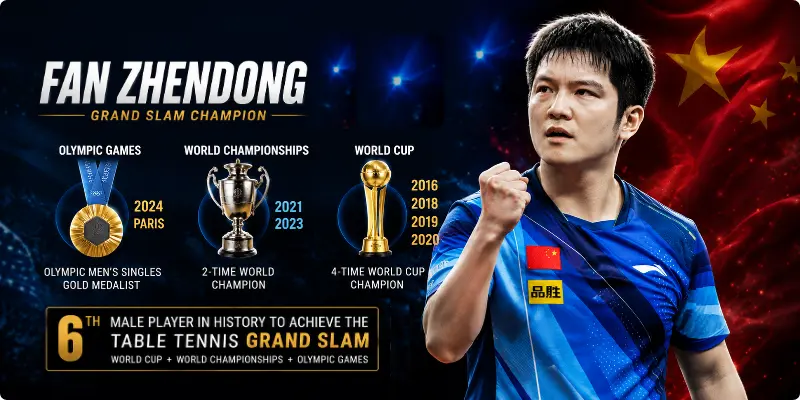
Table of Contents
Fan Zhendong Grand Slam: At a Glance
Eleven players. Six men. One of the hardest achievements in professional sport. In table tennis, it means conquering the Olympics, the World Championships, and the World Cup, and Fan Zhendong completed all three on 4 August 2024. Here is a glance at every title that got him there.
For a complete career overview, including birth date, hometown, height, playing hand, and career prize money, read our full Fan Zhendong profile.
What Is the Table Tennis Grand Slam?
The Grand Slam in table tennis means winning the singles title at three specific events: the Olympic Games, the World Table Tennis Championships, and the World Cup. No other titles count toward it, not the Asian Games, not the WTT Finals, not any tour event, just those three.
The Grand Slam is the hardest individual achievement in the sport, for one simple reason. The Olympics only happen every four years. A player can win the World Championships five times and the World Cup ten times and still not complete the Grand Slam without that Olympic gold. The Olympics is the bottleneck, and it has ended more Grand Slam bids than any other event in the sport’s history.
Grand Slam Requirements
The Grand Slam does not care about team golds, WTT Finals, or Asian Games titles. Just three events. That is all. To complete it, a player must win the singles title at each of the following.
- Olympic Games: men’s singles gold
- World Table Tennis Championships: men’s singles gold
- World Cup: men’s singles gold
As of 2024, eleven players have completed the Grand Slam: six men and five women. The men’s club is historically Chinese, with one exception: Sweden’s Jan-Ove Waldner, who completed it in 1992 and remains one of the most celebrated players in the sport’s history.
The Men Who Completed The Grand Slam Before Fan Zhendong
To understand what Fan Zhendong achieved, it helps to know who was already in the room. Five men sat at that table before him. The first was a Swede who broke China’s grip on the sport. The next four were Chinese legends who built an unmatched dynasty. Each one had to wait for their Olympic moment. Each one earned it. Here is who they are and when they got there.
Ma Long set the benchmark Fan chased for almost a decade. Long completed the Grand Slam at Rio 2016, then went on to defend his Olympic singles title at Tokyo 2020, where Fan finished runner-up. That defeat in Tokyo was one of the defining moments of Fan’s career. It meant waiting another four years. Track his rise from junior prodigy to world No. 1 in our guide on Fan Zhendong’s ranking history.
The Ones Who Almost Made It
Not everyone with the talent to complete the Grand Slam actually got there. Wang Hao came closest among those who never completed it. He reached three Olympic singles finals (2004, 2008, 2012) but lost each time, to Ryu Seung-min, Ma Lin, and Zhang Jike, respectively. Without that Olympic gold, the Grand Slam remained out of reach. His legacy is a reminder that the Olympics is the true bottleneck of achievement.
Wang Hao went on to coach Fan Zhendong, and stood courtside in Paris when Fan finally won the gold his own coach never could. It made Fan’s victory not just a personal triumph, but a shared redemption, the student completing what the teacher couldn’t.
Fan Zhendong Grand Slam: The Full Journey — 2016 to 2024
Fan Zhendong did not wake up one day and win the Grand Slam. He built it piece by piece across nine years. Four World Cups. Two World Championships. One Olympic gold. Each title arrived at a different stage of his career, under different pressure, against different opponents. This section breaks down every major stop on that road, from the teenage World Cup winner in 2016 to the Olympic champion in Paris who finally silenced every doubt.
1. The World Cup: Where It All Started
Fan Zhendong entered his first World Cup in 2015 at the age of 18. He reached the final and lost 4-0 to Ma Long. It was a statement of his potential and a reminder of how far he still had to go. He did not make the same mistake twice. In 2016, Fan returned and won the World Cup, his first major singles title and the first piece of the Grand Slam puzzle. He was 19 years old.
1.1 First World Cup title 2016 — SAARBRÜCKEN
Fan wins his first World Cup title at just 19 years old. He defeats Ma Long’s shadow more than any single opponent, proving he belongs at the highest level. The first Grand Slam piece is secured, and a decade of dominance begins.
1.2 Second World Cup Title 2018 — PARIS
Fan claims his second World Cup title two years later. He drops only two sets across the entire tournament, announcing himself as the sport’s most consistent performer outside of Ma Long. The table tennis world starts asking when, not if, he will complete the set.
1.3 Third World Cup Title 2019 — CHENGDU
Fan captures his third World Cup title in four years. He now holds three of the four World Cups held between 2016 and 2020, a stretch of dominance no other active player can match. Only Ma Long has beaten him in this competition since 2015.
1.4 Fourth World Cup title 2020 — WEIHAI
Fan defeats Ma Long 4-3 in a dramatic final that goes the full distance. It is a symbolic win over the man who had blocked his path for years, fought point by point until the final rally. The scoreline reads 4-3, but the message is clear: the guard is changing.
Four World Cup titles in five years. That is a level of dominance in one competition that very few players in any sport achieve. But the World Championships and the Olympics remained. Learn how he built that consistency in our breakdown of Fan Zhendong’s training guide.
2. The World Championships: The Long Wait
Fan had come close at the World Championships before. He reached the final in 2019 in Budapest and lost to Ma Long in a match that went the full distance. He lost again at Tokyo 2020, this time in the Olympic final; a different competition, but the same opponent and the same outcome. Two finals. Two defeats. The same man, standing across the table. Then 2021 arrived, and everything changed.
2.1 First World Championship 2021 — HOUSTON
At the 2021 World Championships in Houston, Fan Zhendong finally broke through. He defeated Truls Möregård in the final to claim his first individual World Championship title, the same opponent he would face three years later in Paris. Möregård, rising fast through the world rankings, pushed Fan hard. Fan won. The second Grand Slam piece was in place.
2.2 Defending the Title 2023 — DURBAN
Fan Zhendong did not stop at one. At the 2023 World Championships in Durban, he successfully defended his singles title, becoming a two-time World Champion. He also won the doubles title at the same event, capping one of the most dominant individual seasons in modern table tennis.
In 2023 alone, Fan won five major titles, including double gold at both the Singapore Smash and the World Championships. He finished the year with an 81% singles winning rate and seven finals reached, earning the ITTF Male Player of the Year award. The only title he still needed was the one that mattered most. Understand what makes him tactically unique in our Fan Zhendong playing style analysis.
3. Paris 2024: The Olympic Gold That Completed Everything
Fan Zhendong had written “Last dance” on social media when China announced its Paris Olympic roster in May 2024. Two words. No explanation needed. Paris held a specific significance. At 16, Fan had made his first World Championship appearance in the French capital. He knew the city. He had unfinished business there.
3.1 The Road To The Final
The path to gold was never going to be straightforward, and it was not. When top-seeded teammate Wang Chuqin suffered a shock exit in the round of 32, the entire weight of China’s Olympic hopes landed on Fan’s shoulders alone. No safety net. No shared burden. Just Fan and the draw.
The critical moment came in the quarterfinals against Japan’s Tomokazu Harimoto. Fan trailed early and found himself on the brink of elimination. He staged a 4-3 comeback that left the Japanese media stunned. They dubbed him “The Great Wall of China“, a name that stuck for the rest of the tournament.
In the semifinals, Fan dismantled local favourite Felix Lebrun 4-0, silencing a partisan Paris crowd that had been willing Lebrun all the way. Lebrun had been the story of French table tennis’s resurgence. Fan ended that chapter in four sets.
3.2 The Final Against Möregård
The final against Truls Möregård, the first non-Chinese finalist since 2004, did not start well for Fan. He dropped the first set 7-11. Champions adjust. Under the guidance of coach Wang Hao, Fan shifted his tactics, varying his rhythm, controlling Möregård’s tricky spin, and gradually taking command of the rallies. He won the next three sets to lead 3-1.
The fifth set was a masterclass in composure. Fan earned seven gold medal points. Möregård saved five of them, clawing his way back from 10-3 to make it 10-8. On his sixth match point, Fan executed a backhand down the line that settled everything. Final score: 4-1. Match time: 49 minutes. The wait had lasted seven years. For the man behind the medal, including his family and personality, visit our Fan Zhendong personal life article.
3.3 The Dual Redemption
When Fan embraced coach Wang Hao after the final point, the moment carried more weight than a standard post-match celebration. Wang Hao, one of the greatest players of his generation, had earned the painful nickname “the eternal runner-up” after losing three consecutive Olympic finals during his own playing career. He had devoted years to coaching Fan toward the gold he never won himself. When Fan secured it in Paris, both men finally had their answer.
Fan Zhendong after winning Olympic Gold, Paris, 4 August 2024 (XINHUA)
Any person’s performance on court is the result of your hard work behind the scenes.
After the match, Fan performed Kylian Mbappé’s signature goal celebration for the crowd, tucking both hands beneath his armpits. He had already done Cristiano Ronaldo’s Siu celebration after his semifinal win over Lebrun. A die-hard Real Madrid supporter, celebrating Olympic gold in Paris. The city loved it anyway. See exactly what Fan uses on match day in our Fan Zhendong equipment guide.
The Super Grand Slam: Going Beyond
The standard Grand Slam covers three competitions. The Super Grand Slam adds a fourth: the Asian Games singles title. Fan Zhendong won Asian Games gold in men’s singles at both the 2014 Incheon Games and the 2018 Jakarta Games. At the 2023 Asian Games in Hangzhou, he finished with silver, losing the final to Wang Chuqin. Despite that 2023 defeat, Fan is recognised alongside Ma Long as one of the players to have completed the Super Grand Slam, based on his 2014 and 2018 Asian Games titles combined with his full Grand Slam.
Fan Zhendong’s Super Grand Slam Record:
- Asian Games gold: 2014 (Incheon)
- Asian Games gold: 2018 (Jakarta)
- Asian Games silver: 2023 (Hangzhou)
Combined with his Olympic gold, two World Championship titles, and four World Cup titles, Fan stands alongside Ma Long as one of only two men to complete the Super Grand Slam. Ma Long was the first. Fan is the second. The gap between them is smaller than the record books suggest, and in some competitions, it no longer exists at all.
Fan Zhendong vs Ma Long: The Grand Slam Comparison
Any conversation about Fan Zhendong’s Grand Slam eventually comes back to Ma Long. For years, Long was the standard against which Fan measured everything, the rival who won the Olympic finals Fan lost, the champion who completed the Grand Slam eight years before Fan did.
The comparison is worth making clearly.
Ma Long has more Olympic gold medals and more World Championship titles. Fan has spent more weeks at World No. 1 and holds a longer top-five streak, eleven consecutive years from December 2013 to December 2024, the longest in men’s singles history according to the ITTF. Both players are Grand Slam achievers. Both are, by any honest measure, among the two or three greatest male players the sport has ever produced. For a full head-to-head breakdown, see our Fan Zhendong vs Ma Long comparison.
What the Grand Slam Means for Fan Zhendong’s Legacy
When Fan posted “Last dance” before Paris, the phrase carried weight because of what came before it. Years of near-misses. Three World Cup titles before his first World Championship. A Tokyo Olympic final, lost to his own teammate and training partner. The long shadow of Ma Long over every major event he entered between 2016 and 2021.
The Grand Slam does not erase any of that. Every defeat made the Paris moment more meaningful, not less. A player who wins everything easily leaves no story worth telling. Fan’s story has friction in it, and that friction is why the 4 August 2024 backhand down the line will be replayed long after the scoreline fades.
Fan Zhendong is now the sixth man in history to complete it. He is one of two men to have completed the Super Grand Slam. He has spent more time ranked number one in the world than any other active player in the sport. The Grand Slam is complete. The legacy is still being written. Explore his complete net worth breakdown to see how his earnings have grown alongside his legendary career.
Final Word
Fan Zhendong Grand Slam is not a story of inevitable greatness. It is a story of sustained excellence across a decade, interrupted by defeats that would have ended lesser careers, and completed in the most fitting setting possible, Paris, the city where his international journey began at 16.
Fan is the sixth man to have done it, and the only one to complete it while simultaneously holding the longest World No. 1 streak in men’s singles history. Given what his first Bundesliga season produced in 2025/26, and given that the 2028 Los Angeles Olympics remain a realistic target, he may not be finished adding to it yet. The Grand Slam is his. What comes next is still being decided.
Want to explore the full story behind Fan’s World Championship breakthroughs in Houston and Durban? Check out our in-depth guide on Fan Zhendong World Championship.
FAQs
Has Fan Zhendong completed the Grand Slam?
Yes. Fan Zhendong completed the table tennis Grand Slam on 4 August 2024 by winning the men’s singles gold medal at the Paris Olympics. He defeated Sweden’s Truls Möregård 4-1 in the final, having already won the World Championships (2021, 2023) and the World Cup (2016, 2018, 2019, 2020).
What is the table tennis Grand Slam?
The table tennis Grand Slam requires a player to win the singles title at three specific events: the Olympic Games, the World Table Tennis Championships, and the World Cup.
It is the highest individual achievement in the sport. As of 2024, only 11 players in history, 6 male and 5 female, have completed it.
What is the Super Grand Slam in table tennis?
The Super Grand Slam adds the Asian Games singles title to the standard Grand Slam requirements. Fan Zhendong won Asian Games gold in 2014 and 2018. He is recognised as one of two male players, alongside Ma Long, to have completed the Super Grand Slam.
.What number Grand Slam winner is Fan Zhendong?
Fan Zhendong is the sixth male player and 11th player overall to complete the table tennis Grand Slam, according to Xinhua. He achieved it on 4 August 2024 at the Paris Olympics.
Who else has completed the table tennis Grand Slam?
The six male Grand Slam winners are:
1. Jan-Ove Waldner (Sweden)
2. Liu Guoliang
3. Kong Linghui
4. Zhang Jike
5. Ma Long, and
6. Fan ZhendongAll Chinese except Waldner. The five female Grand Slam winners are Deng Yaping, Wang Nan, Zhang Yining, Li Xiaoxia, and Ding Ning.
Did Fan Zhendong win the Grand Slam before or after Ma Long?
After. Ma Long completed the Grand Slam at Rio 2016. Fan Zhendong completed it eight years later at Paris 2024. In the intervening period, Fan won four World Cups and two World Championships, but the Olympic gold, the final piece, did not arrive until Paris
Please Write Your Comments