Fan Zhendong Ranking History: Complete World Ranking Timeline (2013–2025)
Updated: June 1, 2026
1268
Ever wondered how greatness evolves in modern table tennis? Fan Zhendong’s climb to World No. 1 and his ability to stay there for 55+ months define what sustained excellence looks like in the modern era.
Fan Zhendong ranking history isn’t just a timeline of numbers. It’s a decade-long story of strategic development, technical evolution, and competitive dominance across two different ranking systems (ITTF and WTT). From teenage prodigy to the longest-reigning No. 1 of his generation, Fan’s journey through the rankings reflects every phase of his competitive growth.
This guide traces Fan Zhendong ‘s complete ranking history (2013-2025): key milestones, year-by-year breakdown, legendary rivalries, and the factors behind one of table tennis’s most remarkable ranking records.
Table of Contents
Fan Zhendong 2026 Ranking: WTT Withdrawal
In December 2024, Fan Zhendong withdrew from WTT/ITTF international rankings, not from table tennis itself. He stepped back from the international circuit while still holding the World No. 1 position, one of the rarest exits in professional sports history. But stepping away from rankings is not the same as stepping away from competition.
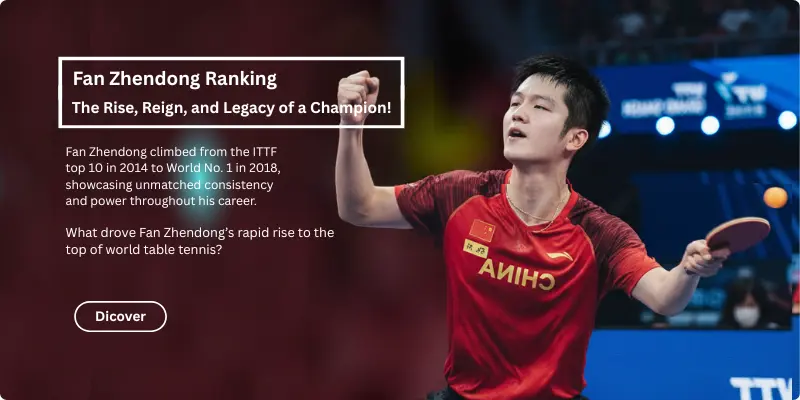
Fan’s current ranking status at a glance:
- Final Official Ranking: World No. 1 (December 2024)
- Withdrawal Date: December 27, 2024
- First Reached No. 1: April 2017 (youngest male ever)
- Total Months at No. 1: 55+ months
- Still Competing: Chinese National Games (gold, 2025), Bundesliga (1. FC Saarbrücken), Chinese Super League
Why he left: Mental exhaustion from the Paris Olympic cycle + WTT’s new participation fine system. Fan’s own words: “I will not retire. I will continue participating in different competitions“. For complete context on his withdrawal decision, see our Fan Zhendong personal life and current status guide. For the full ranking story, continue reading below.
The Competition Behind the Rankings
Fan Zhendong’s 55+ months at World No. 1 didn’t happen in a vacuum. He climbed through one of the deepest talent pools in table tennis history, facing multiple Olympic champions and generational talents across two different ranking systems. Understanding who he beat, and when, reveals why his ranking record is historically significant.
1. The Competition He Dominated
Fan didn’t inherit an empty throne. He took it from legends and held it against the next generation. Here are the rivals who tried and failed to knock him off.
- Ma Long: GOAT-level rival, multiple Olympic champion, Fan’s primary competition for No. 1 throughout 2017-2022
- Xu Xin: Former World No. 2, consistent top-5 threat
- Tomokazu Harimoto (Japan): Speed-focused disruptor, challenged Fan’s dominance 2019-2023
- Wang Chuqin: Current World No. 1 post-withdrawal, Fan’s successor at the top
- Hugo Calderano (Brazil): Tactical rival, reached the top 5 during Fan’s reign
- Dimitrij Ovtcharov (Germany): European power player, consistent top-10 presence
2. Two Ranking Systems Fan Conquered
Ranking systems changed during Fan’s career. His dominance didn’t. Here is how he mastered both.
Dominating across both systems, through equipment changes, format changes, and generational competition, makes Fan’s ranking record uniquely significant. For Fan’s complete biography and career achievements, see our Fan Zhendong complete profile.
Fan Zhendong Ranking History: A Year-by-Year Timeline (2013-2025)
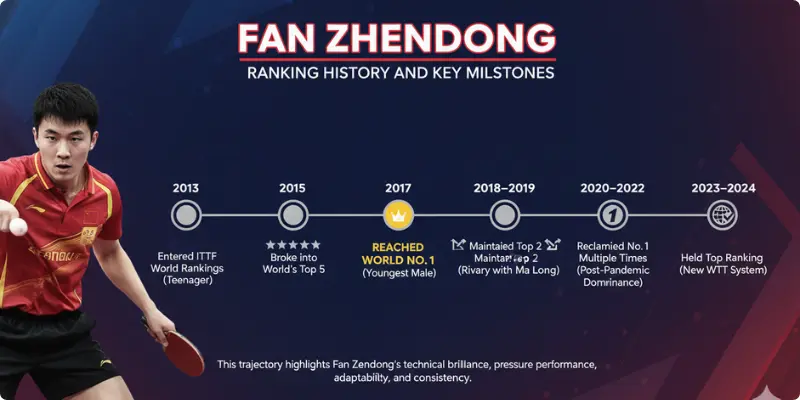
Fan Zhendong ranking history through the world rankings illustrates a remarkable rise from a teenage prodigy to one of the greatest table tennis players of all time. Year by year, he has combined skill, consistency, and mental toughness to climb and remain at the very top of the sport. The following timeline highlights the key milestones of his career, showing how he evolved from a promising newcomer into a dominant force in international table tennis.
1. Fan Zhendong Ranking 2013: The Breakthrough Year
Fan entered the ITTF World Rankings in 2013, quickly making an impression with his aggressive playing style. At just 16, he was already considered one of China’s most promising talents, ranking within the top 20 by the end of the year.
2. Fan Zhendong Ranking 2014: A Rising Star
Fan solidified his place among the elite with strong showings in ITTF World Tour events, finishing the year ranked World No. 7. His consistency in both singles and team competitions marked him as a future World Champion.
3. Fan Zhendong Ranking 2015: Entering the Top Five
By 2015, Fan Zhendong had reached the top five, thanks to multiple podium finishes. His rivalry with Ma Long intensified, and his name became synonymous with precision and dominance.
4. Fan Zhendong Ranking 2016: Building Toward No. 1
Fan maintained his top-5 status throughout 2016, consistently finishing as a semifinalist and finalist in ITTF World Tour events. His rivalry with Ma Long intensified as both competed for the No. 1 spot, setting the stage for Fan’s historic breakthrough the following year.
5. Fan Zhendong Ranking 2017: First World No. 1
A landmark year for Fan, reaching World No. 1 for the first time in April 2017. This year marked a major point in Fan Zhendong’s ranking history, establishing him as the youngest ever World No. 1 at age 20. His victories in the Asian Championships and consistent World Tour performances made it clear: a new era had begun.
6. Fan Zhendong Ranking 2018–2019: Sustained Dominance
Fan remained in the top two, maintaining a tight race with Ma Long. He won multiple ITTF World Tour titles and reached the World Championships final in 2019, cementing his reputation as one of the most reliable and focused players in the sport.
7. Fan Zhendong Ranking 2020–2022: Unshaken at the Top
Even during global tournament disruptions, Fan Zhendong continued to dominate. He reclaimed and held the World No. 1 position, winning the ITTF Men’s World Cup in 2020 and the WTT Champions events in 2021 and 2022.
8. Fan Zhendong Ranking 2023–2024: The Modern Era of Consistency
Under the WTT ranking system, Fan held the World No. 1 spot for most of 2023 and 2024, culminating in his Paris Olympic gold, the defining achievement of his ranking career. His consistent victories proved he remained the gold standard in men’s table tennis. Fan’s gold medal in Paris completed his Grand Slam. See the full timeline in our Fan Zhendong Grand Slam guide.
9. Fan Zhendong Ranking 2025: A Champion’s Exit from Rankings
In 2025, following his withdrawal from WTT/ITTF rankings in late 2024, Fan Zhendong no longer features in the world rankings. He ended his international ranking career as World No. 1 after dominating the top spot for several years. Even after stepping back from international competition, his legacy as one of the most consistent and skilled players in table tennis history continues to inspire the sport worldwide.
Ranking Milestones Summary Table
The table below shows Fan’s ranking milestones at a glance, from teenage prospect to youngest-ever World No. 1, followed by nearly a decade of sustained dominance across two ranking systems.
His ranking journey reflects a steady rise and lasting dominance; a legacy that naturally raises the question: how does Fan Zhendong’s ranking consistency compare to other table tennis legends? Let’s find out.
Fan Zhendong vs Table Tennis Legends: Ranking Comparison
Fan Zhendong’s 55+ months at World No. 1 didn’t happen in isolation. To understand its true weight, you have to measure it against the legends who came before him and the rivals who chased him. Here is how Fan stacks up against the greatest players of the modern era.
1. Fan Zhendong vs Ma Long
Ma Long holds the GOAT argument based on championship titles, two Olympic singles golds vs. Fan’s one. However:
- Fan maintained World No. 1 across TWO ranking systems
- Fan’s average ranking from 2019 to 2024 exceeded Ma Long’s during the same period
- Fan reached No. 1 at a younger age (20 vs. Ma Long’s 24)
2. Fan Zhendong vs Zhang Jike
Zhang Jike’s brief No. 1 reign (~18 months) vs. Fan’s 55+ months illustrates the difference between peak brilliance and sustained dominance. Zhang won Grand Slams faster; Fan maintained the top position longer. One burned bright and fast. The other built a dynasty.
3. Fan Zhendong vs Wang Liqin
Wang Liqin dominated the early ITTF era but faced far less global competition than Fan’s generation. Fan’s No. 1 reign came against the most competitive international field in table tennis history, including Japanese, Brazilian, German, and Swedish challengers simultaneously.
4. Fan Zhendong vs Timo Boll
Timo Boll reached No. 1 twice but never maintained it beyond 12 months. Fan’s 39-month consecutive streak alone exceeds Boll’s total time at the top, against a more globally competitive field. Boll was a pioneer from Europe; Fan was the answer to every pioneer.
Ranking Comparison Table
The numbers below tell the same story as the analysis above, but they make it impossible to ignore. Here is how Fan’s ranking longevity measures up against the legends of the sport.
Ma Long has more titles. Zhang Jike had a higher peak. Wang Liqin defined an era. Timo Boll broke barriers. But no one, not one of them, held the No. 1 ranking as long as Fan Zhendong did across as many generations of competition. That is not just longevity. That is a different kind of greatness.
Key Factors Behind Fan Zhendong’s Consistent Ranking
Fan Zhendong didn’t stay at World No. 1 for 55+ months by accident. He outlasted generational rivals, adapted to a complete ranking system overhaul, and structured his entire career around sustainable excellence rather than short-term points. Most players chase ranking points. Fan let the rankings chase him. Four strategic factors explain how he did it.
1. Two-System Dominance
Fan Zhendong is the only player to hold the World No. 1 under both the ITTF system (pre-2020) and the WTT system (post-2020). Most players struggled with the WTT’s tournament frequency requirements; Fan thrived under both formats. This adaptability alone separates him from every other player of his generation.
2. Rivalry Management
Fan’s ranking consistency came despite facing the most competitive era in table tennis history. He didn’t just survive the competition; he used it to sharpen his own game.
- Outlasted Ma Long‘s prime dominance (2012-2018)
- Neutralized Harimoto‘s speed-game threat (2019-2023)
- Maintained No. 1 as Wang Chuqin emerged (2022-2024)
No previous World No. 1 has maintained their position through three distinct generational challenges simultaneously.
3. Tournament Selection Strategy
Unlike players who chased every ranking point, Fan strategically prioritized major tournaments (Olympic Games, World Championships) over WTT circuit events. He understood that peak performance at the right moments mattered more than accumulating points all year long.
4. Physical & Technical Longevity
Fan’s 55+ months at World No. 1 is partly explained by his equipment philosophy. His all-wood blade and precision-focused rubber setup reduces physical strain compared to carbon-blade power players, allowing him to train consistently without the injury setbacks that shortened other champions’ reigns.
Fan Zhendong didn’t game the ranking system. He mastered it. And when the system changed, he mastered it again. That is why his 55+ months at No. 1 matter more than the number itself. For the complete training methodology behind his consistency, see our Fan Zhendong training guide.
Fan Zhendong’s WTT Withdrawal: The Ranking Exit
In December 2024, Fan Zhendong made one of modern table tennis’s most discussed decisions, withdrawing from WTT/ITTF international rankings while still World No. 1. The decision sent shockwaves through the sport and left an unprecedented vacancy at the top. No player had ever walked away from the No. 1 spot with so much left in the tank.
1. The Ranking Impact
When Fan withdrew, the entire ranking system had to recalibrate. His absence created a void that took months to fill. The WTT rankings suddenly had a new No. 1 who had never beaten Fan in a major final.
- Immediately removed from the WTT world rankings
- Wang Chuqin became the official World No. 1
- Created an unprecedented vacancy at the top
- ITTF president Petra Sorling confirmed Fan could return via the alternate qualification pathway
2. Why It Happened
Fan didn’t leave because he lost form or motivation. Two specific factors drove his December 2024 decision. Neither had anything to do with his ability to compete at the highest level. Fan cited two primary reasons in his December 27, 2024, Weibo statement:
- Mental exhaustion: The Paris Olympic cycle took a significant toll
- WTT fine system: New rules penalize tournament non-participation financially
3. The Historical Significance
Fan’s exit from the rankings belongs alongside the most famous departures in sports history. What makes it unique is that he never stopped playing; he just stopped caring about the ranking. He joins a rare group of athletes who stepped away while still at No. 1.
- Bjorn Borg (tennis, retired World No. 1, 1983)
- Rocky Marciano (boxing, retired undefeated champion)
Unlike both, Fan didn’t retire; he chose competition on his own terms. For his current playing status and Bundesliga results, see our Fan Zhendong personal life and current status guide.
The ITTF to WTT Transition: How It Affected Fan Zhendong’s Rankings
Understanding Fan’s ranking history requires understanding the system it played out under, and how that system changed beneath him. One of the most overlooked aspects of Fan’s ranking history is his navigation of table tennis’s most significant structural change: the transition from ITTF to the WTT ranking system in 2020-2021.
What Changed
The shift was not just cosmetic. It fundamentally altered how players earned and kept their ranking points. The shift from ITTF to WTT affected four key areas of Fan’s ranking strategy:
Fan’s Response
While many of his peers struggled to adapt, Fan treated the transition as just another system to master. Where most Chinese players struggled with WTT’s higher tournament frequency demands, Fan adapted by:
- Maintaining selective participation in the highest-value events
- Focusing on conditioning around Grand Smash tournaments
- Using World Championships and Olympics as ranking anchors
The Irony
What helped him dominate for four years is the same thing that eventually made the system impossible to stay in. The very system Fan mastered ultimately drove his 2024 withdrawal, when new participation fine rules made its frequency demands financially unsustainable.
This transition context explains why Fan’s withdrawal from the ranking wasn’t about competitive decline; it was about a system incompatibility with his career priorities. Through every system change, one thing stayed consistent: his equipment. See what he uses in our Fan Zhendong Equipment guide.
Fan Zhendong’s Legacy in Global Table Tennis
Fan Zhendong’s ranking legacy reshaped what World No. 1 means in modern table tennis. He didn’t just reach the top; he redefined how long you could stay there and what it looked like to leave on your own terms. No player before him had held the No. 1 spot across two different ranking systems while also walking away from it at the peak of his powers.
The impact of Fan’s ranking record can be seen in three specific areas:
- For Chinese table tennis: Proved sustained No. 1 dominance was possible even as global competition intensified from Japan, Brazil, and Europe
- For the WTT system: His 2024 withdrawal exposed fundamental flaws in how the circuit treats elite players, sparking global debate about athlete autonomy
- For future generations: Wang Chuqin, Lin Shidong, and the next wave of Chinese players inherited a blueprint for what sustained No. 1 dominance requires
Fan Zhendong’s 55+ months at World No. 1 across two ranking systems isn’t just a personal record; it’s the standard every future champion will be measured against. Explore his complete net worth breakdown to see how his earnings have grown alongside his historic ranking career.
Conclusion
Fan Zhendong ranking history isn’t a collection of numbers; it’s a decade-long record of sustained excellence across two ranking systems, three generational rivalries, and one of modern sport’s most principled exits. From teenage prodigy to longest-reigning No. 1 of his generation, his ranking journey reflects every phase of his competitive evolution. The numbers tell the story: 55+ months at the top, youngest ever to reach it, and the only player to dominate both ITTF and WTT systems.
What makes Fan Zhendong’s record truly exceptional isn’t just the duration; it’s the consistency. No significant dips. No rebuilding phases. Just sustained World No. 1 performance, year after year. His December 2024 ranking withdrawal didn’t end that record; it preserved it perfectly.
For Fan’s complete career achievements, see our Fan Zhendong complete profile. For the training behind his consistency, see our Fan Zhendong training guide.
FAQs
When did Fan Zhendong become World No. 1?
Fan Zhendong first reached World No. 1 in April 2017, becoming the youngest male player in ITTF history to achieve this milestone at age 20. He surpassed Ma Long following dominant performances at the Asian Championships and ITTF World Tour events.
How long was Fan Zhendong World No. 1?
Fan spent 55+ months as World No. 1 across his career, with a longest consecutive streak of 39 months. His first reign began in April 2017, and his final ranking was World No. 1 in December 2024. He is the only player to dominate both the ITTF and WTT ranking systems. Only Ma Long (60+ months) has spent more time at World No. 1 among modern players.
Did Fan Zhendong retire from table tennis?
No, this is the most common misconception. In December 2024, Fan withdrew from WTT/ITTF international rankings but explicitly stated, “I will not retire. I will continue participating in different competitions.”
1. What changed: No longer ranked in the WTT/ITTF system
2. Still competing: Chinese National Games (gold, 2025), Bundesliga (1. FC Saarbrücken), Chinese Super League.Why did Fan Zhendong withdraw from the WTT rankings?
Two primary reasons from his December 27, 2024, Weibo statement:
1. Mental exhaustion: Described “huge psychological strain” from the Paris 2024 Olympic cycle
2. WTT fine system: New rules imposing financial penalties for tournament non-participation made continued ranking membership unsustainable for players wanting schedule flexibilityHis withdrawal sparked global debate about athlete autonomy and mental health in professional sports.
What is Fan Zhendong’s current ranking in 2026?
Fan Zhendong is unranked in the WTT/ITTF system as of 2026, following his December 2024 withdrawal. Wang Chuqin currently holds the World No. 1 position.
Fan continues competing domestically in China and in Germany’s Bundesliga with 1. FC Saarbrücken, but outside the international ranking system.
Who replaced Fan Zhendong as World No. 1?
Wang Chuqin became the official World No. 1 following Fan’s December 2024 ranking withdrawal. Wang, also Chinese, represents the next generation of Chinese table tennis dominance, trained within the same national system that produced Fan.
How does Fan Zhendong’s ranking record compare to Ma Long’s?
Fan Zhendong:
– 55+ months at No. 1
– First reached No. 1 at age 20 (2017)
– Dominated both ITTF and WTT systems
– 1 Olympic gold (Paris 2024)
– 2 World Championship titlesMa Long:
– 60+ months at No. 1
– First reached No. 1 at age 24 (2012)
– Dominated the ITTF system primarily
– 2 Olympic golds (Rio, Tokyo)
– 5 World Championship titlesMa Long leads in titles. Fan leads in cross-system consistency and age of first No. 1 reign.
What was Fan Zhendong’s ranking at his peak?
Fan’s peak was World No. 1, first achieved in April 2017 and held for 55+ total months. His longest consecutive run was 39 months, one of the longest streaks in modern table tennis history. His ranking peak coincided with his technical peak: the 2020-2024 period when he dominated both the ITTF and WTT systems simultaneously.
Can Fan Zhendong return to World No. 1?
Theoretically, yes, but with significant barriers. ITTF president Petra Sorling confirmed Fan could qualify for the 2028 LA Olympics via alternate pathways similar to North Korean players’ qualification routes.
To return to No. 1, Fan would need to re-enter the WTT ranking system, accumulate points from zero, and win major tournaments against current top players. As of early 2026, Fan has made no public commitment to returning to international competition.
What ranking milestones did Fan Zhendong achieve?
Fan’s historic ranking milestones:
1. 2013: Entered rankings (top 20) as a teenage prodigy
2. 2014: Reached World No. 7
3. 2015: Broke into the top 5
4. 2017: First World No. 1 (youngest male ever, age 20)
5. 2017-2024: Maintained top-2 with minimal dips
6. 2020-2024: Dominated the new WTT ranking system
7. December 2024: Withdrew as reigning World No. 1.No male player has maintained top-2 status longer across two different ranking systems
Please Write Your Comments