Fan Zhendong Playing Style: Key Techniques, Strategies & Lessons for Players
Updated: November 9, 2025
763
What does it take to dominate table tennis for years on end? It’s not raw power; it’s mastering every stroke, movement, and tactical decision under pressure. This is what defines the Fan Zhendong playing style: precision, power, and relentless adaptability.
Few players combine power, precision, and strategy like Fan Zhendong. His style, built on explosive attacks, accurate loops, and opponent-specific tactics, made him World No. 1 for 55+ consecutive months. More importantly, it forced everyone else to change how they play. That transformation didn’t happen by accident; it was a decade of deliberate refinement.
This guide breaks down Fan Zhendong’s playing style: his core techniques, tactical evolution, equipment choices, signature matches, and the lessons every serious player can steal from his game.
Table of Contents
Fan Zhendong’s Playing Style: Why It Changed Everything
Fan Zhendong didn’t just play table tennis at the highest level; he changed how the game is played. His style forced opponents, coaches, and training systems worldwide to adapt. Understanding his playing style isn’t just about technique; it’s about understanding the evolution of modern table tennis itself.
What separates Fan’s style from every generation before him:
- First player to consistently combine explosive two-winged attack
with elite defensive recovery at the World No. 1 level - Bridged eras: Dominated by the equipment change from celluloid
to plastic balls (2015-2024), most players struggled to adapt - Tactical evolution: Forced rivals like Tomokazu Harimoto,
Hugo Calderano and Truls Möregård to develop counter-strategies
Specifically for his style - Coaching influence: Liu Guoliang and Wang Hao built China’s
next generation (Lin Shidong, Wang Chuqin) around Fan’s framework
Before Fan, two-wing attackers sacrificed consistency for aggression. He proved you could have both, and everyone else has been trying to catch up ever since. For Fan’s complete biography and career statistics, see our Fan Zhendong profile.
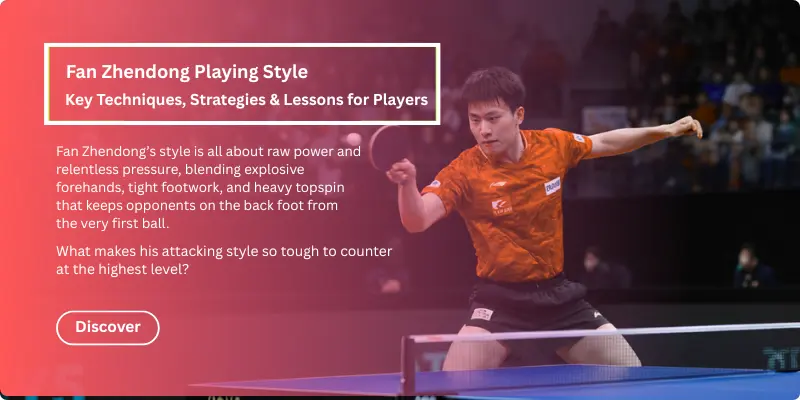
Inside Fan Zhendong’s Playing Style: Techniques, Tactics, and Strengths
Fan Zhendong’s playing style is a seamless blend of power, precision, and tactical intelligence. Known for his explosive forehand loops, lightning footwork, and ability to adapt under pressure, he dominates rallies with calculated aggression rather than raw force. Every stroke reflects balance and strategy, the hallmark of a player who turns speed into control and control into victory.
Fan’s approach isn’t built on power alone; it’s the harmony of speed, anticipation, and strategic mastery that defines his dominance in modern table tennis. To understand what makes his game so complete, let’s break down the core elements of his playing style, from his aggressive offense to his mental resilience.
1. Aggressive Offensive Play
Fan Zhendong is primarily an offensive player. He thrives on controlling rallies from the first shot, using speed and spin to pressure opponents. This aggressive approach forces opponents to defend from the first shot. His style is built around continuous attacks, aiming to force errors and keep opponents on the defensive. The key highlights:
- Looping Power: Fan’s topspin loops, especially on his forehand, are fast and precise, making it difficult for opponents to counter.
- Speed and Pressure: He maintains a rapid pace in rallies, leaving opponents little time to react.
- Control in Aggression: Even while attacking, Fan carefully places his shots, blending power with accuracy.
Fan’s aggressive style isn’t just about overpowering opponents; it’s about maintaining relentless control through precision and pressure.
2. Forehand Dominance
Fan’s forehand is widely considered his strongest weapon. His forehand has decided more big matches than any other single shot in his generation. He uses it to dictate the game, switching between long, powerful loops and short, sharp attacks. The key points include:
- Powerful loops with heavy topspin for mid- to long-distance attacks.
- Varying spin and angles to disrupt opponents’ rhythm.
- Quick transitions from defense to offense, often using his forehand to seize points early.
Fan’s forehand defines his offensive identity: powerful, consistent, and capable of turning any rally in his favor. In the 2019 World Table Tennis Championships semi-final, for instance, against Ma Long, Fan’s forehand consistently outpaced his opponent’s defenses, highlighting his offensive mastery.
3. Backhand Skills and Counterattacks
While the forehand gets most of the attention, Fan’s backhand is highly effective, particularly in close-to-the-table exchanges. Few players can match the speed of his backhand counter in these situations. He uses it for quick flicks, counterattacks, and controlling short rallies. The key Points are:
- Fast backhand flicks to handle short serves
- Strong topspin backhand for mid-distance counters
- Balanced play, with backhand defense complementing forehand offense
Fan’s backhand acts as both shield and sword, a tool for control, precision, and lightning counterplay that complements his forehand perfectly.
4. Serving and Return Game
Fan Zhendong’s serve-and-return strategy is crucial to his success. His serve variation alone wins him free points before rallies begin. His serves are precise, varied, and designed to put opponents off balance. Likewise, his returns often set up immediate attacks. The key points are:
- Wide variety of serves: pendulum, reverse pendulum, and side-spin.
- Precise placement to exploit opponents’ weaknesses.
- Aggressive returns that convert into scoring opportunities.
Fan’s serve-return strategy turns the opening shot into a weapon, setting the tone for control from the very first exchange.
5. Footwork and Movement
Most fans watch Fan Zhendong’s forehand and miss what actually makes it possible, his footwork. Without his footwork, his power would be useless. His movement isn’t just fast; it’s smarter than almost anyone else on tour. Key footwork strengths:
- Reads opponent’s body language and paddle angle to move before the ball arrives
- Maintains perfect balance between feet, hips, and paddle from any position
- Returns to neutral stance faster than most players’ initial movement, neutralizing speed players like Harimoto
- Forces opponents into uncomfortable angles, turning strengths into weaknesses
Fan’s footwork gives him rhythm and reach, the foundation that fuels both his power and consistency.
6. Mental Approach and Strategy
Fan Zhendong’s mental game operates on a different level, not because he’s calmer, but because he competes differently. His ability to raise his level in deciding games separates him from almost everyone else. His key mental strengths:
- Performs better in deciding games than in early rounds, the opposite of most players
- Adjusts game plans mid-match based on opponent patterns, as seen against Ma Long in the 2019 World Championships
- Maintains technical precision and decision-making even in extended five-game matches
- His 2024 WTT withdrawal showed the same long-term thinking visible in his match tactics, always prioritizing what matters most
Fan’s mental discipline transforms technical skill into unstoppable performance, proving that mastery begins in the mind.
Overall, Fan Zhendong’s mastery lies in the seamless blend of technique, strategy, and mental resilience. His strokes, footwork, and tactics work together to control rallies, outmaneuver opponents, and maintain consistency, making his style one of the most complete and effective in modern table tennis.
Fan Zhendong vs. Modern Rivals: Style Comparison
Understanding Fan’s style becomes clearer when contrasted with his main rivals. Each comparison reveals a different dimension of his game.
Fan’s style is uniquely designed to neutralize speed (vs.Harimoto) while overwhelming tactical players (vs. Calderano). This dual effectiveness explains his sustained dominance in table tennis worldwide, helping him to complete his Grand Slam. Read the full story in our Fan Zhendong Grand Slam guide.
How Fan’s Equipment Shapes His Style
Fan Zhendong’s equipment choices are not random. Every blade, rubber, and sponge thickness was selected through thousands of hours of testing to match one goal: maximizing his unique playing style. While most players chase faster carbon blades and bouncier rubbers, Fan went the opposite direction. He chose control over speed, feel over power, and consistency over flash. The result is a setup that rewards precision and punishes laziness, exactly the message his game sends to opponents.
1. Blade: All-Wood Construction
Most elite players have switched to carbon blades for extra speed. Fan stayed with all-wood construction. Feel matters more to him than flash. This choice prioritizes feel and control over raw power, allowing him to sense exactly where the ball contacts the blade.
- Provides superior feel and control at the cost of raw speed
- Matches his precision-first philosophy perfectly
- His style relies on spin consistency over pure speed; carbon blades introduce vibration that reduces his touch game
For Fan’s complete blade lineup, check out our guide to the Fan Zhendong blades series, featuring a full lineup comparison.
2. Forehand: Hard Chinese Tacky Rubber
Fan’s forehand rubber is harder than what most professionals use. It punishes lazy strokes and rewards perfect form. Activating its full potential requires perfect technique on every shot, exactly the standard Fan holds himself to.
- Harder sponge than most players use
- Requires precise technique to activate properly
- Rewards his consistent stroke mechanics
- Creates heavier topspin at an equivalent speed to softer rubbers
3. Backhand: Softer Rubber for Control
While his forehand attacks, his backhand controls. This balance gives him the best of both worlds. Fan uses a softer rubber on his backhand side to prioritize touch and placement over power.
- Provides touch control for the short game and flicks
- Complements his backhand-as-control philosophy
- Allows quick transitions between defense and offense
Fan’s equipment demands technical precision. It punishes sloppy mechanics but rewards clean contact with exceptional spin and placement. His style evolved around this setup, not despite it. Every piece of his gear reinforces the same message: master the fundamentals. For the complete breakdown of his blade, rubbers, booster, and pro personal setup, see our Fan Zhendong Equipment guide.
Style Evolution: How Fan’s Game Changed (2012-2026)
Fan Zhendong’s playing style hasn’t remained static. It evolved strategically across four distinct phases, each building on the weaknesses of the previous one. What started as raw forehand power became a balanced two-wing attack, then transformed into tactical mastery that outsmarted as much as it overpowered.
1. Power Foundation (2012-2016)
Early in his career, Fan overwhelmed opponents with raw forehand power from mid-distance. His backhand remained a liability that top players exploited. This phase established his reputation as a future star while revealing gaps he would later fill.
- Defining characteristic: Raw forehand dominance
- Signature shot: Cross-court forehand loop from mid-distance (70%+ of his attacking shots)
2. Two-Wing Development (2016-2020)
Under coach Wang Hao‘s guidance, Fan Zhendong transformed his backhand from a weakness into a weapon. This phase marked his evolution from a one-dimensional attacker to a complete two-wing player capable of winning points from either side.
- Defining characteristic: Backhand transformation
- Signature addition: Backhand-to-forehand transition combinations (now 40% of his attacking sequences)
3. Tactical Mastery (2020-2024)
In his peak years, Fan Zhendong became the most tactically flexible player on tour. He stopped playing one style and started playing opponents, designing specific game plans for each rival.
- Defining characteristic: Opponent-specific adaptation
- Signature evolution: Serve variation designed for each opponent (documented in 2023 ITTF technical analysis)
4. Bundesliga Fundamentals (2024-Present)
Since stepping back from the WTT circuit, Fan’s style has shifted toward fundamentals. Less opponent-specific complexity. More reliance on technical superiority at the club level. The power remains. The tactics have simplified.
- Defining characteristic: Return to core strengths
- Signature approach: Pure technical execution over match-specific game planning
Every version of Fan Zhendong, the raw power hitter, the two-wing attacker, the tactical genius, would beat the previous version. That is the definition of true evolution. For a complete breakdown of his current techniques, see our Fan Zhendong Training guide.
Signature Matches: Tactical Breakdown
Studying Fan Zhendong’s key matches offers the clearest window into how his technique, strategy, and mental toughness converge under pressure. These aren’t just victories; they’re masterclasses in how his evolving style translated into results against the world’s best.
- 2020 World Cup final vs. Ma Long (Weihai): Came back from 3-1 down to win 4-3, saving match points in a seven-game thriller that proved Fan could beat the greatest
- 2021 World Championships final vs. Truls Möregård (Houston):
Fan’s first world title, dominating the Swedish breakout star 4-0 with relentless forehand pressure and controlled aggression - 2023 World Championships final vs. Wang Chuqin (Durban): A tactical battle where Fan’s experience and mid-match adjustments overcame his younger teammate’s explosive power
- 2024 Paris Olympics final vs. Truls Möregård: Fan’s most complete performance, combining serve variation, footwork precision, and mental composure to win Olympic gold
These matches illustrate why Fan isn’t just a top player; he’s a model of complete, high-level table tennis that aspiring players can study and emulate. To explore how these performances shaped his ranking history, see our full Fan Zhendong ranking history.
Style Lessons: What Players Can Steal From Fan’s Game
Fan Zhendong’s playing style offers clear, actionable lessons for players at every level. These aren’t just training tips; they’re tactical and stylistic principles you can apply immediately at the table. Most players spend years copying techniques without understanding the thinking behind them. Study his patterns, steal what works, and build your own game around them.
1. Build around recovery, not attack
Fan’s forehand isn’t his best weapon; his recovery after it is. Every attacking player hits big shots. Few recover fast enough to hit the next one. The difference between a good shot and a winning rally is what happens in the half-second after contact. Practice recovery drills as seriously as attacking drills.
2. Develop a style signature
Fan’s heavy topspin and compact backhand combination are recognizable. Opponents know it’s coming and still can’t stop it. That’s not a weakness in his game; that’s the whole point. Develop 2-3 shot combinations you execute better than anyone at your level, then make them automatic.
3. Serve to create, not survive
Fan’s serve strategy targets weaknesses identified in the first three games. His pendulum serve to the backhand creates predictable return patterns he’s already prepared to attack. Most players serve to start the rally; Fan serves to end it. Map your serves to specific attack patterns.
4. Use footwork to create time
Most players move to reach balls. Fan moves to create optimal contact positions. That one distinction turns defensive situations into attacking opportunities from the same ball. Position first, power second, always.
Following these lessons helps players build a foundation of skill, strategy, and adaptability, the same qualities that made Fan Zhendong a world-class champion. For the drills and conditioning behind these principles, see our Fan Zhendong training guide.
Conclusion
The Fan Zhendong playing style is a masterclass in evolution, not just technique. From raw forehand dominance to two-wing tactical mastery, his game never stopped developing. Every phase addressed a weakness. Every equipment choice reinforced a philosophy. Every match revealed a new dimension of his competitive intelligence.
What makes Fan’s style truly exceptional isn’t any single technique; it’s the system. Forehand power is enabled by footwork. Footwork enabled by anticipation. Anticipation enabled by mental discipline. Each element feeds the next, creating a style greater than the sum of its parts.
For aspiring players, the lesson is clear: don’t copy his shots. Understand his system. Build your own version. That’s how Fan built his one evolution at a time. Want to know the man behind this playing style? Explore Fan Zhendong’s personal life: his family, hobbies, and net worth.
FAQs
What is Fan Zhendong’s playing style?
Fan Zhendong plays a modern two-winged attacking style built on explosive forehand loops, stable backhand counters, and anticipatory footwork. He attacks relentlessly while maintaining technical precision that most power players sacrifice. For the training methods behind this style, see our Fan Zhendong Training guide.
What makes Fan Zhendong’s forehand so effective?
Three elements:
1. heavy topspin generation from his hard Chinese tacky rubber
2. compact swing mechanics for faster recovery and
3. placement over power.According to 2023 ITTF data, Fan’s forehand first-strike success rate exceeds 68%, among the highest on tour.
How does Fan Zhendong’s backhand compare to his forehand?
Under coach Wang Hao (2016-2020), Fan’s backhand evolved from a liability to a co-equal weapon. His forehand is his primary attack (60% of usage) while his backhand focuses on control and counter-attacks (40% of usage). Backhand-to-forehand transitions now account for 40% of his attacking sequences.
What equipment does Fan Zhendong use?
Fan uses a DHS Hurricane Long 5 blade (all-wood for feel over speed), DHS Hurricane 3 National Blue Sponge on forehand (hard tacky, 41°), and DHS Skyline 3 on backhand (softer for touch control). He tests new rubber setups for 3+ weeks before competition use.
How does Fan Zhendong’s style compare to Ma Long’s?
Fan attacks explosively with heavy topspin; Ma Long plays consistently all-round with precise placement. Fan’s backhand is counter-attacking; Ma Long’s is defensive control. Fan’s peak era was 2019-2024; Ma Long’s was 2012-2021.
Fan’s 2020 World Cup comeback win (3-1 down to 4-3) best demonstrates his pressure-conversion mentality.
Why is Fan Zhendong’s footwork considered elite?
Anticipation over reaction. Fan reads opponents 0.3-0.5 seconds before contact, arrives at optimal contact position, maintains balance from any angle, and recovers faster than most players’ initial movement. This efficiency gap neutralizes speed players like Tomokazu Harimoto.
How has Fan Zhendong’s playing style evolved?
Four phases:
1. Power Foundation (2012-2016, forehand-dominant)
2. Two-Wing Development (2016-2020, backhand transformation under Wang Hao)
3. Tactical Mastery (2020-2024, opponent-specific game plans), and
4. Bundesliga Fundamentals (2024-present, simplified tactics).Each phase directly addressed the weakness of the previous one.
Can amateur players learn from Fan Zhendong’s playing style?
Yes, focus on principles, not techniques. Practice recovery as seriously as an attack. Develop 2-3 signature combinations. Map serves to specific attack patterns. Move to create optimal contact positions, not just to reach balls. For drills, see our Fan Zhendong training guide.
What is Fan Zhendong’s serve strategy?
Three primary serves:
1. Pendulum (heavy side-topspin to backhand)
2. Reverse pendulum (side-backspin variation)
3. Short side-spin (forces weak returns into his forehand).His serve strategy is opponent-specific. 2023 ITTF data shows Fan changes serve patterns more than any other World No. 1.
How does Fan Zhendong perform under pressure?
Statistically anomalous, he performs better in deciding games than early rounds (70%+ win rate in 4th/5th games).
Evidence: 2020 World Cup win from 3-1 down vs Ma Long, 2021 World Championships 4-0 final win, Paris 2024 Olympic gold. He converts pressure into performance fuel rather than just managing it.
Please Write Your Comments