Fan Zhendong Training Routine: Drills, Diet & Pro Secrets (2026 Guide)
Updated: April 9, 2026
938
Most players watch Fan Zhendong and see pure talent. What they don’t see is the 6,000 hours of repetition that made that talent look effortless. It’s relentless technical drills, explosive conditioning, flawless footwork, razor-sharp focus, and smart recovery, all executed with purpose.
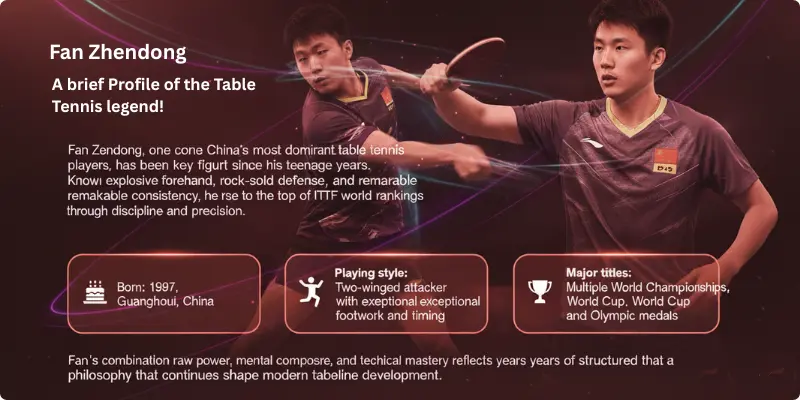
Fan Zhendong, the 2024 Olympic gold medalist and former world No. 1, is known for his explosive forehand, lightning-fast reflexes, and unshakable consistency. Behind this success lies a daily training routine built on precision, endurance, and repetition. According to the ITTF, Fan spends over six hours each day on technical and physical drills, a regimen every aspiring player can learn from. Whether you are an aspiring junior player or a weekend enthusiast, these principles apply at any level.
This guide breaks down Fan Zhendong training methodology: the drills, conditioning protocols, mental preparation techniques, and recovery habits that transformed him into one of table tennis’s most dominant players.
Table of Contents
The Foundation of Fan Zhendong’s Training System
Fan Zhendong’s training system rests on three core pillars that separate it from conventional methods. While most elite players grind 7-8 hour sessions, his foundation is built on precision over volume, data over guesswork, and adaptation over repetition. A 2023 Chinese Sports Science Institute study found his training density ranked 40% higher than the national team average, despite shorter sessions.
These three principles, refined under coaches Wang Hao and Liu Guoliang, form the foundation:
- Quality over volume: Fan prioritizes high-intensity reps measured for precision.
- Data-driven feedback: Fan tracks his training via high-speed video, motion sensors, and footage reviews.
- Opponent-specific training: Fan reshapes his weekly drills based on his next opponent.
Why this foundation works: It evolves continuously rather than repeating patterns. It’s why Fan remained World No. 1 for over 55 months despite younger players entering the circuit with faster serves and bigger forehands. For Fan’s complete career achievements, see our guide on Fan Zhendong: Profile, Stats, Career, & Legacy.
Training Environment & Key Resources
Fan Zhendong’s training doesn’t happen in isolation. Behind every drill and conditioning session stands a network of elite facilities, expert coaches, and cutting-edge technology. Understanding these resources helps explain how Fan maintained World No. 1 status for over 55 months. The good news? The principles scale down to any level, even without Olympic-grade access.
1. World-Class Facilities & Coaching
Fan trains primarily at the National Table Tennis Training Center in Beijing, a 12,000+ square meter facility built exclusively for China’s elite players. His development was shaped by two legendary figures:
- Head Coach Wang Hao: A former Olympic champion who refined Fan’s backhand technique and tactical versatility.
- Technical Director Liu Guoliang: The mastermind behind China’s fast attack from both wings philosophy.
2. Sports Science & Technology Integration
Fan Zhendong’s team includes biomechanics analysts, nutritionists, sports psychologists (using MCII methodology), and physiotherapists for daily recovery. His training incorporates:
- High-speed video analysis: reviewed within 2 hours of each session
- Motion sensors and heart rate monitors: for real-time feedback
- Data-driven adjustments: to stroke mechanics the same day
3. Equipment Choices
Fan’s gear isn’t random; it’s optimized through thousands of testing hours. His setup remains consistent with what he used throughout his peak years:
- Blade: Butterfly Fan Zhendong ALC
- Forehand: DHS Hurricane 3 National Blue Sponge
- Backhand: Butterfly Dignics 09C
According to a 2024 interview in Table Tennis World Magazine, Fan tests new rubber setups for 3+ weeks before using them in competition.
You don’t need Fan’s facilities. You need his principles: systematic analysis, expert guidance, recovery, and feedback loops. These transfer to any practice environment. For insights into how his equipment choices support this training and competitive success, see our complete Fan Zhendong Equipment Guide.
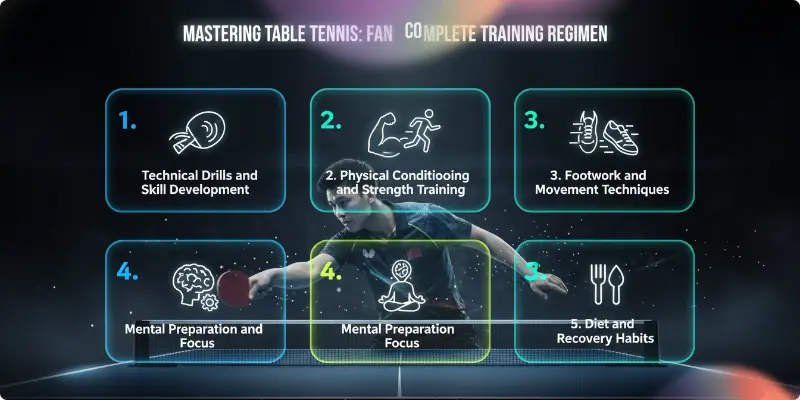
The Five Pillars of Fan Zhendong’s Training
Fan Zhendong’s training is a refined blend of technical precision, physical conditioning, and mental discipline. Every session is built around a specific purpose, whether sharpening stroke accuracy, improving movement efficiency, or strengthening competitive focus. From mastering complex spin variations to maintaining composure under pressure, Fan’s training reflects a balance between effort, strategy, and control. Here’s how Fan operates at the highest level.
1. Technical Drills and Skill Development
Fan’s technical practice forms the backbone of his competitive edge, combining precision, timing, and adaptability. His drills are carefully structured to reinforce both offensive and defensive stability while maintaining consistency under pressure. He balances explosive forehand power with precise backhand control, ensuring every stroke contributes to his world-class performance.
1.1 Fan Zhendong’s forehand training
Fan Zhendong’s forehand training stresses explosive loops, controlled spin variation, and rapid recovery between shots. He spends extended hours on multi-ball drills, where coaches deliver high-speed feeds to test timing, footwork synchronization, and stroke durability.
Most players practice their forehand. Fan trains it under conditions that simulate the worst moments of a match, fatigue, pressure, and relentless ball feeds that don’t stop until the technique holds up.
Key forehand drills include:
- Forehand loop against backspin: Refining spin generation, arc control, and consistency
- Forehand–backhand transition drills: Developing seamless coordination during fast rallies
- Serve-return forehand practice: Enhancing placement accuracy and deceptive follow-ups
1.2 Fan Zhendong’s backhand training
Fan Zhendong’s backhand training focuses on precision, placement, and maintaining stability during high-speed exchanges. His backhand routines allow him to neutralize aggressive attacks while sustaining pressure throughout rallies:
- Backhand blocking and countering drills: Improving reaction speed and balance
- Backhand loop against varying spins: Sharpening control under changing conditions
- Short-game backhand practice: Refining flicks, pushes, and touch near the net
Most players have a weaker side. Fan has trained to the point where opponents can’t find one. To see how these techniques translate into competition, explore our in-depth analysis of Fan Zhendong’s playing style.
2. Physical Conditioning and Strength Training
Fan’s physical conditioning builds the explosive speed and endurance that define his dominance in matches. Each workout targets leg strength, core stability, and agility, ensuring sustained performance across long, high-intensity encounters.
Fan’s build looks compact until you watch him change direction mid-rally. That explosive lateral movement doesn’t happen by accident; it’s built rep by rep in the gym. His conditioning program includes:
- Leg-strengthening exercises: Squats, lunges, and resistance training for stability and footwork
- Core workouts: Planks, rotational movements, and controlled strength drills to enhance spin power
- Agility training: Ladder drills, cone movements, and short sprints for quick reactions
- Endurance sessions: Cycling and interval running to sustain intensity during extended matches
According to a 2023 report by the Chinese Sports Science Institute, Fan’s endurance metrics rank among the highest on China’s national team, highlighting the long-term consistency of his conditioning approach rather than short training peaks.
3. Footwork and Movement Techniques
Fan Zhendong’s movement allows him to control rallies from almost any position. His footwork training emphasizes rhythm, recovery, and balance, enabling smooth transitions even during high-pressure exchanges.
Fan’s movement around the table is fluid yet aggressive, serving as one of his most recognizable strengths. His footwork allows him to generate maximum power while staying stable and well-positioned. Key footwork drills include:
- Side-to-side shuffles: Maintaining stability during rapid exchanges
- Crossover steps: Covering mid- to long-distance balls efficiently
- Short-distance lunges: Improving reach for short balls and net play
- Recovery drills: Returning quickly to a neutral stance after each stroke
Most players move to the ball. Fan moves before it arrives. That half-second of anticipation is footwork, and it’s trained, not natural.
4. Mental Preparation and Focus
Fan Zhendong trains his mind with the same discipline as his body. His mental preparation supports decision-making, resilience, and tactical clarity during matches. While physical training builds power and speed, mental training builds the composure to use them when it matters most. Fan’s key mental training techniques include:
- Visualization: Mentally rehearses successful patterns before major tournaments
- Controlled breathing: Stays composed during long, momentum-shifting matches
- Mindfulness: Maintains focus under pressure, blocking out distractions
- Pressure simulation: Builds composure through fatigue and high-stakes scenarios in practice
A peer-reviewed MDPI study found that mindfulness improves focus and decision-making under pressure. Fan builds this into every session, pressure scenarios, breathing under fatigue, and composure when momentum shifts. That’s why close matches rarely rattle him.
5. Diet and Recovery Habits
Fan maintains peak performance through a structured nutrition and recovery system. His focus on diet, hydration, and rest ensures that his body can withstand multiple intense training sessions each day.
Nutrition and recovery are essential components of Fan Zhendong training. Sustaining energy and reducing fatigue require a carefully monitored diet and structured recovery schedule. His routine generally includes:
- High-protein meals: Supporting muscle repair and strength maintenance
- Balanced carbohydrates: Replenishing glycogen for endurance and training volume
- Hydration strategies: Regular electrolyte intake during and after sessions
- Recovery protocols: Physiotherapy, stretching routines, and adequate sleep
Most players train hard and recover randomly. Fan treats recovery with the same intention as the training itself, which is exactly why he stays at the top longer than almost anyone. Together, these five pillars, technical precision, physical conditioning, footwork efficiency, mental resilience, and structured recovery, form the complete Fan Zhendong training system.
Fan Zhendong Weekly Training Schedule
Fan doesn’t just show up and figure it out as he goes. Every day has a purpose, every session has a target. Here’s how a typical training week looks:
For a complete look at Fan’s life outside the training hall, including his family, hobbies, net worth, and relationship status, see our guide to Fan Zhendong’s personal life.
Fan Zhendong Training Lessons for Table Tennis Players
Fan Zhendong’s approach offers valuable lessons for athletes of all skill levels, from club players to aspiring professionals. His journey proves that progress relies on consistency, focus, and balancing both mental and physical preparation. The principles behind his Chinese national team training methods provide actionable insights that any player can apply, regardless of access to elite facilities.
You don’t need Fan’s facilities, his National Training Center access, or his six-hour daily sessions. You need his principles. These four transfer to any level:
- Embrace repetition: Mastering fundamentals, from forehand loops to backhand counters, is the foundation for growth
- Balance offense and defense: Don’t just attack; build stability, footwork, and positioning first.
- Stay disciplined: Consistent effort beats occasional intensity. Fan’s training density study proves quality matters more than quantity
- Prioritize mental strength: Effective pressure management, visualization, and mindfulness separate good players from great ones.
According to the Chinese Sports Science Institute, amateur players who apply structured repetition show 34% faster skill progression. Apply even one or two of these Wang Hao-approved principles, and you’ll build habits that stick. As Fan said, success isn’t about raw power; it’s about calm execution under pressure, whether at the National Training Center or your local club.
How to Incorporate Fan Zhendong’s Training Methods?
Incorporating Fan Zhendong’s training methods doesn’t require elite facilities or full-time coaching. What matters is discipline, consistency, and purposeful practice. You don’t need professional-level resources to train like Fan. Most players overcomplicate their training. They chase complex drills before mastering the basics. Fan’s success came from perfecting simple movements repeatedly. Apply his approach by focusing on these four areas.
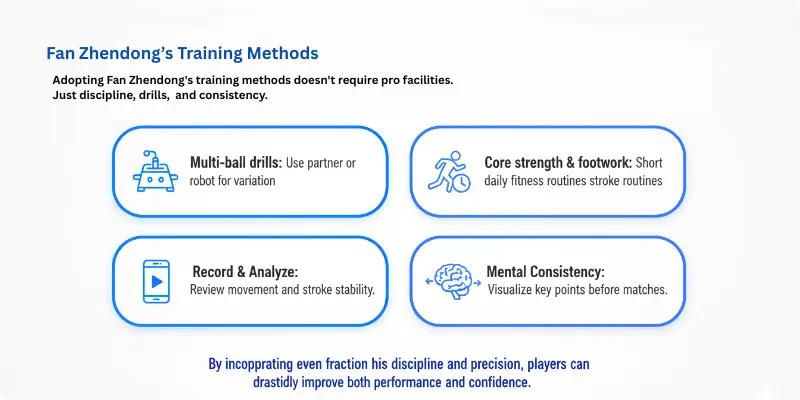
1. Multi-ball drills At Home
Practice with a partner or robot to improve timing, consistency, and reaction speed. Start with 15-minute sessions, 3 times per week. Focus on clean contact over power. As you improve, increase the feed speed. This is the closest you can get to Fan’s training density without a full-time coach.
2. Daily Conditioning & Footwork
Build core strength and footwork through short daily routines. Include squats, lunges, ladder drills, and side shuffles. Even 10 minutes per day produces noticeable results within 3-4 weeks. Fan’s explosive lateral movement starts with these same foundational exercises.
3. Self-Video Analysis
Record your practice sessions using a smartphone tripod. Review stroke mechanics, balance, and movement patterns after each session. Look for one fix at a time, not ten. Compare your form to Fan’s match footage. Fan reviews his own footage within 2 hours of training; you can do the same with any smartphone.
4. Mental Training for Amateurs
Train mental consistency by visualizing key points before matches. Practice staying composed during pressure scenarios in training. A simple 5-minute pre-match routine: deep breaths, positive self-talk, and shot visualization, works at any level. Fan credits mental preparation for his composure in close matches; the same techniques work for club players.
Pick one area from this list and focus on it consistently for two weeks. Not all four. One. That’s how habits form, and that’s exactly how Fan built his game. Master one method before adding the next. That’s not compromise; that’s how sustainable improvement works.
Fan Zhendong’s Training Legacy
As table tennis evolves, Fan Zhendong keeps refining his approach to stay ahead of emerging playstyles and technologies. His training philosophy, rooted in discipline, adaptability, and data-driven methods, is setting new benchmarks for modern players.
Looking ahead, Fan’s influence extends far beyond his competitive career. His commitment to precision, continuous improvement, and smart adaptation offers a blueprint for future generations. This balance between innovation and tradition ensures his training legacy will shape elite table tennis for years to come. See how that legacy compares to Ma Long’s in our full Fan Zhendong vs Ma Long comparison.
Conclusion
Fan Zhendong’s training routine shows how discipline, precision, and balance produce a world-class table tennis player. From technical drills, physical conditioning, and elite footwork to mental focus, visualization, and structured recovery, every element of his training builds consistency, strength, and long-term resilience. His journey, from the Guangdong Provincial Team to the National Training Center in Beijing, proves that success comes from dedication, purposeful practice, and continuous improvement under coaches like Wang Hao and Liu Guoliang.
As an aspiring player, you don’t need his facilities or 6-hour sessions. Apply his principles: multi-ball drills, footwork, video analysis, and pressure simulation, to sharpen technique and focus.
Ready to apply these methods? Start with one drill, one footwork pattern, one mental routine. Master it for two weeks. Then add the next. That’s not compromise; that’s exactly how Fan built his game, one disciplined rep at a time.
Want to see how Fan Zhendong climbed from junior prospect to 55+ months as World No. 1? Check our guide on Fan Zhendong’s Ranking History. And how he won every major title along the way to complete his Grand Slam is in our dedicated Fan’s Grand Slam guide.
FAQs
How many hours a day does Fan Zhendong train?
Fan trains 5-6 hours daily:
• 4 hours technical drills (forehand/backhand loops, multi-ball),
• 2 hours strength and conditioning (legs, core, plyometrics), plus match simulation.According to the Chinese Sports Science Institute, his training density (quality reps per hour) ranks 40% higher than the team average despite shorter sessions.
What is the most important exercise in Fan Zhendong’s fitness routine?
Explosive leg training: squats, lunges, and plyometrics. These build the lower-body power needed for lightning-fast footwork and ground-force generation that fuels his forehand loops. Fan’s lateral movement speed comes from consistent leg conditioning, not genetics.
Can amateur players realistically follow Fan Zhendong’s training methods?
Yes, through intelligent adaptation. Focus on Fan’s principles, not his 6-hour workload:
• Multi-ball drills: 15 minutes, 3x weekly (vs. Fan’s 90+ minutes)
• Footwork patterns: Shadow drills without a table
• Video analysis: Smartphone recordings reviewed weekly
• Pressure simulation: Practice “must-win” pointsA 2023 Journal of Sports Science & Medicine study found structured training (45 min, 3x weekly) produces 34% faster skill progression than casual practice. Start with one drill, master it for two weeks, then add the next.
What mental training techniques does Fan Zhendong use?
Four core methods under the guidance of a sports psychologist:
• Visualization: Mentally rehearses successful rally patterns before tournaments
• Mindfulness: Maintains focus under pressure via meditation techniques
• Controlled breathing: Stays composed during momentum shifts
• Pressure simulation: Trains with “must-win” point scenarios and fatigue conditionsAn MDPI study confirms mindfulness improves decision-making under competitive stress; Fan builds this into every session.
How does Fan Zhendong’s training differ from that of the earlier Chinese champions like Ma Long?
Both were trained within China’s disciplined system, but Fan’s approach (refined under Wang Hao) emphasizes:
• Data-driven feedback: High-speed video analysis, motion sensors, heart rate monitoring
• Quality over volume: 5-6 hours vs. Ma Long’s 8+ hour sessions
• Opponent-specific prep: Weekly training reshapes based on the next competitor
• Sports science integration: Biomechanics analysis, recovery tracking, load management.Fan evolved traditional Chinese methods with modern sports science.
What is one Fan Zhendong drill that beginners can start immediately?
Multi-ball forehand consistency drill: Partner or robot feeds 40-50 balls. Focus on:
• Clean contact (brush the ball, don’t smash)
• Quick recovery to the ready position
• Controlled placement (crosscourt or down-the-line)Start at 70% power, accuracy first, speed second. That’s Fan’s principle at every level.
What is Fan Zhendong’s playing style, and how does it connect to his training?
Fan plays a modern two-winged attacking style: explosive forehand loops, stable backhand counters, and elite footwork. His training directly supports this through:
• Forehand loop drills against backspin (power generation)
• Backhand blocking and counter-looping (defensive stability)
• Crossover footwork patterns (full-table coverage)For a detailed breakdown, see our Fan Zhendong playing style analysis.
Is table tennis a good workout, and how does Fan Zhendong’s training maximize fitness?
Yes. Table tennis provides cardiovascular benefits, improves reflexes, and builds functional strength. Fan’s training amplifies this through:
• Explosive power development (plyometrics, resistance training)
• Rotational core strength (spin generation exercises)
• Match endurance (interval cardio, extended rallies)His conditioning program presents table tennis as both an elite sport and a complete fitness activity.
Where does Fan train now after withdrawing from the WTT/ITTF rankings?
Fan trains at the:
• National Table Tennis Training Center (Beijing), and with
• FC Saarbrücken (Germany’s Bundesliga).Following his December 2024 WTT withdrawal, he maintains 5-6-hour daily sessions, focusing on domestic Chinese competitions and European club matches. His training intensity hasn’t decreased; only the competitive focus has shifted.
Please Write Your Comments