Dimensions of Table Tennis Table: Official ITTF Size (2026)
Updated: May 16, 2026
2456
Have you ever wondered why the dimensions of a table tennis table are so precise, 9 feet long, 5 feet wide, and 2.5 feet high? The answer lies in international standards, and it directly impacts how the game is played.
These numbers aren’t arbitrary; they are the exact measurements set by the International Table Tennis Federation (ITTF) to ensure fair play, consistent ball bounce, and uniform competition worldwide. Whether you’re setting up a table in a basement, garage, or club, understanding these dimensions helps you choose the right table, ensure proper gameplay, and calculate whether it fits your available space.
In this guide, we’ll break down the official table tennis table dimensions, not just length, width, and height, but also net specifications, surface thickness, space requirements, and different table types. We’ll also cover common setup mistakes and explain why these standards matter for your overall playing experience.
Let’s get started
Table of Contents
Official ITTF Table Tennis Table Size in Feet & Meters: A QUICK Answer
The official ITTF table tennis table dimensions are:
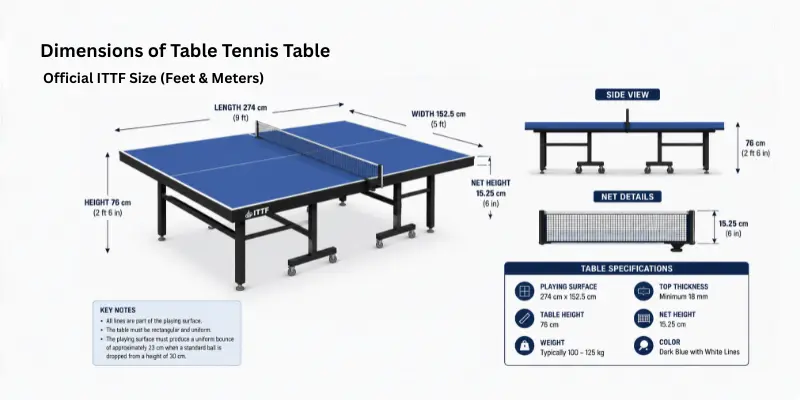
- Length: 2.74 meters (9 feet)
- Width: 1.525 meters (5 feet)
- Height: 76 centimeters (2.5 feet)
- Net height: 15.25 centimeters (6 inches)
Professional tables have a minimum surface thickness of 22 mm, ensuring that a ball dropped from 30 cm bounces approximately 23 cm, providing consistent gameplay.
Why these exact measurements? The ITTF standardizes every dimension worldwide, so a table in Beijing plays identically to one in Berlin. This uniformity ensures your practice translates to any venue, whether you’re training at home or competing in the Olympics. Below, you’ll find detailed explanations, space requirements, table types, and setup tips for every playing environment.
Standard Dimensions of Table Tennis Table (ITTF Specifications)
The standard table dimensions aren’t just numbers; they’re precisely defined by the International Table Tennis Federation (ITTF) to ensure uniformity across all levels of play. Whether you’re setting up a table at home or competing internationally, these standardized dimensions guarantee fair play, consistent ball bounce, and a level playing field for every player.
1. Length of the Table Tennis Table
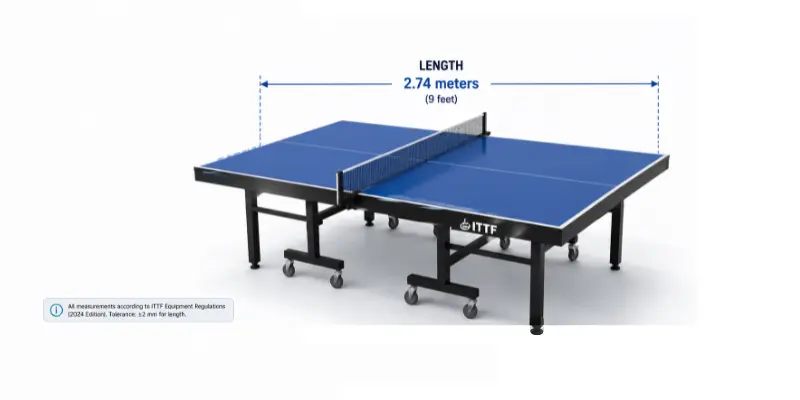
The standard length of a table tennis table is one of its most defining features, helping maintain consistent gameplay across all levels. Officially, the length is 2.74 meters. This measurement provides the ideal space for executing shots and sustaining engaging rallies. The ITTF standardizes this length worldwide, allowing players to anticipate and respond accurately regardless of where they play.
The Length of a table tennis table at a glance:
- Official size: 2.74 meters (9 feet)
- ITTF tolerance: ±2 mm
- Pro tip: 22- 25 mm thickness = consistent bounce
Why 2.74m matters: Creates a 0.3-second ball flight at competitive speeds, exactly enough time to read spin and react, but not so much that rallies slow down.
2. Width of the Table Tennis Table
The official width of a table tennis table is 1.525 meters. This width ensures effective gameplay by providing players with sufficient lateral space to execute a wide range of shot techniques with freedom. The width also allows comfortable side-to-side movement for most adults, roughly aligning with average shoulder span and arm reach.
The official width at a glance:
- Official size: 1.525 meters (5 feet)
- Matches: Average adult shoulder span + arm reach
- Benefit: Freedom for wide shots and side-to-side movement
Why 1.525m matters: Wide enough to reward angled shots, narrow enough that extreme angles stay risky, the perfect balance between attack and defense.
3. Height of the Table Tennis Table
A regulation table tennis table stands 76 centimeters (2 feet 6 inches) above the floor. This height keeps the table at a comfortable level for players of all skill levels and supports consistent ball bounce. This height roughly corresponds to adult hip height, ensuring comfortable posture for forehand and backhand strokes and minimizing strain during long rallies.
The standard height at a glance:
- Official size: 76 centimeters (2 feet 6 inches)
- Matches: Adult hip height
- Benefit: Comfortable posture, less strain during long rallies
Why 76cm matters: Matches adult hip height for optimal stroke mechanics, low enough for powerful loops, high enough to prevent back strain during long rallies.
4. Net Height and Posts
The net must be 15.25 centimeters (6 inches) high. Beyond the height, the tension of the net is a critical factor, as an overly loose or tight net can unfairly alter the trajectory of a “let” cord during competitive rallies. It is suspended by a cord attached at each end to an upright post, which also stands 15.25 cm high. The limit of the post must be 15.25 cm outside the sideline.
Here’s a glance at the net height:
- Net height: 15.25 cm (6 inches)
- Post height: 15.25 cm (6 inches)
- Overhang: 15.25 cm outside the sideline on both sides
- Warning: Loose or tight net alters “let” cord trajectory
Why 15.25cm matters: Ensures it serves to clear the net at 5-8° angles, steep enough to dive into the court, shallow enough to stay controllable.
5. Surface Thickness and Materials
Tabletop thickness directly affects bounce quality and game speed. In the table tennis community, we generally consider the 19mm mark to be the “threshold of quality“; anything thinner often results in a hollow feel and inconsistent spin response. Most quality indoor tables are made of High-Density MDF:
The surface standards at a glance:
- Family / Recreational Games: 12 mm – 15 mm
- Training / Club Use: 16 mm – 19 mm
- Professional / Competitive Games: 22 mm – 25 mm (ITTF minimum: 22 mm)
Why 19mm is the threshold: Thinner surfaces flex on impact, deadening spin. Professional 22-25mm tables stay rigid, preserving 98% of the ball’s rotation.
6. The Official Bounce Test Standard
This is where professional-grade tables separate themselves from recreational models. While many manufacturers claim tournament size, only those that maintain consistent energy return across all nine zones of the table truly meet international playability standards. The ITTF verifies surface quality using a specific physics protocol.
The bounce requirement at a glance:
- The Procedure: A standard 40+ ABS plastic ball is dropped from a height of 30 cm.
- The Requirement: The ball must bounce to a height of approximately 23 cm.
- Consistency: On a high-quality table (22mm–25mm top), this bounce must be uniform across the entire surface.
Why 23cm bounce matters: This 76.7% energy retention allows topspin to “grip” and accelerate while backspin “bites” and slows; the physics sweet spot for modern techniques.
7. Line Markings and Surface Finish
The ITTF requires specific visual standards to ensure the ball is easy to track at high speeds. The coefficient of friction on the surface finish is also regulated, as it determines how much of the ball’s incoming spin is gripped by the table versus sliding off.
The marking standards at a glance:
- The Finish: The surface must be uniformly dark-colored and matte. Glossy surfaces are prohibited as they cause glare under bright lights.
- Boundary Lines: White side lines and end lines must be 2 cm (20mm) wide.
- The Center Line: A 3mm white line divides the table lengthwise for doubles service (governing the right-to-right serve rule).
Why matte finish matters: Eliminates glare that causes split-second visual disruptions. At 20-30 m/s ball speeds, even 0.1 seconds of distraction costs points.
Adhering to official ITTF standard dimensions is the only way to ensure your training at home translates to a club or tournament environment. For a truly professional experience, prioritize a table with at least a 22mm surface thickness and a matte finish to develop the accurate muscle memory and ball-tracking skills required for high-level play.
???? Need to verify your specific setup? If you are measuring a custom space or trying to decide between a mid-size or full-size table, use our interactive tools: Table Tennis Room Size Calculator.
Table Tennis Table Types: Dimensions Comparison
Different table tennis tables are designed to suit different playing environments, space limitations, and skill levels. From professional tournaments to casual home setups, choosing the right table size directly affects gameplay quality, comfort, and overall playing experience. While regulation tables follow strict ITTF standards, smaller alternatives are available for recreational and space-saving use.
Only regulation and recreational tables meet official ITTF dimensions. Mid-size and mini tables are mainly for casual play. For serious training or realistic match conditions, choose a table with official dimensions based on your skill level and available space.
Why do Standard Table Dimensions Matter in Table Tennis?
Standard dimensions of table tennis table aren’t just numbers; they’re the foundation of fair, competitive, and enjoyable table tennis. By maintaining exact specifications worldwide, the ITTF ensures that every player, from casual enthusiasts to Olympians, experiences the same playing conditions. This standardization upholds the integrity of the sport across all levels of play.
- Fair Play: Creates a level playing field worldwide, eliminating size-based advantages.
- Skill Development: Builds transferable muscle memory and accurate technique.
- Consistent Gameplay: Reliable bounce lets players focus on strategy, not adjustment.
- Viewer Experience: Uniform dimensions create a clear, consistent viewing perspective.
Competition tables allow a maximum tolerance of ±2 mm in length, width, or height, ensuring precise and uniform conditions for official matches.
Adhering to official ITTF dimensions for ping pong table isn’t just about rules; it ensures fairness, supports skill growth, and delivers a consistent experience for players and fans alike. Table dimensions standardize play, but so does the ball. See our full guide on table tennis balls.
Understanding Table Construction Materials
The material of your table determines its life expectancy and bounce quality. Here is the breakdown of the materials I look for when evaluating equipment:
Tolerance Levels: How Precise is Official?
Even tiny differences in a table’s measurements can affect fair play. In professional tournaments, precision matters. The ITTF allows only a 2-millimeter difference (about the thickness of two pennies) in length, width, and height. If a table is off by just half an inch, it can change your shot angles and throw off your timing when you play at a different location.
Para Table Tennis: Accessibility Standards
Professional tables must work for all athletes, including wheelchair players. If you’re setting up a club or accessible home space, follow these wheelchair standards:
- Leg Recess: Table legs must be set back at least 40 cm (15.7″) from the table end so wheelchair players can roll under without hitting the frame.
- Clearance Zone: Minimum 1.4 meters (4.6 ft) of clear space behind each baseline for wheelchair movement and defensive positioning.
- Height Standard: Para tables remain 76 cm high, identical to standard tables, ensuring consistent ball bounce for all players.
This ensures a wheelchair player can move their chair under the table without hitting the support frame, which is essential for returning short serves or touch shots at the net.
Space Requirements for Table Tennis Tables
A table tennis table needs more than just its physical footprint; players require a dedicated playing enclosure for unrestricted movement and proper stroke mechanics. Without adequate clearance, you risk injuring yourself or developing a cramped playing style that won’t translate to competitive environments.
Official ITTF Space Standards:
- Professional Competition: 14 m × 7 m (45.9 ft × 23 ft), 2m clearance all sides
- Local Club / League: 10 m × 5 m (32.8 ft × 16.4 ft), 1.5m clearance all sides
- Home / Recreational: 5.8 m × 3.4 m (19 ft × 11 ft), 1.5m end / 1m side clearance
To ensure a functional 19 ft × 11 ft setup, you must allow for at least 5 feet of end-clearance for full backswings, 3 feet of side-clearance for lateral movement, and a 10-foot vertical ceiling height to accommodate high-arc defensive lobs.
???? Not sure if your room is big enough? Use Our Free Table Tennis Room Size Calculator. Get instant, ITTF-aligned recommendations based on your exact room dimensions, skill level, and furniture obstacles.
???? For comprehensive space planning, including furniture placement, flooring choices, and specialized solutions for small apartments, read our full guide: Table Tennis Room Space Requirements & Setup Guide.
Common Table Tennis Table Setup Mistakes to Avoid
Getting the dimensions of table tennis table right is one thing; setting up the table correctly is another. Even with a perfect ITTF-spec table, these common mistakes can ruin your playing experience, affect gameplay quality, and even damage your equipment. By knowing what to avoid, you can ensure your table performs as intended and lasts for years.
1. Measuring Only the Table, Not the Room
Many players measure the table (9×5 ft) but forget the crucial clearance space around it. Without at least 5 ft behind each end and 3 ft on each side, you’ll constantly worry about walls, furniture, or injuring yourself during play.
- The Fix: Use our Table Tennis Room Size Calculator to verify clearance before purchasing.
2. Ignoring Floor Levelness
A table on an uneven floor, common in garages, basements, or outdoors, causes inconsistent ball bounce and unpredictable play. The ITTF allows only a 1% slope maximum for competition tables.
- The Fix: Use a spirit level on the playing surface. For permanent setups, consider self-leveling table feet or shims.
3. Using the Wrong Net or Posts
Not all nets are ITTF-compliant. A sagging net, incorrect height (must be 15.25 cm / 6 in), or unstable posts change ball trajectory and serve legality.
- The Fix: Invest in a competition-grade net with tension adjustment and metal posts. Check the net height with a ruler during setup.
4. Poor Placement and Environment
Where you put the table matters just as much as how you set it up. Placing it near walls or under low ceilings restricts movement and shot options, while direct sunlight or damp conditions can warp the surface over time.
- The Fix: Choose a location with overhead clearance of at least 10 ft, indirect lighting, and stable temperature/humidity.
5. Assuming One-Time Setup
Tables aren’t set and forget. Over time, nets loosen, tables can settle unevenly, and wheels may drift, especially on foldable or portable models.
- The Fix: Perform a quick monthly check of net tension, table levelness, and wheel locks (if applicable).
6. Buying Tournament Size Without ITTF Certification
Many tables advertise regulation size or tournament-ready without actual ITTF certification. These marketing terms have no regulatory weight; only tables with an official ITTF stamp have been independently tested for dimensional accuracy and bounce uniformity.
- The Fix: Look for the ITTF certification logo on the table or in product specifications. If purchasing online, verify that the model appears in the ITTF-approved equipment database before buying.
A perfect table deserves an ideal setup. Even ITTF-spec dimensions won’t deliver consistent play if your setup is flawed. Avoiding these mistakes ensures your 2.74m × 1.525m × 76cm table performs exactly as the ITTF intended, whether you’re training seriously or playing for fun.
Conclusion
The standard dimensions of table tennis table ensure consistency, fairness, and optimal play across all levels. The ITTF’s precise 2.74m × 1.525m × 76cm specifications guarantee that practice at home translates directly to tournament environments. Whether you’re a competitive player or recreational enthusiast, adhering to these measurements is essential for realistic gameplay. Always verify ITTF certification over marketing claims, prioritize 19mm+ surface thickness for authentic bounce, and account for the full 19 ft × 11 ft space requirement, not just the table footprint. While regulation tables are necessary for serious training, mid-size alternatives suit smaller spaces. Choose high-density MDF for indoor play or aluminum composite for outdoor durability. By selecting the right dimensions and providing adequate clearance, you create an ideal environment for table tennis at any level.
Now that you understand official dimensions, learn about choosing the right table tennis racket to complete your setup.
FAQs
What are the dimensions of an Olympic table tennis table?
An Olympic table tennis table follows official ITTF standards: 2.74 m (9 ft) long, 1.525 m (5 ft) wide, and 76 cm (2.5 ft) high.
1. Length: 2.74 m | 9 ft
2. Width: 1.525 m | 5 ft
3. Height: 76 cm | 2.5 ft
4. Net Height: 15.25 cm | 6 in
5. Surface Thickness: 22–25 mm (professional competition grade)These standardized measurements ensure fair, consistent play at all competitive levels, including the Olympics.
How much space is needed for a ping pong table?
A minimum space of 16.4 ft x 9.8 ft is required for casual play, while professional matches require an area of 45.9 ft x 23 ft.
1. Recreational: 5m x 3m (16.4′ x 9.8′)
2. Professional: 14m x 7m (45.9′ x 23′)
3. Vertical Clearance: At least 10 feet of overhead space is recommended for high-lob shots.This ensures players have enough room to move around and comfortably play long rallies.
How big is a standard table tennis table in inches?
In inches, a standard regulation table is 108″ long, 60″ wide, and 30″ high. The net is exactly 6 inches tall. These units are commonly used for US-based home setups and garage measurements.
How long is a ping pong table?
A ping pong table is 2.74 meters (9 feet) long. This length is standardized by the International Table Tennis Federation (ITTF) to ensure uniformity across all levels of play. The length provides players enough room for strategic gameplay and allows for consistent rallies.
What is the official color for table tennis tables?
Regulation tables must have a uniformly dark-colored, matte finish (non-reflective), typically in dark blue or dark green. Glossy surfaces are prohibited by the ITTF as they cause glare and interfere with ball tracking.
What is the weight of a standard table tennis table?
A regulation table usually weighs between 150 lbs and 300 lbs (68–136 kg).
1. Recreational: 150–200 lbs
2. Professional: 250 lbs+ (Heavier frames ensure vibration-free stability during power shots)Are foldable ping pong tables smaller than standard tables?
Quality foldable tables maintain the standard 9×5 ft (2.74m x 1.525m) dimensions when open. However, always check the storage dimensions, which are typically 5′ x 2.5′ x 5.5′ when the table is closed.
How long is a ping pong table?
A regulation ping pong table is 2.74 meters or 9 feet long. This length is standardized by the ITTF to ensure consistent rally distances across all professional and club environments.
How tall is a ping pong table?
A regulation ping pong table is 76 centimeters or 2.5 feet tall. This height is designed to align with adult hip height for optimal stroke posture and consistent ball bounce kinetics.
What is the difference between indoor and outdoor table tennis tables?
While dimensions are the same, indoor tables are made of high-density MDF for superior bounce, while outdoor tables use aluminum composite or melamine to prevent warping from humidity.
Never use an indoor MDF table outside, as moisture will cause the surface to swell and ruin the ITTF-certified bounce.
What is the size of a table tennis room in feet?
For home play, a room of at least 17′ x 10′ is recommended. For professional play, the “playing enclosure” must be at least 46′ x 23′. Sufficient “backswing” space is the most common factor players miss when calculating room size.
Are Olympic table tennis tables smaller?
No. Olympic tables are not smaller; they are standard ITTF competition size (9′ x 5′ x 2.5′). They are simply the highest grade of equipment, often featuring 25mm thick tops for maximum bounce uniformity.
Please Write Your Comments