Fan Zhendong vs Ma Long: Head-to-Head, Playing Styles & Who Is Greater (2026)
Updated: June 8, 2026
371
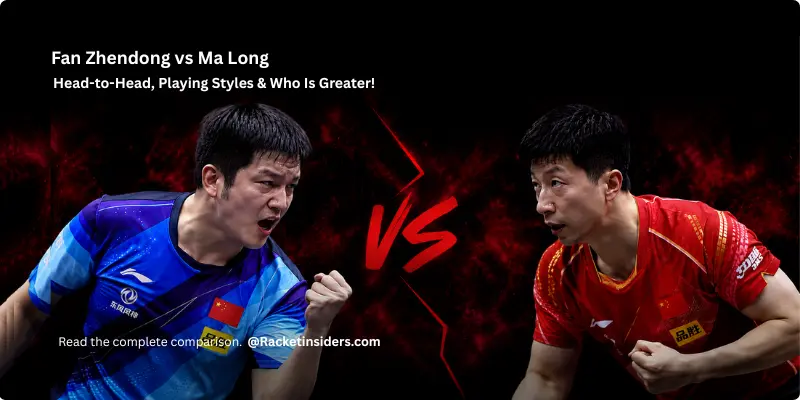
Two players, one era. Fan Zhendong vs Ma Long. The most debated rivalry in modern table tennis, and one of the few where teammates became each other’s greatest obstacle.
Fan Zhendong and Ma Long have shared courts, locker rooms, and gold medals, and faced each other in some of the most electric matches the sport has ever produced. One is the most decorated player in table tennis history. The other is the Paris 2024 Olympic champion who completed his career Grand Slam at 27. Comparing them is not straightforward. But it is worth doing properly.
This guide covers the Fan Zhendong vs Ma Long’s head-to-head record, their playing styles, how they handle pressure, career titles, and the question every table tennis fan eventually asks: who is the greater player?
Table of Contents
Fan Zhendong vs Ma Long: A Quick Comparison
The numbers offer a useful starting point. But they don’t tell the whole story. The table below lays out their major titles, ranking achievements, and playing-style contrasts side by side, providing a clear snapshot before the full breakdown that follows. Read the numbers, then keep scrolling; the real story is below.
Want to dive deeper into each player’s career? Read our Fan Zhendong’s complete profile and explore Ma Long’s career, titles, and achievements.
Fan Zhendong vs Ma Long: Head-to-Head Record
Numbers can be deceptive. The raw count favours Ma Long, but it doesn’t tell you when those wins happened or how the rivalry evolved. Across all recorded competitive matches, including domestic tournaments, the head-to-head record stands at Ma Long 22 wins, Fan Zhendong 9 wins. In major ITTF-sanctioned events, the record is 13-4, still in Ma Long’s favour, but closer when weighted toward recent years.
Ma Long’s 70% advantage came largely from the period when Fan Zhendong was still young and learning how to handle Ma Long’s rhythm, placement, and experience. The rivalry shifted meaningfully as Fan matured.
In three recent major finals, Fan Zhendong won two: the Singapore Smash 2023 and the Singapore Smash 2022. Ma Long won the Asian Championships 2023 final, but that match was decided by small margins.
The head-to-head numbers tell the history of the rivalry. The recent results tell their present. The full picture depends entirely on which years you choose to look at. Fan’s Grand Slam in Paris rewrote the rivalry. Read the full story in our Fan Zhendong Grand Slam breakdown.
Fan Zhendong vs Ma Long: Playing Styles Compared
Understanding why the Fan Zhendong vs Ma Long head-to-head evolved as it did requires understanding how differently they play. One controls the table with tactical intelligence. The other overwhelms it with raw power. Same sport, completely different weapons. Neither approach is better, but each explains a different kind of dominance.
Ma Long: The Hexagon Warrior
Japanese media outlet Tokyo Table Tennis News described Ma Long using a hexagonal radar chart with every skill value maxed out, earning him the nickname “Hexagon Warrior,” meaning all-around excellence. That description is accurate. Ma Long does not have one dominant weapon. He has no significant weakness.
His game is built on:
- Tactical variation: Changes serve placement, spin, and speed within a single match, a skill that played a pivotal role in his biggest victories
- Placement and control: “My game intelligence is my strength,” he once said. He wins by positioning opponents badly, not by overwhelming them with speed
- Mental resilience: His record in deciding games and high-pressure moments is unmatched in the modern era
- Forehand consistency: His forehand loop was one of the most powerful and consistent in history, supported by footwork that covered the table effortlessly
What Ma Long lacks compared to Fan is raw explosive power. Injuries slowed him later in his career, but he compensated by avoiding prolonged rallies and adapting his strategy.
Fan Zhendong: The Cannon
Fan’s game is built on entirely different foundations. Where Ma Long controls, Fan overwhelms. His technical style is characterised by strong attack initiation, strong confrontation, and strong rally ability. He is a right-handed shakehand grip player using inverted rubber on both sides, combining topspin loops with quick attacks.
His core strengths include:
- Backhand dominance: Compact, efficient, and concentrated force production. This is the weapon that separates him from every other player of his generation
- Two-winged attacking: Attacks with equal authority from forehand and backhand, no safe side for opponents to play to
- Physical power: His loops carry a level of weight and speed that few players can absorb comfortably
- Rally-stage dominance: His scoring rate in the stalemate stage reached 66.7%, rated as excellent
His relative weakness, particularly earlier in his career, was serve variation and short game complexity, areas where Ma Long has always held an advantage. For a complete breakdown of Fan Zhendong’s playing style, techniques, and tactical patterns, see our dedicated guide.
The Key Tactical Difference
When rallies become fast, Fan Zhendong has the advantage. His backhand pressure is higher, and his forehand is more stable under speed. Ma Long can still win with variation and placement, but he cannot hold Fan back the way he once did.
That dynamic explains the shift in their recent head-to-head results. Fan grew physically stronger and technically more complete. Ma Long aged. The tactical tools that once neutralised Fan’s power became less effective at slowing him down. The playing styles above are not innate; they are built through years of practice. See how Fan Zhendong trains in our complete training routine guide.
Fan Zhendong vs Ma Long: How They Handle Pressure
What happens at 8-8 or deuce? Match analysis reveals two completely different approaches in high-leverage moments. One waits for mistakes. The other forces them. The contrast explains more about their rivalry than any single result. It is the difference between Ma Long’s 64-month world number one reign, built on consistency, and Fan Zhendong’s four World Cup titles, built on explosive moments.
Ma Long in Deciding Points
Ma Long trusts the structure of his game more than any single shot: his footwork, placement, decades of repetition. The same tactical intelligence that earned him three World Championship titles and two Olympic golds does not disappear when the score gets tight. It sharpens.
- Plays more conservatively
- Focuses on placement and forcing opponent errors
- Relies on rally length, his win rate climbs when exchanges extend
Fan Zhendong in Deciding Points
Fan trusts his weapons more than the rally: his backhand flick, two-wing power, and the ability to end points early. The same backhand that Frontiers’ biomechanical research identified as technically superior becomes his primary weapon when the stakes are highest.
- Increases single-shot quality
- Takes higher risks with backhand flicks
- Seeks to end rallies early, his advantage comes within the first few shots
Neither approach is wrong. Both have won crucial matches. But knowing which player defaults to which mindset at 10-9 changes how you watch every future meeting between them.
Fan Zhendong vs Ma Long: Career Achievements
In a rivalry defined by margins, the title count is where most comparisons begin. But numbers alone do not tell you who faced tougher competition, who peaked at the right moments, or who sustained excellence longer. They offer a foundation, not the full picture. Below is what each player actually won, followed by the context that gives those numbers real meaning.
Ma Long
Ma Long is a two-time singles Olympic champion (2016, 2020), three-time singles World Champion (2015, 2017, 2019), and three-time singles World Cup winner (2012, 2015, 2024). He is the first player in history to achieve a Grand Slam, and later completed a Super Grand Slam by winning every major title twice.
His key achievements:
- Most Olympic gold medals of any table tennis player, two in singles, four in team events
- Record 28 ITTF World Tour titles
- Unprecedented 35-month reign as world number one (2015–2018)
On August 11, 2024, in Paris, the Chinese men’s team defeated Sweden 3-0 to claim the team gold. Ma Long’s contribution made him China’s most decorated Olympian with six gold medals, after which he announced his retirement from Olympic sports.
Fan Zhendong
Fan Zhendong is the Paris 2024 singles Olympic champion, a two-time singles World Champion (2021, 2023), and a four-time singles World Cup winner (2016, 2018, 2019, 2020). His Paris 2024 gold completed his career Grand Slam, making him the sixth male player and eleventh player overall to achieve the feat.
His key achievements:
- Long-time world number one with 55+ months at the top
- Dominated both the ITTF and WTT ranking systems
- Defended his National Games men’s singles title in 2025, the second player ever to do so after Ma Long.
Fan’s titles came in an era where beating Ma Long was a prerequisite for winning anything significant. In December 2024, he withdrew from the ITTF world rankings, citing the psychological toll of the Paris cycle and a dispute with WTT’s fine policy, but continues competing professionally in the German Bundesliga and Champions League. For his full ranking timeline, see our dedicated guide: Fan Zhendong Ranking History.
Fan Zhendong vs Ma Long: Equipment Choices
Fan and Ma Long’s playing styles are opposites. Their equipment choices follow suit. One prioritises all-around consistency. The other builds around a single devastating weapon. Equipment at this level is not a preference; it is a philosophy. Below is how each player’s gear supports their unique style.
Ma Long’s Equipment
Everything about Ma Long’s setup says control, from the all-wood blade to the same rubber on both sides. Ma Long uses the DHS W968 blade with DHS Hurricane 3 Neo National Blue Sponge on both sides, a setup optimised for all-around performance, consistency, and tactical flexibility.
- Blade: DHS W968 (all-wood construction)
- Forehand: DHS Hurricane 3 Neo National Blue Sponge
- Backhand: DHS Hurricane 3 Neo National Blue Sponge (same rubber on both sides)
Everything about his gear is balanced. No extreme speed. No extreme spin. Just control across every shot.
Fan Zhendong’s Equipment
Fan builds his setup around one specific weapon: a backhand rubber that generates more spin than anything else Butterfly makes. Fan Zhendong uses the Butterfly Fan Zhendong ALC blade, DHS Hurricane 3 National Blue Sponge on the forehand, and Butterfly Dignics 09C on the backhand.
- Blade: Butterfly Fan Zhendong ALC (5-ply wood + 2 Arylate-Carbon)
- Forehand: DHS Hurricane 3 National Blue Sponge (tacky, requires booster)
- Backhand: Butterfly Dignics 09C (highest spin rating in Butterfly’s catalogue)
The Dignics 09C is a deliberate choice that amplifies the backhand weapon his game is built around. Where Ma Long balances, Fan specializes. For a full breakdown of Fan Zhendong’s equipment, see our dedicated guide: Fan Zhendong Equipment.
What They Share
Despite their different philosophies, both players prepare their gear the same way, and neither uses retail versions. At the elite level, what you see on the product page and what these players actually use are two entirely different things.
- Both apply speed booster (Haifu/Kailin) to their forehand Hurricane 3 rubber.
- Both use hand-selected double-code versions of their equipment, not available at retail.
- Both test new setups for weeks before tournament use.
The philosophy differs; the preparation process does not. The shared discipline is a reminder that even the most contrasting styles are built on the same foundation of obsessive preparation.
Fan Zhendong vs Ma Long: Key Matches That Defined the Rivalry
A head-to-head record without context is just a number. In a rivalry this long, not all wins carry equal weight. The real story lives in the matches themselves; the ones where titles were won, dynasties shifted, and two teammates became each other’s ultimate test. Below are the encounters that shaped their rivalry more than any stat ever could.
1. Tokyo 2020 Olympic Games: Men’s Singles Final
The defining match of Ma Long’s late career. He defeated Fan in the Tokyo final, denying Fan his first individual Olympic gold on the biggest stage. Ma Long: the experienced champion. Fan: the powerful challenger is not yet able to close the gap. For Ma Long, it was validation. For Fan, a lesson he would not forget.
2. WTT Singapore Smash 2022: Men’s Singles Final
Fan reversed that dynamic emphatically. He beat Ma Long in the final, the first of two consecutive Singapore Smash titles. For the first time in a major final, Fan looked like the one in control rather than the one trying to catch up. The win announced that the chase was over.
3. WTT Singapore Smash 2023: Men’s Singles Final
Fan did it again. He controlled more rallies and forced Ma Long to defend more often. Back-to-back wins over the Dragon in one of the biggest events on the calendar proved Fan had found a consistent edge. Two years, two finals, two wins. The narrative had officially shifted.
4. China National Games 2021
Revenge. Fan beat Ma Long to help Guangdong secure its first China National Games men’s table tennis gold in 24 years. The Olympic final had stung. This was Fan’s answer, not with words, but with a gold medal of his own. It was a small result in the grand scheme of their rivalry. But psychologically, it changed everything.
5. Paris 2024 Olympics
Ma Long did not compete in singles. Wang Chuqin and Fan were China’s representatives. Fan won gold. Ma Long claimed team gold, his sixth Olympic medal, then announced his retirement from Olympic competition. They never faced each other in Paris. But the torch had already been passed.
These five matches tell the arc of the rivalry better than any spreadsheet ever could. One built his legacy on big-match victories. The other learned, adapted, and eventually turned the tide. Together, they pushed each other to heights neither would have reached alone. To explore Fan’s complete World Championship journey, check out our in-depth guide on Fan Zhendong’s World Championship.
Who Is the Greater Player: Fan Zhendong vs Ma Long?
This is the question the rivalry invites. It deserves an honest answer, not a diplomatic one. Comparing two all-time greats is never straightforward, but avoiding the question helps no one. The debate centres on Ma Long’s unmatched trophy cabinet against Fan Zhendong’s dominance during a deeper, more competitive era. Below is the case for each player, followed by a direct verdict.
The case for Ma Long
By any objective measure of titles and records, Ma Long’s career is the greater body of work. No player in table tennis history has won more at the highest level. His trophy cabinet is deeper than that of any player in the history of the sport. Here is what that looks like in numbers.
- Two Olympic singles golds to Fan’s one
- Three World Championship singles titles to Fan’s two
- The first Grand Slam and the Super Grand Slam
- Record 64 months as world number one
- Six Olympic gold medals
The case for Fan Zhendong
Fan dominated a period when global competition was arguably higher than at any point in table tennis history. His prime years coincided with a deeper, more international field than Ma Long ever faced. Winning against this generation required beating a wider range of elite players than any previous era demanded. Here is why that matters.
- Nine years younger than Ma Long
- Best backhand ever produced by a men’s singles player
- Completed his Grand Slam at the Paris Olympics, where Ma Long was not selected in singles
- Head-to-head record, when weighted toward recent years, shows Fan pulling ahead
The honest verdict
Ma Long is the greatest player in table tennis history by achievement. Fan Zhendong is the best player of his generation and, at the time of his ranking withdrawal, was the strongest active force in the sport. These are not contradictory statements; they reflect two different measures of greatness applied to two different careers at different stages. One built the throne. The other proved he could sit on it.
The head-to-head numbers show the past. The recent results show the present. The present belongs to Fan Zhendong. But the history, the records, and the legacy belong to Ma Long. That is not a slight to Fan. It is simply the truth of two extraordinary careers. Both players should be celebrated, not reduced to a single winner. Want to know more about the man behind the medals? Read about Fan Zhendong’s personal life, family, hobbies, and net worth.
Final Thoughts
Fan Zhendong vs Ma Long is the defining rivalry of modern table tennis. It spans a decade, two Olympic cycles, and a generational shift in how the sport is played. Ma Long built his dominance on tactical intelligence, all-around completeness, and an almost unnatural ability to win under pressure. Fan built his on explosive power, backhand dominance, and the physical capacity to sustain an attack that no opponent has consistently handled.
That is what makes the rivalry worth studying and still worth debating. Neither player is diminished by comparison to the other. Ma Long set the standard. Fan Zhendong met it. That is the highest compliment one champion can pay another.
Want to see Fan Zhendong’s complete career timeline and achievements? Read our guide on Fan Zhendong’s complete profile, with stats, career & legacy, or explore his complete net worth breakdown.
FAQs
Who has more titles, Fan Zhendong or Ma Long?
Ma Long leads in total major titles: two Olympic singles golds, three World Championship singles titles, three World Cup singles titles, and six Olympic gold medals in total. Fan Zhendong holds one Olympic singles gold, two World Championship singles titles, and four World Cup singles titles. By raw title count, Ma Long’s career is the greater body of work.
Who won between Fan Zhendong and Ma Long at the Tokyo Olympics?
Ma Long won. He defeated Fan Zhendong in the Tokyo 2020 men’s singles final, claiming his second consecutive Olympic singles gold. Fan won his first individual Olympic gold four years later at Paris 2024.
What is the Fan Zhendong vs Ma Long head-to-head record?
Across all recorded competitive matches, including domestic tournaments, Ma Long leads 22 wins to Fan Zhendong’s 9. In major ITTF-sanctioned events, the record is 13-4 in Ma Long’s favour. Weighted toward recent years, Fan has won the majority of their major final encounters.
Who is better: Fan Zhendong or Ma Long?
Ma Long is the greatest player in table tennis history by achievement. Fan Zhendong is the best player of his generation and his legitimate successor. Most analysts consider Ma Long the GOAT by record, Fan Zhendong the dominant force of the modern era.
Did Fan Zhendong ever beat Ma Long in a major final?
Yes. Fan beat Ma Long in the WTT Singapore Smash 2022 final and again in the WTT Singapore Smash 2023 final, back-to-back wins at one of the sport’s biggest events. He also beat Ma Long at the 2021 China National Games.
Why was Ma Long not in the Paris 2024 Olympics singles?
The Chinese Table Tennis Association selected Wang Chuqin and Fan Zhendong as China’s men’s singles representatives for Paris 2024. Ma Long was not selected for singles but competed in and won the men’s team event, his sixth Olympic gold, before announcing his retirement from Olympic competition.
Are Fan Zhendong and Ma Long teammates?
Yes. Despite their rivalry in individual competition, both played for the Chinese national team throughout their careers. They won Olympic team gold together at Tokyo 2020, and Ma Long contributed to China’s team gold at Paris 2024 alongside Fan Zhendong.
What is the difference between Fan Zhendong and Ma Long’s playing style?
Ma Long is the Hexagon Warrior, an all-around player with no significant weakness, winning through tactical variation, placement, and mental resilience. Fan Zhendong is The Cannon, an explosive two-winged attacker whose backhand is widely considered the best produced by a men’s singles player. Ma Long controls rallies. Fan Zhendong ends them.
Please Write Your Comments