Fan Zhendong Rubber Setup: Forehand vs Backhand, Compared (2026)
Updated: August 17, 2026
203
One side is tacky. The other is not. One needs a booster bottle before it is even playable. The other does not. Fan Zhendong rubbers do not just look different from each other; they are built on two completely different philosophies of how to generate spin, and understanding that split is the key to understanding his entire game.
The Fan Zhendong rubber setup has stayed remarkably consistent at the core, a tacky Chinese forehand paired with a tensor European backhand, even as the exact rubber choices have changed across his career. That split reflects a broader divide in the sport: Chinese players have leaned on tacky, high-grip forehand rubbers for decades, while most of the rest of the world builds around tensor speed instead. The setup runs both philosophies on the same racket, which is part of what makes this game so hard to replicate. The rubbers have changed; the logic behind them has not.
This guide breaks down every Fan Zhendong rubber he currently plays, every rubber he has played before, what the specs actually mean, and which rubbers, if any, make sense for your own game.
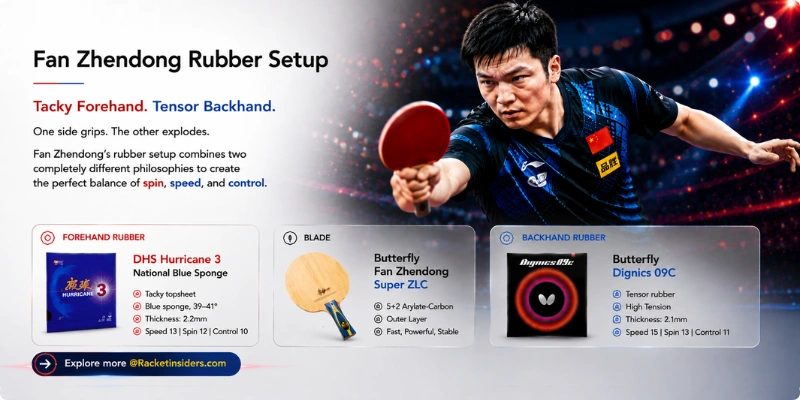
Table of Contents
Tacky Forehand, Tensor Backhand: The Core Split
Most club players run the same rubber philosophy on both sides. Fan Zhendong doesn’t, and neither does most of the Chinese national team. His forehand relies on a tacky, high-friction Chinese sponge built to grab the ball on contact; his backhand relies on a tensor, high-tension Japanese sponge built to catapult the ball back out. Same player, two entirely different ways of generating spin.
That split isn’t cosmetic. It’s the reason his forehand loop and backhand loop feel like they belong to different playing styles entirely, and it’s the first thing to understand before looking at the individual rubbers below. Before going further, it helps to know the player these rubbers are built around; see our complete Fan Zhendong profile, covering his stats, career, and legacy.
Fan Zhendong Rubber Setup: A Full Breakdown
Fan Zhendong’s current setup pairs DHS Hurricane 3 National Blue Sponge on the forehand with Butterfly Dignics 09C on the backhand, but neither side has stayed static across his career. Each change tells you something about how his game has evolved, not just what he happened to try. The breakdown below is grouped by side, current rubber first, followed by what he played before it.
1. Forehand Rubbers
Fan’s forehand has stayed remarkably consistent for one simple reason: it’s the side his entire spin game is built around, and a tacky Chinese rubber is the only tool that produces the kind of grip his loop depends on. It’s also the side that demands the most from a player before it even feels playable.
1.1 DHS Hurricane 3 National Blue Sponge
The Hurricane 3 National Blue Sponge is the forehand rubber Fan has trusted through every major title of his career, and it’s the same rubber choice shared across most of the Chinese national team. It’s an inverted, tacky-topsheet rubber built to grip the ball deeply on contact rather than launch it back out, the opposite approach to nearly every European tensor rubber on the market.
- Type: Inverted, tacky topsheet
- Sponge: Blue, 39–41 degrees (Chinese hardness scale)
- Thickness: 2.2mm (commercial version)
- Ratings: Speed 13 | Spin 12 | Control 10
- Approx. price: $80–$100 (commercial National version)
Straight out of the sleeve, this rubber is stiff enough that most advanced players would struggle to loop with it. That’s by design, and it’s covered fully below. → Full DHS Hurricane 3 review (coming soon)
1.2 Butterfly Zyre 03
At the ETTU Final Top 4, equipment trackers observed Fan briefly playing Butterfly Zyre 03 on his forehand (and backhand, covered below), a rubber he had previously tested but never adopted as a standard configuration. It’s a newer, non-tacky rubber Butterfly has positioned as a potential successor to both Tenergy 05 and Dignics 09C.
- Type: High Tension, Pimples-In, non-tacky
- Sponge: 44 degrees (Butterfly scale), equivalent hardness to Dignics 09C
- Best for: Advanced players wanting maximum speed and arc
- Approx. price: $90–$110
This appearance was brief and isn’t part of Fan’s standard forehand configuration, but it’s worth knowing about if you spot it on his racket in future match footage. → Full Butterfly Zyre 03 review (coming soon)
2. Backhand Rubbers
Fan’s backhand rubber has changed more than any other single piece of his equipment, tracking directly with how much more dominant his backhand loop has become over the course of his career. Each switch reflects a deliberate push toward more spin, not just a change in brand.
2.1 Butterfly Dignics 09C
The Dignics 09C carries the highest spin rating in Butterfly’s entire catalogue. It’s built around Spring Sponge X technology, and it blends the grip of a tacky rubber with the energy return of a high-tension sheet, a combination that makes it unlike anything else in Butterfly’s own lineup.
- Type: High Friction High Tension, Pimples-In
- Sponge: Spring Sponge X, 44 degrees (Butterfly scale)
- Thickness: 1.9mm or 2.1mm
- Ratings: Speed 79 | Spin 96 | Arc 96
- Approx. price: $90–$110
It replaced Tenergy 05 as Fan’s backhand rubber and remains his primary choice today. → Full Butterfly Dignics 09C review (coming soon)
2.2 Butterfly Tenergy 05
This was Fan’s backhand rubber before he switched to Dignics 09C. Tenergy 05 defined an entire era of professional table tennis after its release, and it’s a tensor rubber with a softer, springier sponge than anything in the Dignics line, prioritizing catapult and touch over raw grip.
- Type: High Tension, Pimples-In
- Sponge: Spring Sponge, 36 degrees (Butterfly scale)
- Thickness: 2.1mm
- Best for: Fast counter-topspin, touch-sensitive blocking
- Approx. price: $70–$90
Fan used Tenergy 05 through the Tokyo 2020 Olympics before moving on as his backhand game grew more spin-dominant. → Full Butterfly Tenergy 05 review (coming soon)
2.3 Butterfly Dignics 05
Between Tenergy 05 and Dignics 09C, some equipment trackers have placed Fan briefly on this rubber, a transitional choice released in 2019 as Butterfly’s first attempt at combining Tenergy’s speed with a grippier, more controllable topsheet.
- Type: High Friction High Tension, Pimples-In
- Sponge: Spring Sponge X, 40 degrees (Butterfly scale)
- Thickness: 2.1mm
- Best for: Players wanting more control than Tenergy 05 without losing spin
- Approx. price: $80–$100
Dignics 05 sits squarely between Tenergy 05 and Dignics 09C on the hardness scale, and it’s a useful reference point for understanding where Fan’s backhand choices have trended over time: consistently harder, grippier, and more spin-focused. → Full Butterfly Dignics 05 review (coming soon)
2.4 Butterfly Zyre 03
As noted on the forehand side above, Fan was also previously observed playing Zyre 03 on his backhand during that same ETTU Final Top 4 appearance, running it on both wings rather than pairing it with his usual Hurricane 3.
- Type: High Tension, Pimples-In, non-tacky
- Sponge: 44 degrees (Butterfly scale)
- Best for: Sharp, penetrating backhand topspin and flicks
- Approx. price: $90–$110
This wasn’t part of his standard rotation, but it’s a reminder that even a setup this dialed-in still gets tested. For the full picture of how his rubber choices connect to his blade and overall setup, see our complete Fan Zhendong equipment guide.
Does Fan Zhendong Switch Rubbers by Table or Ball Brand?
Fan Zhendong’s rubber setup isn’t as fixed as most fans assume; it actually shifts based on the table and ball brand in play. According to fellow professional Tao Yuchang and observations from competitive players, Fan does not run one fixed rubber setup across every tournament. His choice reportedly shifts depending on the table and ball brand in play:
- On Tibhar tables and balls: Fan uses Dignics 09C on both sides. The Hurricane 3 reportedly becomes too slippery on Tibhar equipment.
- On DHS and Nittaku balls: he returns to Hurricane 3 National Blue Sponge on the forehand, his standard confirmed configuration.
There’s also a reported one-off. At the December 2025 Bundesliga, trackers noted a trial with Dignics 09C on the forehand and Hurricane 3 on the backhand, a full reversal of his established sides. It wasn’t adopted, but it shows even this setup gets tested. Read more about Fan Zhendong’s Bundesliga reign: One Season, Three Trophies, and a legacy in the making.
Fan Zhendong Rubbers Comparison Table
Trying to keep track of every rubber Fan has played across his career gets confusing fast. This table lays out the type, hardness, role, and price of each one side by side, so you can see exactly how his forehand and backhand choices differ, and how his backhand has evolved.
| Rubber | Side | Type | Hardness | Best For | Approx. Price |
|---|---|---|---|---|---|
| Hurricane 3 National Blue | Forehand (current) | Tacky, inverted | 39–41° (Chinese scale) | Heavy looping topspin, deep grip | $80–$100 |
| Zyre 03 | Forehand (rarely observed) | High tension, non-tacky | 44° (Butterfly scale) | Maximum speed and arc | $90–$110 |
| Dignics 09C | Backhand (current) | High friction, high tension | 44° (Butterfly scale) | Sharp counter-attacks, backhand loops | $90–$110 |
| Tenergy 05 | Backhand (former) | High tension | 36° (Butterfly scale) | Fast counter-topspin, touch | $70–$90 |
| Dignics 05 | Backhand (former, transitional) | High friction, high tension | 40° (Butterfly scale) | Control-leaning spin play | $80–$100 |
| Zyre 03 | Backhand (rarely observed) | High tension, non-tacky | 44° (Butterfly scale) | Sharp backhand topspin and flicks | $90–$110 |
| ⚡ Chinese-scale and Butterfly-scale hardness numbers aren’t directly comparable; they’re measured differently. Treat them as relative within their own brand, not against each other. | |||||
Bookmark this table as your quick reference for how Fan Zhendong’s rubber setup has actually evolved, not just what he’s using right now. For more on how rubber hardness and thickness affect play more broadly, see our guide to table tennis sponge thickness.
Rubber and Blade Pairing
A rubber this demanding doesn’t perform the same way on every blade. The blade you pair it with changes how forgiving or explosive the whole racket feels, and getting that pairing wrong is one of the most common mistakes players make when trying to copy a pro setup.
1. Hurricane 3 National (forehand)
It needs a stable, control-leaning blade underneath it; paired with a very fast blade, the combination becomes nearly unplayable for anyone without elite timing. This is exactly why Fan runs it on the balanced standard ALC rather than a faster blade in his own signature lineup.
2. Dignics 09C (backhand)
The Dignics 09C pairs well with control-to-mid-speed blades; on a very stiff, fast blade it can push shots long, since the rubber already adds significant catapult on its own. Getting this pairing wrong is one of the fastest ways to lose consistency on the backhand side.
3. Tenergy 05 / Dignics 05
The Tenergy 05 / Dignics 05 is more forgiving across a wider range of blades than the two rubbers above, which is part of why they remain popular choices for players not yet ready for a harder, tackier setup. They’re a safer entry point if you’re still dialing in your blade choice.
4. Zyre 03
The Zyre 03 demands a stable blade with a large sweet spot; its non-tacky, high-arc character rewards clean timing over raw grip, so pairing it with an unstable or overly flexible blade makes consistency difficult. A forgiving blade underneath it goes a long way toward smoothing out that demand.
Match your rubber to your blade before you match your blade to Fan Zhendong’s. For the full lineup of blades built around this exact setup, see our complete Fan Zhendong blades comparison.
Which Fan Zhendong Rubber Should You Buy?
Copying Fan Zhendong’s exact rubber setup is one of the most common mistakes the newer players make when upgrading their equipment. What actually matters is matching the rubber’s demands to where your technique is right now, not to what the World No. 1 plays with.
1. Beginners and Control Players
This is the stage where a tacky Chinese rubber will do more harm than good. Skip Hurricane 3 National entirely and start with a softer, more forgiving all-round rubber; the control and predictability will help you build clean technique before spin-heavy rubbers become useful at all.
2. Intermediate Players Building Topspin
This is the stage where a rubber like Tenergy 05 or Dignics 05 starts to make sense. Both reward a developing loop without demanding the near-elite timing that Hurricane 3 National or Dignics 09C require, making them a realistic step toward Fan’s actual setup rather than a leap into it.
3. Advanced Players Wanting the Forehand Feel
This is the stage where Hurricane 3 National becomes worth trying, provided you’re ready to boost it and put in real practice time. The adjustment period is longer than most players expect. Without both of those, the rubber will feel dead and unresponsive rather than the spin weapon it’s meant to be.
4. Advanced Players Wanting the Backhand Feel
This is the stage where Dignics 09C becomes a realistic backhand upgrade. It rewards committed strokes, not passive blocking. It’s demanding, but nowhere near as unforgiving as the forehand side of Fan’s setup, and most advanced players adjust to it faster than they expect.
Whichever tier fits you, both sides of Fan’s setup reward technique over raw power, so building your own game up to meet the rubber, not the other way around, is the fastest path to actually benefiting from it. Still working out where your game sits? See how Fan Zhendong’s own playing style shapes the rubber choices behind this exact setup.
Final Thoughts
Fan Zhendong rubber setup is a direct extension of his game: a tacky, high-grip forehand built for heavy looping topspin, and a tensor, high-arc backhand built for sharp, controlled counter-attacks. The Hurricane 3 National Blue Sponge remains the constant, unchanged since early in his career, while his backhand rubber has evolved from Tenergy 05, through Dignics 05, to today’s Dignics 09C, tracking the rise of his backhand as a genuine weapon.
Neither rubber is a beginner’s choice. But understanding exactly what he plays, and why each one earns its place, gives you a real framework for building your own setup around your own game, rather than just copying a name off a spec sheet.
Once your rubbers are sorted, the next step is making sure your blade choice matches; see our complete all-wood vs carbon blades guide to understand what’s actually happening underneath the rubber.
FAQ
What rubber does Fan Zhendong use on his forehand?
Fan Zhendong uses DHS Hurricane 3 National Blue Sponge on his forehand, boosted before each tournament. It’s a tacky, inverted rubber rated 39–41 degrees on the Chinese hardness scale.
What rubber does Fan Zhendong use on his backhand?
Fan Zhendong currently uses Butterfly Dignics 09C on his backhand at 1.9mm or 2.1mm thickness. It carries the highest spin rating in Butterfly’s entire catalogue and replaced Tenergy 05 in 2022.
Did Fan Zhendong always use Dignics 09C?
No. Fan used Tenergy 05 on his backhand through the Tokyo 2020 Olympics, with some equipment trackers placing a brief transitional period on Dignics 05 before he settled on Dignics 09C.
Does Fan Zhendong boost his rubber?
Yes. Like most Chinese national team players, Fan applies a speed booster to his Hurricane 3 National Blue Sponge forehand rubber before competition. Without it, the rubber is too hard and unresponsive to loop with effectively.
Why are Fan Zhendong’s forehand and backhand rubbers so different?
His forehand uses a tacky Chinese rubber built to grip the ball for heavy topspin, while his backhand uses a tensor Japanese rubber built to catapult the ball for sharp counter-attacks. This tacky-forehand, tensor-backhand split is standard across most of the Chinese national team.
Has Fan Zhendong used any other rubbers?
Equipment trackers have observed Fan briefly using Butterfly Zyre 03 on both sides at the ETTU Final Top 4, though this wasn’t part of his standard tournament configuration.
Can I buy Fan Zhendong’s exact rubbers?
You can buy the commercial versions of Hurricane 3 National and Dignics 09C through most retailers. Fan’s actual competition rubbers are believed to be hand-selected and boosted to his own specification, which isn’t publicly available.
Is red or black rubber different in performance?
No, color does not affect how a rubber plays; it’s an ITTF requirement that one side be red and the other black. See our full explainer on why rackets have red and black sides for the rule itself.
Please Write Your Comments