Best Table Tennis Rubbers (2026): Expert Picks by Playstyle & Budget
Updated: August 31, 2026
316
Search for a table tennis rubber, and you’ll hit the same wall every player does: hundreds of sheets, all claiming to be the best. Sponge degrees, tensor claims, and spin ratings dressed up as science make it nearly impossible to spot a genuinely great rubber from an expensive disappointment.
The wrong rubber does not just waste your money. It fights your technique, buries your spin, and turns a sport that should be fun into frustration. Unlike a blade, which only refines what you already do, rubber creates spin, speed, and control right at the point of contact. Finding the best ping pong rubber for your level and playstyle isn’t optional; it’s the foundation on which everything else in your game is built.
This guide breaks down ten rubbers by what actually matters: overall performance, spin, speed, control, and price, based on real playing characteristics, not marketing copy. No filler, no default brand loyalty. Just the best table tennis rubbers for 2026.
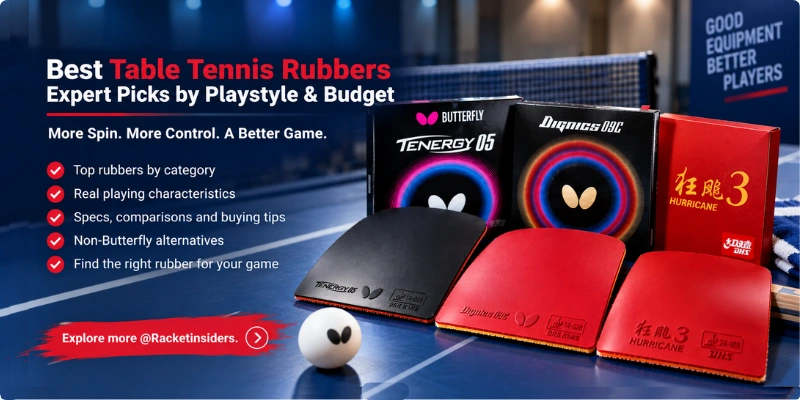
Table of Contents
How to Read Rubber Specs Before You Buy
A few terms show up constantly across any table tennis rubber guide, and understanding them before you buy will save you from picking a rubber that fights your technique instead of supporting it. These four concepts alone cover most of what you need to compare two rubbers at a glance.
- Sponge hardness (37°–52°): Softer (35°–42°) is forgiving; harder (45°+) rewards power but punishes weak technique.
- Thickness (1.5mm–2.2mm/Max): Thinner means more control; thicker means more speed and power, less margin for error.
- Tensor vs non-tensor: Tensor sheets feel springier and more explosive. Non-tensor is more predictable and cheaper.
- Inverted vs pips-out: Inverted (smooth) is standard for most competitive players. Pips-out cuts spin, used defensively.
Once these terms feel familiar, comparing any two rubbers becomes far less confusing. So with that out of the way, here are the picks. Want to go deeper on specs before you buy? Check out our complete Table Tennis Rubber guide.
The Best Table Tennis Rubbers by Category
No single rubber wins at everything, so the picks below are grouped by what actually matters to your game: overall performance, spin, speed, control, and budget. Find the category that matches how you play, or read straight through if you’re still figuring that out.
1. Best Overall
These are the two table tennis rubbers that come closest to doing everything well at once: spin, speed, and control in a single sheet, which is why they show up repeatedly in nearly every serious equipment discussion.
1.1 Butterfly Tenergy 05
The rubber every other spin rubber gets measured against, built on a high-tension spring sponge for exceptional topspin and speed together. It remains a top choice among competitive players over a decade after release, sitting at the premium end of the market.
Key Specs
- High-tension spring sponge, inverted, 2.1mm
- Elite-level spin and speed in one sheet
- Premium price, pro-proven performance
Butterfly Tenergy 05 does almost everything well and remains the safest premium pick in 2026. Skip it if you haven’t developed a consistent loop yet.
1.2 Butterfly Dignics 09C
A hybrid rubber combining a tacky, Chinese-style top sheet with Butterfly’s Spring Sponge X for unusually heavy, stable topspin. It has become one of the most-recommended backhand rubbers among top-level players who loop aggressively but want more predictability than pure tacky rubbers.
Key Specs
- Hybrid top sheet: Chinese tack + Japanese elasticity
- Spring Sponge X for power without instability
- Top pick among pros for backhand use
The Butterfly Dignics 09C is the closest thing to Chinese spin, Japanese control in one sheet. Not the pick if your game is flat and hitting-based rather than looping. Not sure which blade pairs best with these? Check our guide on the best Table Tennis Racket.
2. Best for Spin
Spin is where table tennis rubbers are won or lost on the scoreboard. These two picks consistently top spin-focused comparisons for very different reasons; one rewards raw technique, the other makes heavy rotation more accessible.
2.1 DHS Hurricane 3 (Neo/Blue Sponge)
Still one of the highest-spin rubbers available when paired with the right technique, rewarding players who generate their own power rather than relying on the rubber to do it. It remains a generational benchmark, still used at the highest levels of forehand-focused competitive play.
Key Specs
- Extremely tacky top sheet, non-tensor
- Elite spin ceiling, technique-dependent
- Decades-long benchmark at forehand positions
The DHS Hurricane 3 has an unmatched spin ceiling, but unforgiving. Avoid it if you don’t yet generate your own power.
2.2 Nittaku Fastarc G-1
A grippy top sheet paired with a 47° sponge produces heavy spin on both opening loops and counter-loops from mid-distance. It’s noticeably more forgiving than pure Chinese tacky rubbers, popular among Japanese players who still want serious rotation.
Key Specs
- Grippy top sheet, 47° sponge
- Strong on loops and counter-loops alike
- More forgiving than pure tacky rubbers
The Nittaku Fastarc G-1 is a great middle ground for serious spin without Hurricane 3’s steep demands. Look elsewhere if you want a soft, forgiving learning curve.
3. Best for Speed & Attacking Play
For players whose game is built on pace rather than heavy rotation, these are some of the top table tennis rubbers that consistently deliver the most usable power without becoming impossible to control at high speed.
3.1 Andro Rasanter R47
Built with a thick 2.3mm sponge and a thinner top sheet to maximize power within ITTF thickness limits, striking a strong balance between speed and spin. The medium arc it produces makes high pace noticeably easier to control than most pure speed rubbers.
Key Specs
- 2.3mm sponge, ITTF thickness-compliant
- Medium arc for controllable power
- Balances speed with usable spin
Serious pace without the wild, hard-to-control arc most speed rubbers produce. Not a good option if your swing is short or compact.
3.2 Butterfly Tenergy 64
The speed-focused member of the Tenergy family, sharing the same spring-sponge technology but tuned toward pace rather than spin. It’s noticeably faster off the blade than Tenergy 05, making it a strong choice for players with a flat, powerful hitting style.
Key Specs
- Spring sponge tech, speed-tuned
- Faster off the blade than Tenergy 05
- Best suited to flat, powerful hitters
The pick for hitting hard and flat rather than heavy topspin loops. Skip it if your game is spin-first.
4. Best for Control
Not every player needs maximum spin or speed; these two picks prioritize consistency and touch, making them the strongest table tennis rubbers for players whose game depends on placement rather than raw power.
4.1 Butterfly Rozena
Built on similar spring-sponge technology to Tenergy but tuned down for a steadier, more predictable feel, at around 60% of the price. It’s an excellent step-up rubber for intermediate players not yet ready for a fully explosive tensor sheet.
Key Specs
- Spring sponge tech, tuned for stability
- ~60% of Tenergy’s price, most of the performance
- Ideal step-up from beginner-level rubber
The best almost-Tenergy option, more affordable and easier to control. Hold off if you’re chasing a maximum spin ceiling.
4.2 Butterfly Tenergy 25
The most control-oriented rubber in the Tenergy lineup, offering a shorter, more compact catapult effect than 05 or 64. It suits players who value touch and placement over raw power, particularly in short game, blocking, and close-to-table exchanges near the net.
Key Specs
- Compact catapult effect vs other Tenergy variants
- Built for touch, not raw power
- Excels at short game and blocking
Ideal if your game lives at the table: blocks, short game, placement. Not the pick if you rely on power from distance.
5. Best Value / Budget
These two prove you don’t need to spend premium prices to get real performance; both are frequently cited as the best budget table tennis rubbers available right now, not just good for the price.
5.1 Sanwei Gear Hyper
A hybrid rubber that punches well above its roughly $25 price point: durable, spinny, and controlled enough to compete with rubbers costing two to three times as much. Frequently cited as the standout budget pick in 2026 buying guides.
Key Specs
- Hybrid construction, ~$25 per sheet
- Performs like rubbers 2-3x the price
- Durable enough for regular club play
The best price-to-performance rubber on this list. Avoid it if you specifically want a pure tacky Chinese-style feel.
5.2 Yinhe Mercury II
One of the most popular true budget rubbers on the market at around $8 a sheet, offering surprisingly solid durability for the price. It’s a sensible pick for a second racket, a loaner paddle, or players still deciding whether to invest in premium gear.
Key Specs
- ~$8 per sheet, genuinely usable
- Solid durability for the price point
- Great as a loaner or backup racket rubber
Cheap and reliable while you figure out what you actually want. Not a good option if you’re chasing a high-performance ceiling.
A note on boosting: many competitive players apply oil-based boosters to inverted rubbers. Hurricane 3 is a common example to soften the sponge and increase speed. Boosting is banned in ITTF-sanctioned play regardless of which rubber it’s applied to, so check your local competition rules before doing this. With that, these ten rubbers cover every serious playstyle and budget, so the rest comes down to matching one to your own game.
Also Worth Considering: Non-Butterfly Alternatives
If you’d rather diversify away from Butterfly, these three hold their own in the same categories above; they’re not ranked in the picks or table, but each is a legitimate swap depending on what you’re after.
- Tibhar Hybrid K3: a hybrid rubber in the same spin territory as Dignics 09C, offering heavy topspin with a slightly firmer, more direct feel.
- Xiom Vega X: a strong speed-and-spin alternative to Tenergy 64, popular among players who want Tenergy-level pace without the Tenergy price tag.
- Donic Bluefire M1: a control-leaning rubber comparable to Rozena, known for a soft touch feel that suits backhand and close-to-table play.
None of these are worse choices than the picks above; they simply didn’t make the cut for this list’s focus, and trying any of them alongside your Butterfly options is a reasonable way to figure out what you personally prefer.
Rubber Comparison Table: Specs at a Glance
Here’s how all ten picks stack up side by side. A quick-reference view of these best table tennis rubbers across speed, spin, control, and price before you commit to a full sheet.
| Rubber | Speed | Spin | Control | Approx. Price | Best For |
|---|---|---|---|---|---|
| Butterfly Tenergy 05 | High | Very High | Medium | $$$$ | Overall / advanced loopers |
| Butterfly Dignics 09C | High | Very High | Medium-High | $$$$ | Backhand, hybrid spin |
| DHS Hurricane 3 | Medium | Very High | Low-Medium | $$ | Forehand, spin specialists |
| Nittaku Fastarc G-1 | High | High | Medium | $$$ | All-round attacking |
| Andro Rasanter R47 | Very High | High | Medium | $$$ | Attacking, power loopers |
| Butterfly Tenergy 64 | Very High | Medium-High | Medium | $$$$ | Flat hitters, speed |
| Butterfly Rozena | Medium-High | High | High | $$$ | Control-focused intermediates |
| Butterfly Tenergy 25 | Medium | Medium-High | High | $$$$ | Short game, touch play |
| Sanwei Gear Hyper | High | High | Medium-High | $ | Best overall value |
| Yinhe Mercury II | Low-Medium | Medium | Medium | $ | Budget / second racket |
Wondering if the color on your rubber actually matters? Find out here: Red vs Black Table Tennis Rubber: Is there really a difference?
What to Look For When Buying Table Tennis Rubber
Beyond the picks above, a few buying principles apply no matter which of these table tennis rubbers you’re leaning toward, and skipping them is the most common reason players end up unhappy with an otherwise well-reviewed rubber. None of these are hard rules, but they’ll save you from the mistakes that come up again and again.
1. Match technique, not goals.
A high-tension tensor rubber won’t make you a better looper; it’ll just amplify whatever you’re already doing, good or bad. Build the stroke first, then let the rubber keep pace with it.
2. Split forehand and backhand.
Most players benefit from a spin/power rubber on the forehand and a softer, more controlled rubber on the backhand rather than matching both sides. Matching them usually means compromising on both.
3. Mind sponge thickness.
A thinner sponge (1.8-2.0 mm) is more forgiving; a thicker sponge (2.0mm-Max) raises the performance ceiling but also raises the skill floor needed to control it. Start thinner and size up once your technique catches up.
4. Factor in replacement cost
A $70 rubber that lasts 6 months can be cheaper per month than a $15 rubber you replace every 6 weeks. Track how often you actually replace yours before assuming cheaper is better value.
5. Check blade compatibility
Pairing a very fast blade with a very fast rubber often produces an uncontrollable setup. Balance one fast component with one control-oriented component. The same logic applies in reverse for two control-heavy pieces.
6. Ignore pro-usage hype
A rubber being used by a top pro doesn’t mean it fits your level. Pros compensate for extreme rubbers with technique most club players don’t have yet. Choose based on your own game, not someone else’s highlight reel.
Get these fundamentals right, and even a mid-range rubber will outperform an expensive one bought for the wrong reasons. Want the full setup pros like Fan Zhendong actually use, and why it might not suit your level? Read our full guide to Fan Zhendong Rubber setup.
Verdict: Which One Should You Pick?
If you only take one thing from this guide, let it be this: buy based on your current technique, not your aspirational playstyle. The right choice depends entirely on where your game actually is right now, not where you want it to be. Here’s how that breaks down by player type:
- Advanced players with a developed loop: Tenergy 05 or Dignics 09C; the performance ceiling is worth the price once your technique can use it
- Intermediate players who want real match results: Rozena or Fastarc G-1, easier to control consistently than a premium tensor sheet
- Forehand spin specialists with strong technique: Hurricane 3 unmatched spin ceiling for players who generate their own power
- Budget-conscious players: Sanwei Gear Hyper, a genuinely competitive rubber, not a compromise pick
Whichever you choose, remember that the rubber should adapt to your game, not the other way around. Get that part right, and the specific sheet you land on matters far less than you’d think. For a deeper dive into rubber fundamentals before you buy, see our complete Table Tennis Rubber guide.
Final Thoughts
There’s no single best rubber in table tennis, only the best rubber for your current level, playstyle, and budget. Use the categories above as a starting point, but don’t be afraid to test a couple of options at your club before committing to a full sheet. Rubber is a consumable, not a permanent investment, so the cost of experimenting is lower than it feels. As your technique develops, revisit this guide to the best table tennis rubbers. The sheet that felt too much a year ago might be exactly right today.
Playing against pips or thinking about switching yourself? Check our in-depth guide on Long Pips vs Short Pips: Which one Should You Play?
FAQ
What’s the difference between forehand and backhand rubber?
Forehand rubber is usually chosen for maximum spin and power generation, since the forehand stroke has a longer swing to work with. Backhand rubber tends to favor softer sponge and more control, since the backhand stroke is shorter and closer to the body.
How often should I replace my rubber?
Most players replace rubber every 3-6 months with regular play, sooner if you play multiple times a week. Performance (grip, spin, bounce consistency) degrades gradually before it becomes visually obvious.
Do I need different rubber for different blades?
Not strictly, but faster blades pair better with control-oriented rubber, and slower/control blades pair well with faster rubber; matching two fast or two control components can push your setup to an extreme that’s hard to control.
What’s the best rubber under $20?
Sanwei Gear Hyper and Yinhe Mercury II are consistently the strongest value picks in this range, delivering performance well above their price point.
Is thicker rubber always better?
No. Thicker sponge (2.0mm-Max) increases speed and power but reduces control and touch. Beginners and control-focused players are often better served by 1.8-2.0mm.
Do I need a tensor rubber to compete?
No, many non-tensor rubbers like Hurricane 3 remain fully competitive at club and even tournament level. Tensor rubbers offer more raw power potential but demand more technique to control.
Related guides: Table Tennis Rubber Basics · Table Tennis Blade Guide · Best Forehand Rubbers · Best Backhand Rubbers
Please Write Your Comments