Table Tennis Sponge Thickness Guide: How MM Affects Speed, Spin & Control
Updated: August 9, 2026
306
Two rubbers can look identical on paper, same brand, same price, same color, yet feel completely different on the table. Nine times out of ten, the culprit is one number most players overlook: sponge thickness.
It’s arguably the single most influential spec on any rubber. It dictates speed, spin, forgiveness, and even how fatigued your arm gets. Yet most players pick their sponge thickness by guessing or copying a pro, without understanding what the number actually does.
In this guide, we’ll break down what table tennis sponge thickness measures, why the ITTF’s 4.0mm rule exists, how it affects inverted, pips, and antispin setups, and exactly which range fits your level. By the end, you’ll look at any spec sheet and know instantly whether that thickness suits how you play.
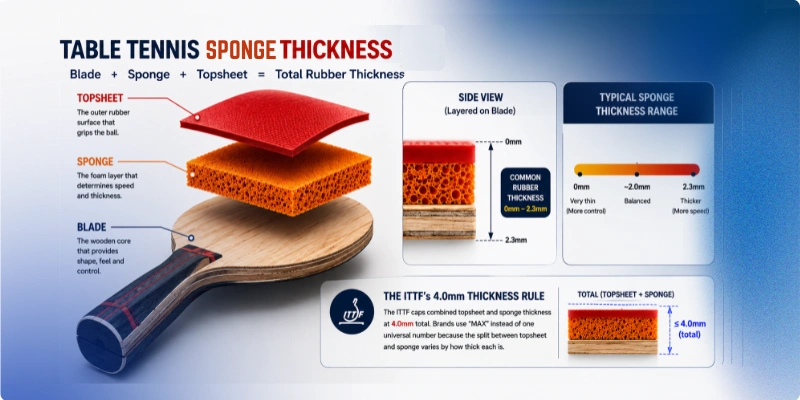
Table of Contents
Quick Answer
Sponge thickness ranges from 0mm (no sponge) to about 2.2–2.3mm, and the ITTF caps topsheet + sponge combined at 4.0mm. On inverted rubber, thicker means more speed and spin but less margin for error; thinner means more control but less power. The logic shifts for pips and antispin.
See the full breakdown by rubber type below, or jump to the skill-level guide if you’re on inverted.
What Sponge Thickness Actually Measures
The sponge is the foam layer between your blade and the rubber’s outer topsheet. It’s not the same thing as rubber thickness, even though the two terms get used interchangeably online. Knowing the difference matters, because product listings often quote one number or the other without saying which. Once you can tell them apart, every spec sheet becomes much easier to read at a glance.
- Topsheet thickness: the thin outer layer that contacts the ball. Fixed by the manufacturer, rarely varies within a single product.
- Sponge thickness: the foam layer underneath. This is the number you’re actually choosing: 1.8mm, 2.0 mm, MAX.
Once you’re clear on which number is which, the rest of this guide will make a lot more sense, starting with the one rule that shapes every sponge on the market.
The ITTF’s 4.0mm Thickness Rule
The ITTF caps combined topsheet and sponge thickness at 4.0mm total. That’s why brands use “MAX” instead of one universal number — the sponge thickness varies depending on how thick the topsheet is. A thinner topsheet allows a slightly thicker sponge, and vice versa, which is why quoted sponge numbers look inconsistent between brands. Same ceiling, different split. If a spec seems off, that’s almost always the explanation.
How Thickness Changes Ball Behavior
Think of the sponge as a trampoline. The ball compresses into it briefly before springing back out. That compression window is called dwell time, and it’s the concept everything else in this guide traces back to. The longer that compression lasts, the more the sponge can do to the ball before it leaves your racket. Understanding dwell time is really the key to understanding every thickness recommendation that follows.
- Thicker sponge: longer dwell time. More energy transfer (speed), more time for the surface to grip and rotate the ball (spin).
- Thinner sponge: shorter dwell time. Less power, less spin, but the ball comes off close to how you intended it to.
Thickness and control move in opposite directions. More dwell time means more reward for a clean stroke, and more punishment for a mistimed one. This is the baseline mechanism, built around how inverted rubber’s smooth surface grips the ball; pips and antispin bend these rules in their own ways, covered later in this guide.
Why Is There a Practical Limit to Sponge Thickness?
You already know about the 4.0mm ITTF rule. What’s less obvious: it’s rarely the actual limiting factor. Two other forces do most of the real limiting, and neither one shows up in the rulebook. Both are worth understanding, since they explain why even unrestricted rubbers wouldn’t keep getting thicker.
- Weight. A 2.2mm sponge on both sides adds real, noticeable mass over a 1.5mm setup, enough to slow your swing and tire your arm over a long match.
- Physics. Past roughly 2.2–2.3mm, no realistic swing generates enough force to fully compress the sponge; any extra material beyond that point is just dead weight, not stored energy.
Between the two, weight is the one you’ll feel first; the physics ceiling only matters once you’re already swinging hard enough to reach it.
Sponge Thickness Chart: What Each Range Actually Does
Every rubber type is covered here at a glance; use this as your quick reference, then read the section below for the reasoning behind each row.
| Rubber Type | Thickness | Feel / Effect | Best For |
|---|---|---|---|
| Inverted | 0.5–1.4mm (Thin) | High control, low power | Beginners, choppers, defensive players |
| 1.5–1.9mm (Medium) | Balanced control and power | Intermediate, all-round styles | |
| 2.0–2.2mm (Thick) | Fast, high dwell time, spin-heavy | Offensive/looping players | |
| MAX (2.2–2.3mm) | Maximum legal speed and spin | Advanced/competitive attackers | |
| Short Pips | OX (no sponge) | Awkward, low-spin, wobbly returns | Hardbat-style control |
| ≤1.5mm | Fast, controlled contact | Blocking, defensive short pips play | |
| 2.0mm+ | Attacking power and dwell time | Active blocks, punches, hits, loops | |
| Long Pips | OX (no sponge) | Maximum spin reversal | Close-to-table blockers |
| 0.5mm | Some self-generated spin, still reversal-friendly | Learning or consistency-focused chopping | |
| 1.0mm+ | Maximum self-generated backspin | Advanced away-from-table choppers | |
| Antispin | Thin | Maximum spin-reversal, less control | Close-to-table disruption |
| Thick | More control, less reversal | Forgiving, defensive setups | |
| ⚡ Thickness affects speed, spin, and control differently depending on rubber type. Choose based on your playing style and skill level. | |||
Does Thickness Mean the Same Thing on Every Rubber Type?
No. Most thickness advice online is written for inverted rubber and quietly assumes that’s what you’re using; switch rubber types and several of those assumptions stop holding. This catches out more players than you’d expect, especially anyone experimenting with pips or antispin for the first time. The chart above gives you the numbers; here’s the reasoning behind them.
1. Inverted
This is the baseline the rest of this guide builds on. Thicker sponge reliably means more speed and spin, since the smooth topsheet grips the ball longer and stores more energy to return. The chart above and the skill-level guide below apply to you directly, no adjustment needed.
2. Short pips
Thickness splits by intent, not level. Attacking with blocks, punches, hits, or loops? Run 2.0mm or thicker. Playing defensively? Stay at 1.5mm or under, since short pips already have less grip than inverted and thinner sponge keeps contact fast and controlled. OX (no sponge) short pips are true hardbats, prized for awkward, low-spin returns.
3. Long pips
The right choice depends on where you stand at the table, not your skill level. Close-to-table blockers should run OX, since no sponge gives maximum spin-reversal. Away-from-table choppers need the opposite; OX can’t generate much spin on its own, so sponge gives that ability back, starting around 0.5mm and moving toward 1.0mm+ for advanced choppers chasing maximum backspin.
4. Antispin
Antispin runs on a dampening sponge, so the trade-off flips from inverted; thinner sponge maximizes spin-reversal, thicker sponge trades some of that for control. One exception: grippier antispin variants can support real attacking play when paired with a thicker sponge, cutting against the usual defensive-only assumption.
If you’re inverted on one side and pips or antispin on the other, don’t carry the same thickness logic across both; each type above is solving a different problem, and what works for one can actively work against the other.
What Thickness Should You Actually Buy?
What actually determines your ideal thickness depends on your rubber type first: swing power for inverted, attacking intent for short pips, table position for long pips, and how much reversal you want for antispin. Use the categories below as a starting point, then trust how a rubber actually feels over what the label suggests you should be using. It’s completely normal to move between categories as your technique develops..
- Beginner (Inverted): 1.6–1.9mm. Not thin. Too thin gives you almost no spin to work with, and you never develop a feel for brushing the ball.
- Intermediate (Inverted): 1.9–2.1mm on your forehand. This is the first real upgrade once your basic strokes are consistent. Keep your backhand slightly thinner.
- Advanced (Inverted): Run MAX on your attacking side once you’re controlling loops confidently at 2.0mm. Keep your other side at 2.0mm or above; most offensive players don’t drop below that even on the backhand.
- Defensive (All types): Stay thin across the board. Inverted at 1.0–1.5mm. Short pips at 1.5mm or under. Long pips at OX or 0.5mm. Antispin thin.
- Short Pips Attacker: Run 2.0mm or thicker. The extra dwell time rewards offense the same way it does on inverted. Drop to 1.5mm or under for blocking.
- Long Pips Chopper: Start at 0.5mm if you’re learning or prioritizing consistency. Push to 1.0mm or beyond if you’re advanced and chasing max backspin.
- Antispin User: Go thin for maximum disruption and reversal. Go thicker for more control if you’re willing to trade some unpredictability for safety.
None of these categories are permanent; as your role, table position, or technique changes, it’s normal to move between categories, or even between rubber types entirely.
Common Sponge Thickness Mistakes to Avoid
Even players who’ve read through the sections above still trip on a few of these in practice. None of them are expensive to fix, but they’re worth catching before you buy. Overlooking these details is the difference between a setup that clicks and one that sits in your bag collecting dust, so read carefully before your next purchase.
- Buying MAX because it sounds like the best option. Thickness isn’t a quality tier; it’s a tool for a specific stroke style. A beginner on MAX is usually just fighting their own equipment.
- Comparing quoted mm numbers directly across brands. The 4.0mm cap means two rubbers with different sponge thicknesses can still have similar total feel; don’t assume bigger is automatically thicker.
- Ignoring how thickness pairs with hardness. A thick, soft sponge behaves nothing like a thick, hard one. (Covered fully in our [Sponge Hardness Guide].)
- Applying inverted-rubber thickness logic to pips or antispin. Thicker is faster for inverted, backwards for antispin, and table-position dependent for long pips; carrying one rule across all four is a common mistake.
Catching these early saves you from buying a rubber that looks right on paper but never quite feels right on the table.
Final Thoughts
The number on the box matters less than what your stroke can actually do with it, and less than what rubber type it’s printed on. Getting your table tennis sponge thickness right isn’t about chasing the biggest number; it’s about matching it to your technique and your rubber type. If you’re on inverted and still unsure where to start, 1.8mm is the safest default across skill levels; enough thickness to feel real spin, without punishing you for a swing that’s still developing. If you’re on pips or antispin, your starting point comes from your role in a rally, not a single universal number. Treat your first choice as a starting point, not a permanent decision; most players adjust at least once as their table tennis sponge thickness needs change. Whatever you land on, the goal is a setup you stop thinking about mid-rally.
FAQ
Can you use different thicknesses on each side?
Yes, common at intermediate level and above. Thicker on your attacking side, thinner or medium on the other, for control. No ITTF rule against mixing, as long as each side stays under the 4.0mm combined limit and the sides are visually distinguishable (red/black).
What thickness do professional players use?
Most professional offensive players run MAX on their primary attacking side with something thinner on the other for control, built on years of technique suited to handling that much stored energy, not a beginner reference point.
What’s the real difference between MAX and 2.0mm sponge?
MAX, typically 2.1mm to 2.3mm, stores and returns more energy on a hard swing, giving a higher speed and spin ceiling. 2.0mm gives up a little of that ceiling for a more direct, predictable feel that’s easier to control on a moderate swing. Neither is universally better; MAX rewards a faster, more committed stroke, while 2.0mm is more forgiving of a slightly slower or less consistent one.
Does sponge thickness affect how long rubber lasts?
Not directly. Lifespan is driven more by tackiness degradation and surface wear than thickness. See our [Rubber Lifespan guide] for what actually shortens usable life.
Please Write Your Comments