All-Wood vs Carbon Blades in Table Tennis: Which Fits Your Playstyle
Updated: August 14, 2026
925
Ever feel like your table tennis game is missing a key edge that could take your shots to the next level? Step up your game with the best table tennis blade for your style!
The blade you choose for your table tennis racket can make a world of difference, affecting your speed, control, and overall playing style. Among the most debated choices are all-wood vs carbon blades, each offering distinct advantages depending on how you play. Do you crave speed and power with a carbon table tennis racket like Butterfly’s Viscaria, or do you prioritize control and spin with a wooden table tennis racket like the Petr Korbel? Understanding these differences is key to refining your game.
This article breaks down the key differences between all-wood and carbon blades, their specs, covers the ITTF rule that shapes how every blade is actually built, and compares real blades, including models used by pros like Fan Zhendong, Xu Xin, and Ma Long, so you know exactly which one fits your style.
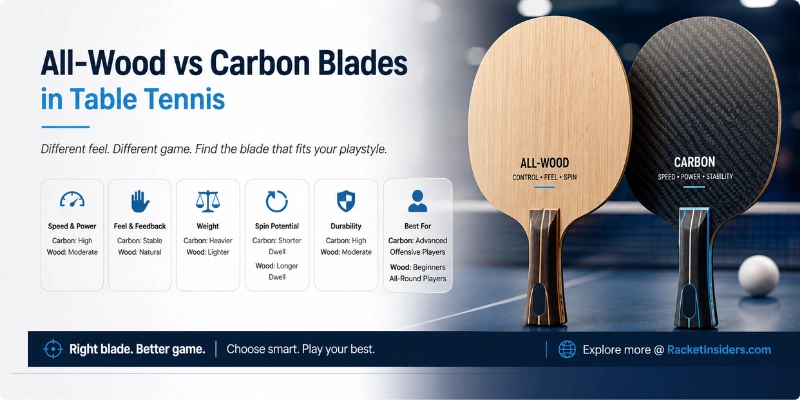
Table of Contents
Table Tennis Blade: What It’s Actually Made Of
A table tennis blade is the core of a table tennis racket, forming the foundation for the rubber and playing a crucial role in a player’s control, speed, and spin. Every blade is built from multiple layers, or plies; typically 5 or 7, and those layers determine how the blade performs before any rubber is even attached.
An all-wood blade is built purely from wood plies, while a carbon blade sandwiches one or two fiber layers between the wood; the wood itself never fully disappears from either type. That distinction is the foundation for everything else in this guide. For the full picture beyond just the blade, see our complete guide to the table tennis racket.
The ITTF Wood Rule: Why Carbon Rarely Means Pure Carbon
The ITTF regulates how much non-wood material a legal blade can contain, which is why a true all-carbon blade doesn’t exist. Every blade on the market, carbon included, is still mostly wood. In practice, a carbon blade really means a wood-and-fiber hybrid, and the specific fiber used isn’t always generic carbon either. The key facts:
- Minimum wood content: at least 85% of the blade’s thickness must be natural wood.
- Maximum non-wood material: less than 7.5% of thickness or 0.35mm (whichever is smaller),
- Common ply combinations: 5 wood + 2 fiber layers, or 3 wood + 2 fiber layers.
- Common fiber types: Arylate-Carbon (ALC) and Zylon-Carbon (ZLC), rather than generic carbon sheet.
This is also why carbon blades are sometimes labeled composite blades instead; the name reflects the specific fiber used, not a pure-carbon construction. For more on the body behind these regulations, see our overview of the International Table Tennis Federation (ITTF).
All-Wood vs Carbon Blades: The Two Core Types, Explained
Now that you know what actually goes into a blade, it’s time to look at the two types themselves, where they diverge, and what that means for how each one plays. The construction basics are the same across both, but the choices made within that structure are what end up defining your entire game on the table.
1. Carbon Table Tennis Blades: Speed, Power & Stability
Carbon blades incorporate thin fiber layers, usually sandwiched between wooden plies, to boost stiffness, speed, and power. The exact feel varies from model to model depending on where the fiber layer sits and which specific composite is used, so two carbon blades can play quite differently from one another. Butterfly’s Viscaria and Timo Boll ALC are two of the most widely used examples on the professional circuit, and several of the sport’s top players, including world No. 1 Fan Zhendong, Xu Xin, and Ma Long, compete on carbon blades from Butterfly’s signature lineups. See our Fan Zhendong Blades guide for a full breakdown of one such lineup.
Key Characteristics
- Feel: Stiff and stable, with minimal vibration
- Speed: High, built for fast attacking play
- Best for: Advanced, offensive players
Pros
- Higher speed and power, ideal for aggressive attacks and counter-loops.
- Larger sweet spot and more consistent feedback during fast rallies.
- More durable, holding up better under heavy competitive use.
Cons
- Harder to control, especially for beginners or less experienced players.
- Reduced touch sensitivity, making delicate pushes and short game shots harder.
- More expensive than most all-wood blades.
Overall, carbon is the category to reach for once speed starts mattering more than pure control. It’s worth remembering that a carbon blade won’t fix inconsistent technique on its own. It simply amplifies whatever habits, good or bad, you already bring to the table. To see carbon blades in action, check out our breakdown of Fan Zhendong’s equipment setup.
2. All-Wood Table Tennis Blades: Control, Feel & Spin
All-wood blades are built entirely from natural wood, typically five to seven plies glued together. The exact ply count and wood selection still shift how a given all-wood blade plays, even without any fiber layer involved, so not all wood blades feel alike either. As with carbon, we break down full specs for individual all-wood blades in their own dedicated reviews. Butterfly’s Korbel is one of the most established examples still in wide use today, and several professionals, including Kristian Karlsson, Tibhar Lebesson, and Miu Hirano, compete at the top level on all-wood blades, purely down to personal preference.
Key Characteristics
- Feel: Soft, with natural feedback
- Speed: Moderate, control-focused play
- Best for: Beginners and all-round players
Pros
- Excellent control, ideal for precise placement and tactical play.
- Natural feedback that helps beginners learn proper technique faster.
- Better spin generation thanks to longer ball dwell time.
Cons
- Slower speed, less suited to fast, aggressive rallies.
- Lower stiffness, which limits power on weaker strokes.
- Wears faster than carbon under heavy use.
Overall, all-wood remains the category to start with while technique is still being built. Even many advanced players eventually return to all-wood for its consistency and feel, so it’s rarely a blade you truly outgrow, just one you may set aside for a while.
Both types share the same core job: moving the ball, but everything about how they do it, from feel to speed to price, diverges sharply from here. The next section breaks down exactly where.
All-Wood vs Carbon Table Tennis Blades: Key Differences
Beyond the basic pros and cons, five specific factors drive nearly every practical difference between the two blade types. Understanding how each one shifts between carbon and all-wood makes it much easier to predict how a given blade will actually feel in your hand, rather than relying on the carbon = fast, wood = control shorthand alone.
1. Speed and Power
This is often the first difference players notice on the table. Carbon’s added stiffness transfers energy more efficiently off the blade face, producing faster, harder shots with less effort from the player; all-wood trades that speed for superior control and precision, requiring a bit more input to generate the same pace.
2. Feel and Feedback
This is where the two blade types feel most different in hand. Carbon dampens vibration on contact for a more direct, stable feel that many advanced players prefer during fast exchanges; all-wood keeps that vibration intact, giving richer, more natural feedback that makes it easier to sense a well-struck ball.
3. Weight
Weight is a small difference on paper, but it changes how the blade swings. Carbon blades run slightly heavier due to the added fiber layers, which helps stabilize powerful strokes; all-wood blades stay lighter, favoring the quick wrist movement needed for close-to-table play.
4. Spin Potential
Dwell time is the hidden factor driving this difference. All-wood’s longer ball dwell time makes spin generation more intuitive, especially for developing players; carbon’s shorter dwell time still allows fast, dangerous spin, but it typically takes more technique to produce consistently.
5. Durability
This becomes more relevant the more often you play. Carbon holds up better over the long-term, high-frequency use thanks to its fiber reinforcement; all-wood can wear and soften faster under heavy competitive play, so it may need replacing sooner.
Together, these five factors explain why neither blade type is definitively better, just better suited to different players. These factors are also exactly what the comparison table below condenses into a single, scannable view. If rubber choice interests you as much as blade construction, see our comparison of Red vs black table tennis rubber.
Carbon vs All Wood Table Tennis Blades: A Quick Comparison
For a faster read, here’s everything above condensed into one side-by-side view. Use it to quickly check which blade type lines up with your priorities. Come back to it any time you’re deciding between two specific blades.
| Feature | Carbon Table Tennis Blade | All-Wood Blade / Wooden Table Tennis Racket |
|---|---|---|
| Speed & Power | High speed and stiffness for aggressive, fast-paced play | Moderate speed, slower but offers precise control |
| Feel & Feedback | Less vibration, stable performance for offensive players | Soft, natural feel with excellent touch and feedback |
| Weight | Slightly heavier, adds stability and power | Lighter, easy to maneuver for quick wrist movements |
| Spin Potential | Fast spins possible, though dwell time is shorter | Better spin generation due to flexibility and longer dwell time |
| Durability | Highly durable, long-lasting for competitive play | Moderate durability, can wear faster under heavy use |
| Best For | Offensive, aggressive, and advanced players | Beginners, defensive, and versatile all-around players |
With the side-by-side view in hand, the next step is matching it to your own skill level and playing style. Looking for spin specifically? See our picks for the best table tennis racket for spin.
Which Table Tennis Blades Should You Choose?
With the differences laid out, the actual decision comes down to matching the blade to where you currently are as a player, not to which type sounds more impressive. Skill level is the single biggest factor, though playing style narrows it down further within each level.
1. Beginners
This is the stage where fundamentals matter most. Beginners benefit most from all-wood blades; the control and natural feedback make it easier to learn proper technique before speed becomes a factor, and the forgiving feel helps build consistent strokes early on.
2. Intermediate players
This is the stage where personal style starts to take shape. Intermediate players can start experimenting with carbon, since the added speed supports a more offensive style while enough control remains to keep refining technique, especially once looping starts to feel consistent.
3. Advanced and competitive players
This is the stage where speed and consistency both matter. The advanced and competitive players typically prefer carbon for its speed, stability, and durability during fast, sustained rallies, since their technique is already developed enough to control the extra pace.
As covered above, ITTF rules mean every blade, carbon included, is still mostly wood. So the real decision isn’t wood or carbon, so much as how much fiber reinforcement fits your game. Whichever level you’re at, it’s worth revisiting this choice as your technique develops rather than treating it as permanent. Not ready to build a custom setup? Browse our roundup of the best pre-made table tennis rackets.
Final Thoughts
The all-wood vs carbon decision comes down to your playing style, skill level, and personal preference. All-wood blades excel in control, feel, and spin; ideal for beginners and all-round players who value consistency. Carbon blades offer greater speed, power, and stability, suiting aggressive and advanced players who rely on fast attacks and counter-loops. And with the ITTF’s wood-content rule shaping every blade on the market, the choice really comes down to how much fiber reinforcement matches your game. Test different options where you can, and pick the blade that helps you play with confidence and control.
For more hands-on advice once you’ve picked a blade, check out our table tennis tips.
FAQ
Are carbon blades better for table tennis?
Carbon blades offer higher speed and power, making them well-suited to aggressive, offensive players. Beginners typically find all-wood blades easier to control while they’re still building technique.
Is carbon fiber better than wood for table tennis blades?
Carbon fiber adds stiffness and speed, giving carbon blades an edge for fast-paced play. Wood provides better control, spin, and feedback, making it ideal for beginners and precision-focused players.
Which blade material is best for my playing style?
Offensive players often prefer carbon for power, while defensive or all-around players may choose wood for precise placement and enhanced spin.
Are there any table tennis blades made entirely of carbon?
No. ITTF regulations require every blade to be at least 85% natural wood by thickness, so what’s marketed as a “carbon blade” is always a wood-and-fiber hybrid, not a pure carbon construction.
Please Write Your Comments