Red vs Black Table Tennis Rubber: Is There Really a Difference?
Updated: August 1, 2026
138
Every legal table tennis racket has one red side and one black side, but does that color actually change how the rubber plays, or is it just a rule with no real bite behind it? It’s a question that deserves a straighter answer than most guides give it.
It’s one of the most debated, half-answered questions in the sport. Some players swear the two sides feel completely different, faster off red, grippier off black, while others insist any difference is placebo, a rule with zero real performance consequence attached to it. Is there really a difference, or is the whole debate just table tennis folklore? The honest answer lies somewhere in between and depends far more on the specific rubber than on the color itself.
In this guide, we break down red vs black table tennis rubber, explaining when it matters and when it doesn’t, and give you the practical advice you need to choose the right setup for your game.
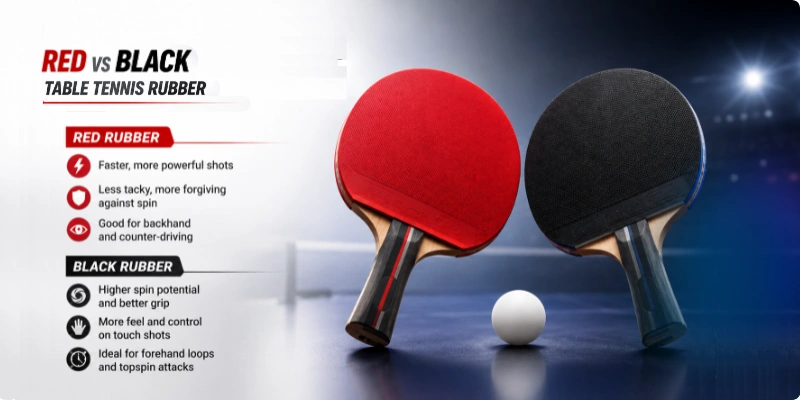
Table of Contents
Does Rubber Color Ever Really Matter?
How much color changes a rubber’s feel varies from product to product, not from color as a universal rule. Manufacturers dye and finish red and black sheets slightly differently, and how noticeable that is depends heavily on the rubber’s underlying construction. That means the honest answer is sometimes rather than a flat yes or no.
- On tacky, high-grip rubbers, the red/black difference is real, measurable, and widely reported by players who’ve used both versions of the same product
- On standard inverted rubbers, the difference between red and black is often close to insignificant, sometimes not noticeable at all
- Some manufacturers deliberately engineer both colors to play identically, closing the gap entirely on purpose
- A small amount of the perceived difference is genuinely psychological; players expecting a difference sometimes report one even when testing shows the rubber performs the same
The practical rule: take the color seriously on tacky rubbers; on standard inverted sheets, just pick whichever side you want the color on. For more on rubber types and specs, see our table tennis rubber guide.
The Official ITTF Two-Color Rule for Rackets
Every racket needs one red rubber surface and one black rubber surface; this is an ITTF requirement, not a style choice. It applies to every legal racket used in sanctioned play, from local club matches up to the Olympics, and equipment that doesn’t meet it simply isn’t tournament-legal.
The rule wasn’t always in place, and it exists for a practical reason rather than tradition. Mismatched rubbers once let players disguise their shots, and the ITTF stepped in to close that gap.
- One side must be black, the other a clearly contrasting color; no exceptions for matching colors
- The rule exists to stop players from disguising which rubber struck the ball
That covers the legal side; this article covers what the rule doesn’t answer, whether the color itself changes performance. For the full history, see our breakdown on why table tennis rackets have red and black sides.
Red Rubber: Characteristics, Pairings, and Who Uses It
Red rubber has a reputation for being the faster, harder-hitting option. It’s generally less tacky, trading spin for raw speed and power, and the dye used in manufacturing tends to firm up the top sheet slightly.
There’s also a visual side effect worth knowing about. Black rubbers tend to be fully opaque, while red is often translucent enough to show the sponge underneath, and some players use that lower contrast against the ball for serve deception.
Pros
- Faster, more powerful shots out of the box
- Less tacky, so it’s more forgiving against heavy incoming spin
- Slightly reduced visual contrast with the ball, useful for serve deception
- Well suited to backhand blocking and counter-driving
Cons
- Lower spin ceiling compared to black on the same rubber line
- Less grip means less margin on touch shots
- Some players find it feels slicker and less controllable
Red rubber is most commonly found on the backhand side, especially among players who prioritize a firm, fast block or counter-drive over heavy spin generation. It’s also a common default for beginners simply because most starter bats ship with red as the primary side.
Black Rubber: Characteristics, Pairings, and Who Uses It
Black rubber has the opposite reputation, and it’s backed by a genuinely large body of player testimony. It’s generally softer and tackier than red, and that tackiness holds its grip longer over time.
This is precisely why black is the near-universal forehand choice among top Chinese players; it’s tackier, holds grip longer, and gives more feel on extended rallies. It’s a real, brand-dependent physical property, not superstition.

Pros
- Higher spin ceiling, especially on tacky Chinese-style rubbers
- Tackiness lasts longer across a session
- Preferred by the majority of elite forehand loopers
- Slightly better feel on extended, high-spin rallies
Cons
- Slightly less raw speed than red on the same rubber line
- Tackiness can degrade the playing surface faster if not cared for
- Marginally more expensive on some premium Chinese rubber lines
Black rubber is most commonly found on the forehand side, particularly among attacking and looping players who rely on spin generation as their primary weapon. See what equipment Fan Zhendong plays on his forehand for a real-world example.
Red vs Black Rubber: Key Performance Differences
Put the two rubbers side by side, and the pattern that emerges across nearly every major table tennis community and manufacturer discussion is remarkably consistent. Each of these differences traces back to how the dyeing and finishing process treats the top sheet during manufacturing. Here’s how the two compare, point by point.
▸ Speed off the blade
Red rubber tends to play faster out of the box, since a firmer top sheet lets the ball come off with less absorption. The black rubber, by contrast, plays slightly slower but generates more grip-driven power on contact.
▸ Spin Generation
Black rubber holds the edge here almost universally, since its tackier surface grips the ball longer through the stroke for more rotation, while red trades that extra grip for a firmer, quicker release off the sheet.
▸ Consistency across Brands
The gap is real but not universal, nearly insignificant on most European and Japanese inverted rubbers, more noticeable on tackier Chinese rubbers where the dyeing process affects the sheet more heavily.
▸ Feel and Touch
Black offers a slightly grippier, more tactile contact that many players say helps with touch shots, while red feels crisper and closer to a pure, direct bounce off the blade.
▸ Durability and Upkeep
The black holds its tack longer but picks up dust and residue faster, so it needs more frequent cleaning to keep performing well; red is lower-maintenance but tends to lose its initial pop a bit sooner.
One practical note: none of these differences are large enough to override technique or rubber type as the bigger factor in how you play; color is a fine-tuning choice, not a foundational one. Since color-driven differences are only part of the picture, the rubber line itself matters more. See our best table tennis rubbers guide to find one that fits your game.
Red vs Black Rubber: Full Comparison Table
Rather than digging back through every section above, this table pulls the key differences into one place so you can compare red and black at a glance and decide which side fits your game.
| Feature | Red Rubber | Black Rubber |
|---|---|---|
| Speed | Generally faster | Slightly slower |
| Spin potential | Lower | Higher |
| Tackiness | Less tacky | More tacky, lasts longer |
| Feel | Firmer, crisper | Softer, grippier |
| Visual contrast (ball) | Lower, useful for deception | Higher, easier to read |
| Best paired with | Backhand, blocking, counter-driving | Forehand, looping, spin-heavy play |
| Difference most noticeable in | Chinese tacky rubbers | Chinese tacky rubbers |
| Difference least noticeable in | European/Japanese inverted rubbers | European/Japanese inverted rubbers |
| ⚡ Red and black rubbers have subtle differences in performance — choose based on your playing style and preference. | ||
Which Should You Actually Choose?
With the performance differences and trade-offs laid out, the choice usually comes down to your playing style and which side of the racket you’re outfitting. Use the breakdown below as a starting point, then adjust based on the specific rubber line you’re considering.
▸ Choose black if:
You’re a looping, spin-focused attacker, especially on your forehand, and you play a rubber line known for a real red/black gap, like Chinese tacky rubbers.
▸ Choose red if:
You want a firmer, faster response, especially on your backhand for blocking and counter-driving, or if you’re using a European/Japanese rubber where color performance differences are minimal anyway.
▸ Don’t overthink it if:
You’re a beginner or intermediate player on a standard inverted rubber. At that level, technique and rubber type (not color) will affect your game far more than which side is red versus black.
One practical note: since ITTF only requires one red and one black side, you’re never locked into black on forehand as a rule; it’s a convention built on real (if rubber-dependent) physical properties, not a requirement. Plenty of excellent players run the reverse setup successfully. Still working out the rest of your setup? Check our table tennis racket guide.
Final Thoughts
The red vs black table tennis rubber debate isn’t a myth, but it’s also not the universal rule some players treat it as. The honest picture: color-driven differences are real and worth caring about on certain rubber lines, especially tacky Chinese sheets, and close to irrelevant on most standard inverted rubbers.
If you take one thing from this, it’s to stop asking which color is better and start asking: does this specific rubber play differently in red versus black? Since that’s the question that actually has a useful answer.
Before you settle on a color, make sure you’ve picked the right pip style. See our in-depth guide on Long pips vs Short pips rubber to compare speed, spin, and control.
FAQs
Is red or black table tennis rubber better?
Neither is universally better. Red tends to be faster with less spin; black tends to be tackier with more spin, but the size of that difference depends heavily on the specific rubber line, not color as a general rule.
Why do Chinese players use black on their forehand?
Because black rubber on Chinese-style tacky sheets holds grip longer and produces more spin, which suits the forehand loop-heavy style most Chinese players build their game around.
Does rubber color affect ball visibility for opponents?
Slightly. A white or orange ball shows less contrast against red rubber than against black, which some players use as a subtle serve-deception tactic.
Can I use black on both my forehand and backhand?
No. ITTF rules require one side to be black and the other a clearly contrasting color. Red is the traditional and most common choice, but since 2021, blue, green, pink, and purple are also officially approved alternatives to red; black must still be on the other side either way.
Is the red/black difference the same across all brands?
No. It’s most noticeable on tacky Chinese rubbers and often close to unnoticeable on standard European or Japanese inverted rubbers.
Please Write Your Comments