Fan Zhendong vs Harimoto: Who Really Won This Rivalry?
Updated: June 16, 2026
416
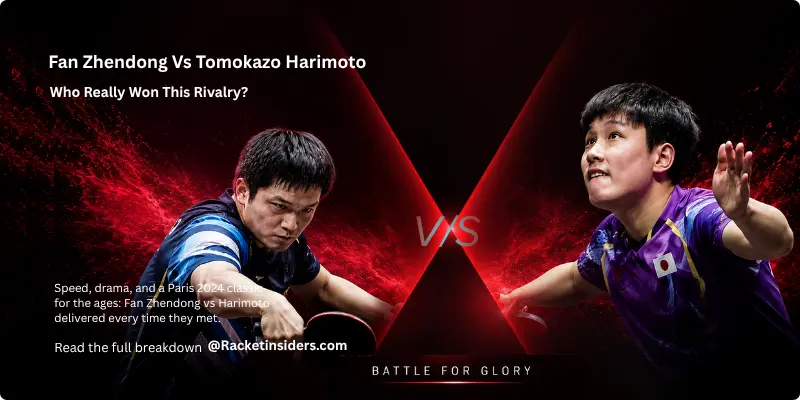
Two players. Two countries. Six years of electric table tennis. One rivalry that refused to stay calm, even when the world expected it to fade. From the ITTF Asian Cup to the Paris Olympics, Fan Zhendong vs Harimoto delivered drama at every turn.
Fan Zhendong, China’s Olympic champion and Grand Slam legend, and Tomokazu Harimoto, Japan’s teenage prodigy turned world number three, have produced some of the most gripping matches the sport has ever seen. From the 2018 Asian Cup, where a 14-year-old Harimoto shocked the world, to the Paris 2024 Olympic quarterfinal that went the full seven games, these two have never given fans a dull moment. Every rally feels like a chess match played at sprinting speed.
This is the full breakdown of Fan vs Harimoto’s head-to-head record, playing styles, career achievements, key clashes, ITTF and WTT results, and what this rivalry means for the future of table tennis.
For a complete overview of Fan’s career, read our: Fan Zhendong: A Complete Profile, Stats, Career & Legacy.
Table of Contents
At a Glance: The Numbers Behind the Fan vs Harimoto Rivalry
Fan Zhendong leads the head-to-head, but the margins are smaller than most people realise. Harimoto is the only active non-Chinese player who has consistently pushed Fan to the limit across multiple years. The numbers below tell the story of two elites operating at the very top of world table tennis.
Who Are Fan Zhendong and Tomokazu Harimoto? The Quick Profiles
To understand the rivalry, you first need to understand the men behind it. Fan Zhendong represents the gold standard of Chinese table tennis: technically complete, mentally unshakeable, and decorated with every major title the sport offers. Tomokazu Harimoto represents the new wave: young, fearless, and built to challenge the established order. Here is how their careers and credentials compare side by side.
| Category | Fan Zhendong | Tomokazu Harimoto |
|---|---|---|
| Date of Birth | 22 January 1997 | 27 June 2003 |
| Birthplace | Guangzhou, China | Sendai, Japan |
| Nationality | Chinese | Japanese |
| Nickname | “Xiao Pang” (Little Fatty) | — |
| Playing Style | Right-handed, shakehand | Right-handed, shakehand |
| Height | 173 cm (5 ft 8 in) | 178 cm (5 ft 10 in) |
| Highest ITTF Ranking | No. 1 (April 2018) | No. 2 (November 2022) |
| ITTF Ranking (May 2026) | Withdrawn | No. 3 |
| Olympic Singles Medal | Gold (2024), Silver (2020) | None yet |
| World Championships Singles | 2021, 2023 | Best: Quarterfinal |
| World Cup Singles | 2016, 2018, 2019, 2020 | Best: Semifinal |
| Grand Slam | Yes | No |
Fan Zhendong held the world number one ranking from April 2018, stayed in the top three for over a decade, and won Olympic gold at Paris 2024, becoming the sixth male Grand Slam champion in history. Tomokazu Harimoto, born in Sendai to Chinese professional parents, became a Japanese citizen in 2014. At 14, he won the Czech Open, breaking Fan’s ITTF youngest-winner record, then won the World Tour Grand Finals at 15, again the youngest ever. As of May 2026, he sits at world number three and remains the most dangerous active challenger outside China. Fan’s journey from teenage prodigy to Grand Slam champion is a story worth knowing: Fan Zhendong Grand Slam: How He Became the Sixth Man in History to Achieve It.
Playing Styles: Where They’re Similar and Where They Diverge
On the surface, they share a profile: both play right-handed shakehand, both attack from the outset, and both possess devastating backhand games. Go deeper, though, and the differences matter a great deal. Fan’s game is built on structure and patience. Harimoto’s on speed and disruption. One waits for the opponent to break. The other tries to break before the rally starts. Let us break down exactly how each player operates.
1. Fan Zhendong: The Complete Package
Fan Zhendong did not become a Grand Slam champion by accident. Every element of his game applies pressure while leaving minimal openings for his opponent. If you want to understand why he has dominated this rivalry, start here. Here is what makes him so complete.
1.1 Forehand topspin
One of the most powerful in the sport’s history. Generated through explosive hip rotation and immaculate footwork, Fan can loop a winner from almost any position on the table. When he connects cleanly, even the best defenders can only watch the ball fly past.
1.2 Backhand attack
Equally dangerous. He attacks with the backhand early in rallies and redirects pace with precision that most players cannot match. This shot keeps opponents guessing because they never know whether he will go cross-court or down the line.
1.3 Footwork
Elite-level court coverage. Fan covers mid-to-wide angles better than almost anyone, and his recovery speed between shots is exceptional. This allows him to turn defensive positions into attacking opportunities within a single rally.
1.4 Serve variation
His reverse pendulum serve is particularly difficult to read, generating unpredictable spin combinations that disrupt opponents’ return rhythms. Many of his easiest points come directly from weak returns off this serve.
1.5 Mental strength
Arguably, his greatest asset. The Paris 2024 quarterfinal, where he was two games down and 3-2 down against Harimoto, is the clearest proof. He adjusted mid-match and won the last two games 11-7, 11-7. Few players in history could have survived that storm and still found a way to win.
Want to break down Fan’s technique in more detail? Start here: Fan Zhendong Playing Style: Key Techniques, Strategies & Lessons for Players.
2. Tomokazu Harimoto: Speed and Backhand Terror
If Fan represents the traditional Chinese ideal, Harimoto represents something new. He plays closer to the table than almost anyone. He takes the ball earlier than logic suggests is safe. Here is how his unique approach creates problems that even Fan struggles to solve.
2.1 Close-to-table backhand
His most feared weapon. Harimoto attacks right off the bounce, staying closer to the table than virtually any other top player, including the Chinese stars who define that style. This dramatically compresses the opponent’s reaction time.
2.2 Backhand flick
His go-to attack on short balls. Harimoto trusts his backhand flick to initiate play aggressively from the very first exchange in a rally. When it is working, he can win three or four points in a row before his opponent even finds a rhythm.
2.3 Rally tempo
He plays faster than almost anyone alive. Against slower-paced opponents, this is crushing. Against Fan, it creates genuinely difficult exchanges, as Paris 2024 demonstrated. The moment Harimoto slows down, he loses his biggest advantage.
2.4 Forehand
Strong and improving, though historically considered slightly less dominant than his backhand. He sets up patterns with the backhand and finishes with forehand topspins when the angle opens. If his forehand ever catches up to his backhand, he becomes a completely different level of threat.
2.5 Fighting spirit
Harimoto does not fold under pressure. In Paris, he was 3-2 up against Fan with everything on the line. Even after losing the sixth game, he took Fan to 7-7 in the seventh before the champion’s quality finally showed.
As Harimoto said after that match:
In the last two sets you saw the quality that Fan had. He had the slight edge over me.
When you put these two styles side by side, one thing becomes clear. Fan wins when the rally extends beyond five shots. Harimoto wins when he can end the point inside the first three or four. That is why their matches are so tense. Every rally is a race. Fan wants time. Harimoto wants to steal it. The player who controls the rally length almost always controls the result.
Tactical Scorecard: Who Wins and Why
Numbers only tell half the story. The head-to-head record tells you Fan leads 3-1. But it does not tell you why. That answer lives in the tactical details: who controls the rally length, who wins the backhand exchanges, who handles pressure better. This scorecard breaks down exactly where each player holds the edge, factor by factor.
The equipment behind Fan’s game: Fan Zhendong Equipment: Blade, Rubbers & Full Setup (2026)
Who Is Better at the Same Age?
Numbers do not exist in a vacuum. Age changes everything. A 16-year-old Harimoto beating a 16-year-old Fan is not the same as a 22-year-old Harimoto facing a 29-year-old Fan. Comparing players at the same age cuts through the noise and shows who was further along in their development. This section answers the question fans love to ask.
- At 16 years old, Harimoto had 5 World Tour titles plus 1 Grand Final title. Fan had 2 World Tour titles. But Chinese players have fewer international opportunities at that age.
- At 22 years old, Fan had multiple World Cup titles and a World Championship final appearance. Harimoto has an Asian Championship gold and multiple WTT titles.
Fan peaked later but peaked higher. Harimoto is still climbing. The question is not who was better at the same age. It is who will have the better career when both are done. That answer is still being written.
Head-to-Head Record: All Verified Senior Singles Matches
The tactical scorecard shows why each player holds the edge. But the scoreboard tells the final story. Here are the key documented results between Fan Zhendong and Tomokazu Harimoto in the senior singles competition. Each match tells its own story, from Harimoto’s breakout win in 2018 to Fan’s legendary comeback in Paris.
The overall tally across all verified senior singles meetings: Fan Zhendong 3 wins, Tomokazu Harimoto 1 win.
Career Achievements: How Their Legacies Stack Up
Titles define legacies. Fan Zhendong has collected almost every major trophy the sport offers. Tomokazu Harimoto is still building his collection. But numbers alone do not tell the full story. This section breaks down what each player has won, when they won it, and what it means for their place in table tennis history.
1. Fan Zhendong
Fan Zhendong’s trophy cabinet is among the most decorated in table tennis history. He has won everything that matters, often more than once. His Olympic gold in Paris 2024 completed a journey that started with a World Tour Grand Finals win at 16. Here is what he has achieved.
- Olympic Men’s Singles Gold: Paris 2024
- Olympic Men’s Team Gold: Tokyo 2020, Paris 2024
- Olympic Men’s Singles Silver: Tokyo 2020
- World Championships Singles: 2021 (Houston), 2023 (Durban)
- World Cup Singles: 2016, 2018, 2019, 2020 (four titles)
- ITTF World Tour Grand Finals: 2013 (youngest winner at that time)
- ITTF World No. 1: April 2018, held for over 50 months total
- Grand Slam completed: 6th male player in history
2. Tomokazu Harimoto
Tomokazu Harimoto’s career is still being written. He does not have the same number of trophies as Fan. But he has records Fan does not. Youngest World Tour winner. Youngest Grand Finals winner. And a growing list of scalps that includes Fan himself. Here is what he has achieved so far.
- Olympic Men’s Team Bronze: Tokyo 2020
- Asian Table Tennis Championships: 2024 (first Japanese winner in 50 years)
- ITTF World Tour Men’s Singles: youngest winner ever (Czech Open, 2017, age 14)
- ITTF World Tour Grand Finals: 2018 (youngest winner ever, age 15)
- ITTF Career-high world ranking: No. 2 (November 2022); current ranking: No. 3 (May 2026)
- WTT Champions Yokohama 2025: defeated Wang Chuqin 4-3 in the final
- WTT Finals Hong Kong 2025: defeated Truls Moregard 4-2 in the final
The gap in major titles is significant. Fan has Olympic, World Championship, and World Cup gold. Harimoto has none of the three. But age changes the picture. Fan is 29. Harimoto is 22. At 22, Fan hadn’t won a World or Olympic singles title either. Harimoto still has time. To see how Fan finally broke through and became a two-time World Champion, check out our guide on Fan Zhendong’s World Championship.
The Match That Defined Everything: Paris 2024 Olympic Quarterfinal
Every great rivalry has one match that stands above the rest. For Fan Zhendong and Tomokazu Harimoto, that match is the Paris 2024 Olympic quarterfinal. The stakes could not have been higher. The result could not have been closer. This was not just a match. It was a statement.
- Date: August 1, 2024
- Event: Olympic Games Paris 2024, Men’s Singles Quarterfinal
- Winner: Fan Zhendong 4-3
- Game scores: 2-11, 9-11, 11-4, 11-7, 4-11, 11-7, 11-7
Watch the decisive moments from this historic quarterfinal in this 12-minute highlight reel, including the final 4-point run from 7-7 in the decider:
Wang Chuqin had already been eliminated. If Fan lost, China would have failed to win a singles medal for the first time in Olympic history. Harimoto came out firing, won the first two games, and pushed the match to a decider. At 7-7 in the seventh, Fan scored four straight points to seal it. The ITTF called it a contest where “both players showcased exceptional skill and determination.”
After the match, Harimoto admitted, “In the last two sets, you saw the quality that Fan had. He had the slight edge over me.”
Fan’s comeback was not luck. He tightened his return game, cut out risky backhands, and forced Harimoto into longer rallies where his footwork and consistency gave him the edge. It was a masterclass in match management under maximum pressure. How Fan trains to handle pressure like that: Fan Zhendong Training Routine: Drills, Diet & Pro Secrets.
Where Things Stand Now
Nothing stays the same in table tennis. Players evolve. Careers shift. The Fan vs Harimoto rivalry has entered a new phase. One player has stepped away from the international stage. The other is still climbing toward his peak. Where they go from here will define how this rivalry is remembered. Here is where both stand today.
1. Fan Zhendong: Stepping Back
Fan Zhendong’s international career has reached a pause. The weight of Paris 2024, combined with new WTT regulations, proved too much to carry forward. Here is what has changed.
- Withdrew from ITTF World Rankings in December 2024, citing new WTT fine regulations as unworkable following the psychological toll of the Paris Olympic cycle.
- The Chinese Table Tennis Association officially confirmed his withdrawal on December 31, 2024, alongside Ma Long and Chen Meng.
- May still compete in domestic Chinese competitions, but his ITTF career is effectively complete.
2. Tomokazu Harimoto: Still Climbing
While Fan steps back, Harimoto keeps moving forward. He has never been more dangerous than he is right now. Here is where he stands.
- Sits at world number three as of May 2026 and remains active on the international circuit.
- Has begun winning major titles against the best of the current Chinese generation.
- His 4-3 victory over Wang Chuqin at the 2025 WTT Champions Yokohama final, coming back from 1-3 down, showed mental resilience that should concern every rival.
One question defines Harimoto’s next chapter. Can he complete the Grand Slam? The singles titles at the Olympics and World Championships are the two remaining pieces. At 22 years old, with his best table tennis almost certainly still ahead of him, there is no reason why not.
The Verdict
At some point, you have to stop counting wins and start measuring meaning. Who actually won this rivalry? On the record, Fan Zhendong wins. Three wins to one. Grand Slam complete. Olympic gold secured. A decade at the top of world table tennis. There is no serious argument against his place as the dominant figure of this rivalry.
But Harimoto is the one still playing. He pushed the greatest men’s singles player of his generation to a seven-game decider at the Olympics. He is only 22 years old. And the titles Fan holds, the ones that matter most, are exactly the titles Harimoto is hunting.
Fan won the rivalry. Harimoto is not finished writing his answer to it. For more rivalry breakdowns, explore: Fan Zhendong vs Ma Long: Head-to-Head, Playing Styles & Who Is Greater?
Final Thoughts
The Fan Zhendong vs Harimoto rivalry gave table tennis something it rarely gets: a genuine, multi-year battle between two players operating at the absolute limit of the sport. Fan set the standard. Harimoto refused to accept it.
Fan leaves the international stage with every major title the sport offers. That is not up for debate. But Harimoto is 22, ranked world number three, and winning titles that matter. The Olympic singles gold and World Championships singles title are still unclaimed. Both are exactly what he is building toward.
Fan won this rivalry on points. Harimoto is not done making his case. The next few years will determine whether this goes down as one great champion versus a nearly-man, or the beginning of a legacy that eventually rivals Fan’s own. Either way, every match they played was worth every second. That alone tells you everything about what this rivalry meant.
FAQs
Who leads the Fan Zhendong vs Harimoto head-to-head record?
Fan Zhendong leads 3 wins to 1 across their verified senior singles meetings. Their most recent meeting, the Paris 2024 Olympic quarterfinal, went to seven games before Fan won 4-3.
Has Harimoto ever beaten Fan Zhendong?
Yes. Harimoto beat Fan at the 2018 ITTF Asian Cup in Yokohama. He also came within two points of beating Fan in the seventh game of their 2024 Olympic quarterfinal.
Is Fan Zhendong still playing table tennis?
Fan withdrew from the ITTF World Rankings in December 2024 and can no longer compete in ITTF or WTT-sanctioned events. The Chinese Table Tennis Association confirmed his withdrawal on December 31, 2024. He may still compete in domestic Chinese competitions.
What is Harimoto’s current world ranking?
As of May 2026, Tomokazu Harimoto is ranked number three in the ITTF world rankings. His career-high ranking is number two, reached in November 2022.
Has Harimoto completed the Grand Slam?
Not yet. Harimoto has not won an Olympic singles gold or a World Championships singles title, both of which are required for the Grand Slam. He is 22 years old and remains one of the active favourites to achieve it.
Why did Fan Zhendong retire from international table tennis?
Fan cited new WTT fine regulations, which penalise players financially for missed sanctioned tournaments, as unworkable for him following the psychological strain of the Paris Olympics cycle. He announced his withdrawal on December 27, 2024, via his Weibo page.
Please Write Your Comments