Long Pips vs Short Pips: Choosing the Right Table Tennis Rubber
Updated: August 18, 2026
1056
Struggling to handle spin or control the pace of a rally? The answer might lie in your rubber choice. Most players blame their technique when a match slips away, when the real problem is often sitting right there on their blade.
In today’s fast-evolving table tennis scene, every edge matters, and your choice of rubber can be the difference between dominating rallies or constantly scrambling. Among the many types out there, two styles stand out for their unique impact on gameplay: long pips vs short pips.
Whether you’re a crafty defender looking to disrupt rhythm or an all-out attacker aiming for blistering pace, knowing the difference between these rubbers is essential. In this guide, we’ll break down what sets them apart and, more importantly, which one fits your style.
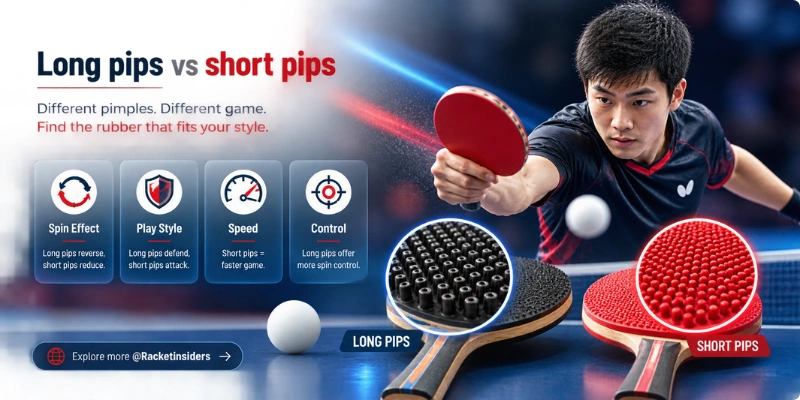
Table of Contents
Table tennis rubbers play a crucial role in a player’s style, spin, and control. Among the various types, long pips and short pips stand out for their unique characteristics, though they aren’t the only pimpled options on the market. Before diving into the details of each type, let’s first understand the pips-out/ pimpled rubbers.
What Are Pips-Out/Pimpled Rubbers?
Pips-out, or pimpled rubbers, are a type of rubber used on table tennis rackets that feature small, outward-facing pimples on the playing surface, rather than the smooth surface of inverted rubbers. This single structural difference is what separates every pips-out rubber from the inverted sheets most players start out on. A few things define the category as a whole:
- Effect on play: All pips-out rubbers alter spin, speed, and control differently than a standard inverted sheet.
- Structure: Small pips arranged in rows, facing outward instead of inward toward the sponge.
- Variation: Pip length, shape, and spacing all differ between models, and each change affects performance.
- Main types: Long pips and short pips are the two most common categories, though medium pips and anti-spin rubbers also exist as related variants.
Once you understand what sets pips-out rubbers apart as a category, the real differences between long and short pips become much easier to follow.
1. Long Pips (Long Pimples)
Long pips or long pimpled rubbers are known for their tall, thin pimples that reverse incoming spin, making them a longtime favorite among defenders and choppers. Where most rubbers try to add spin, long pips do the opposite, stripping it away and sending it back in a form the opponent never expected. That reversal effect is the entire reason this rubber has survived as a defensive weapon for so long.
Long pimpled rubbers are especially popular among defensive players and choppers. Thinner options, or OX with no sponge, sharpen spin reversal for close-to-table blocking, while thicker sponges add cushioning for chopping further back. The ITTF regulates pips by a height-to-diameter ratio, generally classing them long past roughly 0.89, worth checking before competition.
Key Characteristics
- Low Spin Reversal: Returns backspin as topspin, and vice versa.
- Passive Play Style: Suits choppers and blockers who wait for mistakes.
- Requires Good Technique: Demands precise touch and angle control.
- Harder to Attack With: Generates little spin, making smashes difficult.
- Best For: Defensive, disruptive players who chop away from the table and rely on spin reversal to confuse opponents.
Pros
- Reverses incoming spin, throwing off even strong attackers.
- Highly disruptive for defensive, close-control play.
- Neutralizes heavy topspin without needing to match its power.
Cons
- Generates almost no spin of its own.
- Demands precise touch to control consistently.
- Poor choice for direct attacking or smashing.
It’s a style with real precedent at the top level too. Former world champion Zhang Xielin built his entire game around long pips, and his defensive, disruptive approach is still cited as one of the clearest examples of what this rubber can do in the right hands.
2. Short Pips (Short Pimples)
Short pips or short pimpled rubbers trade grip for speed, using stiffer, shorter pimples built for fast, flat hits close to the table. Instead of grabbing the ball and generating spin, the surface stays firm on contact, sending shots back quicker and flatter than almost any other rubber type. That directness is exactly what makes short pips such a natural fit for aggressive, close-to-table players.
Short pimpled rubbers are often favored by aggressive players who block, hit through spin, and stay close to the table. Thinner sponges (1.5–1.8mm) favor control and blocking, while 2.0mm or above suits attackers wanting more pop. The trade-off is precision: less dwell time means the ball leaves faster, so timing matters more than with inverted rubber.
Key Characteristics
- Faster, Flatter Hits: Less dwell time means quicker rebound.
- Better for Blocking & Counter-Driving: Built for close-to-table aggression.
- Moderate Spin Generation: Some spin, but less than inverted rubber.
- Less Sensitive to Spin: Handles heavy topspin or backspin more easily.
- Best For: Fast, attacking players close to the table who want flat hits with reduced spin sensitivity.
Pros
- Fast, flat rebound suited to aggressive close-to-table play.
- Reduced spin sensitivity makes blocking more reliable.
- Strong for counter-driving and quick-reaction rallies.
Cons
- Generates far less spin than inverted rubber.
- Requires precise timing due to shorter dwell time.
- Loses effectiveness away from the table.
Mima Ito is the clearest modern example of this style in action; her close-to-table, rapid-fire attacking game relies heavily on short pips-style speed and directness. For the full breakdown of her setup, see our complete Mima Ito equipment guide.
Long Pips vs. Short Pips: key differences?
Once you understand what each rubber does on its own, the real decision comes down to five practical factors that separate them on the table. These aren’t abstract specs pulled from a catalogue; they’re the differences you’ll actually feel mid-rally, whether you’re trying to control pace or manufacture confusion. Here’s how short pips and long pips stack up against each other, factor by factor.
1. Speed
Speed is usually the first thing players notice when switching between pip types, and it shapes almost everything else about how a rally unfolds. A rubber that rebounds quickly forces faster decisions, while a slower one buys time to think and reposition.
- Short pips: fast, sharp rebound, built for close-to-table attacking.
- Long pips: slower pace, suited to controlled defensive rallies.
If pace is your priority, short pips will feel far more natural from the first few shots. Speed alone, though, rarely settles the decision on its own.
2. Spin Sensitivity
Both types reduce how much incoming spin affects your return compared to inverted rubber, but they handle that spin in completely different ways. One simply dampens it; the other actively works against it.
- Short pips: dulls incoming spin without reversing it.
- Long pips: reverses spin, turning topspin into backspin and vice versa.
That reversal effect is exactly what makes long pips so disruptive to face across the table. It’s the single biggest reason long pips feel so unfamiliar to attack.
3. Learning Curve
Neither rubber plays like a standard inverted sheet, but the adjustment period required is nowhere near equal between the two. One rewards players almost immediately; the other demands a genuine rebuild of touch and timing.
- Short pips: an easier transition, especially coming from inverted rubber.
- Long pips: a steeper curve, demanding new touch and timing.
Expect a longer adjustment period if you choose long pips, and be patient with early results. Rushing this stage is where most long pips players quit too soon.
4. ITTF Approved?
Both rubber types are legal for competitive play, but they aren’t held to identical standards once you look past the basic approval. Long pips in particular face extra scrutiny due to how easily their pimple structure can be modified for advantage.
- Both: approved for ITTF-sanctioned competition.
- Long pips: must meet strict pimple length and spacing regulations.
Always confirm a rubber’s current approval status before using it in a sanctioned match. A quick check can save you a disqualified racket on match day.
5. Best For
Ultimately, the right pip type comes down to the role you actually play on the table, not which rubber sounds more advanced or interesting. Matching the rubber to your game plan matters more than matching it to your ambitions.
- Short pips: attackers and blockers looking to counter spin directly.
- Long pips: defenders and disruptors built around confusion and variation.
Match the rubber to your role on the table, not the one you find more interesting on paper. The rubber should serve your game plan, not define it.
Taken together, these five factors explain why short pips and long pips rarely appeal to the same type of player. One rewards speed, directness, and a shorter learning curve; the other rewards patience, disruption, and a willingness to play a longer game.
Short Pips vs. Long Pips: Quick Comparison Table
For anyone who just wants the fast version, here’s every factor above laid out side by side. Speed, spin sensitivity, learning curve, legality, and best-fit playstyle, all in one glance. No need to scroll back through each section separately.
| Factor | Short Pips | Long Pips |
|---|---|---|
| Speed | Fast, sharp rebound | Slower, more controlled pace |
| Spin Sensitivity | Dulls incoming spin | Reverses incoming spin |
| Learning Curve | Easier, especially from inverted rubber | Steep, requires new technique |
| ITTF Approved | Yes, standard approval | Yes, with strict pimple regulations |
| Best For | Attackers and blockers | Defenders and disruptors |
Wondering why one side must be red and the other black? Check out our in-depth guide on Red & black sides of the rackets for the ITTF rule.
The Combination Bat: Why Pips Rarely Go on Both Sides
Most competitive pips players don’t actually run pips on both wings. Instead, they pair a pips rubber on one side with a standard inverted rubber on the other, a setup known as a combination bat. This lets a player disrupt and defend with the pips side while still keeping a genuine attacking option available on the other, rather than being locked into a purely defensive game. It’s part of why so few top-level pure chopper playing styles remain; even dedicated defenders now build in an attacking threat somewhere in their setup.
Why Pips Give Lower-Level Players So Much Trouble
Pips have a reputation as junk rubber, and it’s not entirely unfair. At beginner and intermediate levels, unfamiliar bounce and reversed spin can produce a string of free points with very little effort from the pips player. That reputation shifts at higher levels, though. As players improve their reading of spin and adjust their timing, the same rubber that once caused chaos becomes far more manageable, and leaning on pips without developing real technique underneath them tends to become a disadvantage rather than a shortcut.
Which One Is Right for You?
The right pips rubber isn’t about what’s trendy or what the pros use; it’s about matching your rubber to your natural instincts on the table. Choosing between long pips vs short pips depends on your playing style and strategy far more than it depends on which rubber sounds more advanced. The right choice usually becomes obvious once you’re honest about how you actually play.
- Choose short pips if: you attack aggressively, play close to the table, and want a shorter learning curve.
- Choose long pips if: you defend, chop, or want to disrupt your opponent’s rhythm through spin reversal.
- Still unsure? Try borrowing a friend’s racket or renting both types at a club before committing to a purchase.
- Either way: expect an adjustment period, especially if you’re coming straight from inverted rubber.
Both types of rubber pips require practice to master, so experimenting with different options can help you find the best fit for your game. There’s no universally better choice here, only the one that matches the player you already are on the table.
???? To better understand how each type of rubber affects your play, see our guide on Table Tennis Rubber Explained, to choose the best one for you.
Final Thoughts
Both long pips and short pips rubbers have their unique place in modern table tennis, and experimenting with them can add new dimensions to your game. Comparing long pips vs short pips, long pips offer defensive players an element of unpredictability, while short pips are great for aggressive, fast-paced play. Whether you want to control the game with speed or disrupt your opponent’s rhythm, understanding the strengths of each rubber type can help you make an informed decision.
Choosing the right rubber is a key part of optimizing your table tennis strategy, so consider your playing style and try different options to see what works best for you.
Ever wondered whether red and black rubbers actually play differently? Check out our guide on Red vs Black rubber, myth or fact? for the real answer.
Please Write Your Comments