5 Ply vs 7 Ply Table Tennis Blade: Which One Is Right for You? (2026)
Updated: July 29, 2026
213
Once you move past your first racket, you’ll run into a spec that trips up almost everyone: ply count. Listings throw around 5-ply all-wood and 7-ply carbon, like you’re supposed to already know what that means. Most beginners nod along and buy based on price or brand recognition instead, and that’s exactly when the confusion starts.
The truth is, the 5 ply vs 7 ply table tennis blade decision is one of the most misunderstood choices in the entire sport. More misunderstood than rubber hardness. More misunderstood than blade weight. It sounds like a simple number, but it’s actually describing a completely different playing character. Get it wrong, and you’ll spend months wondering why your shots feel off, when the real issue was never your technique at all.
This guide breaks down the real difference between 5-ply and 7-ply blades, so you can choose the right one for your game instead of guessing.
Table of Contents
What Ply Actually Means
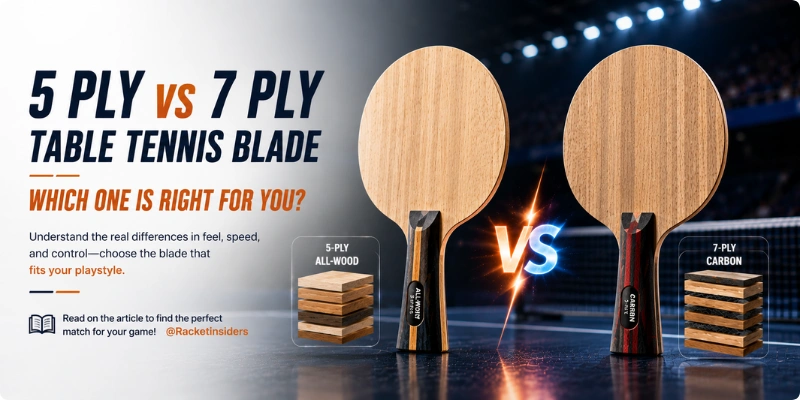
A table tennis blade isn’t a single piece of wood. It’s built from thin layers, called plies, glued together under pressure, similar to how plywood is constructed. Each layer is oriented slightly differently to control flex, stiffness, and feel. Think of it like a deck of cards glued together; each card (ply) contributes to the overall character of the blade.
- 5-ply means five layers of wood
- 7-ply means seven layers, sometimes wood only, sometimes wood combined with two thin carbon or fiberglass layers replacing a couple of the wood plies
More layers isn’t automatically more advanced. It’s a completely different playing character, not an upgrade path. In fact, ply isn’t just a marketing term, it’s governed directly by the ITTF’s official equipment regulations, which is why blade construction can’t be pushed infinitely in one direction. Understanding the 5 ply vs 7 ply distinction starts with recognizing that each construction serves a distinct purpose for different types of players.
Why Large Core Construction Matters More Than Ply Count
Ply count alone doesn’t tell the full story, and this is the part that often matters more than the number printed on the box. Most modern blades, whether 5-ply or 7-ply, use a large core construction, meaning the center layer is disproportionately thick, often close to half the blade’s total thickness. This is what actually creates the deep ball contact and extended dwell time that makes looping shots possible.
- Older or budget blades without a large core tend to have evenly thin layers throughout
- This produces a noticeably different feel in play, even at the same ply count
- Large core construction is often the bigger performance factor than ply count alone
When comparing two blades, treat ply number as a starting point, not the full picture. The quality of construction, wood types, and core thickness often matter just as much as the ply count itself. If spin is your main priority regardless of ply count, our best table tennis racket for spin guide breaks down exactly which builds maximize dwell time.
5-Ply Blades: Feel, Control, and Who They’re For
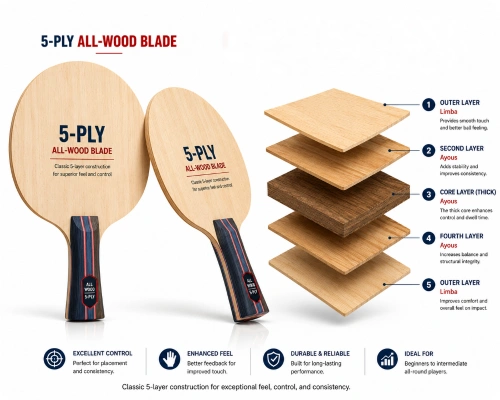
Five-ply blades are the standard construction for beginner and control-focused rackets, and for good reason. The all-wood build keeps the blade light and simple, with nothing standing between your stroke and the ball. That translates directly into feel. You sense exactly how clean (or messy) your contact was on every shot, which is exactly the feedback a developing player needs to correct their technique. The trade-off is less inherent speed; you generate power through your own stroke, not the blade doing it for you.
Pros
- Forgiving on mishits
- Excellent feedback for learning
- High control and spin potential
- Encourages proper stroke development
Cons
- Lower built-in speed
- Requires good technique to generate power
- Can feel underpowered to advanced attackers
The 5-ply blades are best for true beginners, control-focused players, and anyone still building consistent stroke mechanics, exactly the profile our best beginner table tennis racket guide is built around.
Blades like the Butterfly Korbel, Stiga Allround Classic, Yasaka Sweden Extra, and Nittaku Acoustic are well-known examples of this construction, all favored by control and all-round players for the same reason: the feedback and touch a soft blade provides.
7-Ply Blades: Speed, Stiffness, and Who They’re For
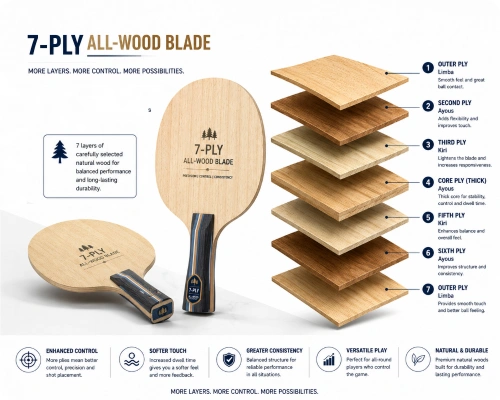
Seven-ply blades are stiffer by construction. That stiffness holds its shape better under heavy contact, giving you a more predictable, consistent response shot after shot. When two of those seven layers are carbon or fiberglass instead of wood, the effect intensifies further. Carbon plies add explosive pop and a livelier, more responsive feel, but they also amplify mistakes. A slightly late or slightly early contact gets punished harder on a stiff 7-ply blade than it would on a forgiving 5-ply one.
Pros
- Higher inherent speed
- Better for attacking and looping
- Crisp, responsive feel
- Carbon versions add explosive power
Cons
- Less forgiving on off-center hits
- Reduced feel and feedback
- Can mask or punish technical flaws
The 7-ply blades are best for intermediate players with consistent, repeatable strokes who are ready to convert good technique into more pace and attacking power, the stage covered in our best rackets for intermediate players guide.
Blades like the Stiga Clipper, Butterfly Korbel SK7, DHS Power G7, and Victas Koki Niwa Wood are well-known examples of this construction, typically reached for by players who’ve outgrown a 5-ply setup but aren’t ready for a full carbon blade.
5-Ply vs 7-Ply Blades: Key Performance Differences
The number of plies in a blade isn’t just a spec sheet detail; it directly shapes how the blade feels and plays. It’s the difference between a blade that helps you learn and one that helps you attack. Here’s how a 5-ply and 7-ply stack up across the areas that actually matter on the table.
1. Flex and Dwell Time
Fewer layers means a thinner, more flexible blade. A 5-ply lets the ball compress into the wood slightly longer before leaving; that extra dwell time is what makes heavy topspin easier to generate. A 7-ply, with two extra layers of wood, is noticeably stiffer. The ball springs off faster with less sink, giving a crisper, more direct energy transfer rather than a cushioned catapult effect.
2. Speed and Power
This is where the two diverge the most. A 5-ply tends to play slower and is built more for controlled looping and versatile, all-round rallies. A 7-ply trades some of that control for raw pace; it’s built for players who want to counter-loop or attack aggressively from close to the table, where quick, powerful strokes matter more than a slow buildup.
3. Control and Touch
A 5-ply gives that classic wood-on-wood feedback players talk about; it’s forgiving and intuitive, especially for touch shots, drop shots, and short game work near the net. A 7-ply feels harder and more locked-in; it holds up better under fast blocking exchanges, but because there’s less natural cushioning, it demands cleaner, more consistent stroke technique to keep shots from flying long.
Put side by side, the pattern is clear: everything about a 5-ply favors feel and spin, while everything about a 7-ply favors speed and directness. The table below puts that pattern in one place.
5-Ply vs 7-Ply Blade: Full Comparison Table
With both constructions explained individually, here’s every key difference laid out side by side. This comparison table makes the 5-ply vs 7-ply decision much easier to visualize at a glance.
| Feature | 5-Ply | 7-Ply (Wood or Carbon) |
|---|---|---|
| Feel | Soft, forgiving | Stiff, responsive |
| Flexibility | Higher | Lower (stiffer) |
| Dwell time | Longer | Shorter |
| Speed | Lower, built through technique | Higher, built into the blade |
| Spin potential | Higher | Moderate |
| Control | High | Medium |
| Forgiveness on mishits | High | Low |
| Feedback | Excellent | Reduced |
| Best for | Beginners, control players | Intermediate to advanced, attacking players |
| ⚡ 5-ply blades offer control and feel; 7-ply blades provide power and speed — choose based on your skill level and playing style. | ||
Does More Plies Always Mean a Better Blade?
This is the single biggest misconception buyers have, and it’s an easy one to fall into, because more usually does mean better when you’re shopping for most other things.
Ply count isn’t a quality scale; it’s a playing-style scale. A 7-ply blade in the hands of a true beginner doesn’t make them better; it makes every inconsistency in their stroke more visible and harder to control. Rallies get shorter, not longer, and frustration builds instead of progress.
- A 5-ply blade helps you learn
- A 7-ply blade helps you execute what you’ve already learned
The right question isn’t which has more plies; it’s which matches where my technique actually is right now. Going up in ply count too early is one of the most common, and most avoidable, mistakes new players make when buying their second racket.
Where Carbon-Reinforced Blades Fit In
Once you’ve got a handle on the 5-ply vs 7-ply blade question, carbon adds a third category worth understanding on its own, since it’s often marketed alongside 7-ply without much explanation of what actually changes.
Carbon-reinforced 7-ply blades sit a step beyond standard 7-ply wood. Brands like Killerspin and Butterfly use carbon layers to add speed and spin potential without adding significant weight, popular among players who’ve outgrown their first racket and want a genuine performance jump.
However, there’s a hard limit on how much carbon a legal blade can contain. Under ITTF Rule 2.4.2, at least 85% of a blade’s thickness must be natural wood, with any carbon or fiber reinforcement capped at 7.5% of total thickness. That’s why even carbon blades are mostly wood, and why every blade legal for WTT competition has to meet this threshold, regardless of how it’s marketed.
These blades represent the natural upgrade path once your technique is solid: start on 5-ply for control, move to 7-ply wood once you’re consistent, and consider carbon only when you’re ready to maximize attacking power. For the full breakdown of blade materials, ply structures, and how they interact with different rubber choices, see our complete table tennis blade guide.
Which Ply Count Should You Actually Choose?
With the specs and comparisons out of the way, here’s the part that actually matters: matching a blade to where you genuinely are right now, not where you’d like to be in six months. The 5 ply vs 7 ply blades decision becomes much clearer when you honestly assess your current skill level and playing style.
✔️ Choose 5-ply if:
You’re a beginner, your strokes are still developing, you value control and feedback, or you’re a defensive/control-oriented player. Blades like the Butterfly Korbel or Stiga Allround Classic are typical starting points here. The feedback loop a 5-ply provides during your first year is invaluable for building proper technique.
✔️ Choose 7-ply (wood) if:
You have consistent strokes, you’re an offensive player, and you want more built-in speed without sacrificing too much control. The Stiga Clipper and DHS Power G7 fall in this category. This is the natural upgrade once you’ve been playing 1–2 years and your shots land consistently with good form.
✔️ Choose 7-ply (carbon) if:
You’re an advanced attacker with solid technique, you want explosive pace, and you’re comfortable with a livelier, less forgiving response. This construction only makes sense once you’ve already mastered 7-ply wood and genuinely need the extra pop for competitive attacking play.
One golden rule: when in doubt between two options, choose the slower, more controllable blade. You can always generate more power with your own stroke, but you can’t recover control once you’ve lost it to equipment that’s faster than your technique can manage.
Final Thoughts
The 5 ply vs 7 ply table tennis blade decision is one of the more consequential equipment choices you’ll make as a developing player, but it’s not one you have to overthink, and it’s certainly not one that needs to cost you months of frustration if you get it wrong the first time.
Get it roughly right, and your blade complements your game instead of fighting it. Get it wrong, and you’ll spend months blaming your technique for problems that are actually coming from equipment mismatched to where you currently are, chasing speed you can’t yet control, or stuck on a blade too slow for strokes you’ve already outgrown.
If you take one thing from this guide, let it be this: the goal isn’t to own the fastest or most advanced blade on the market. It’s to own the blade that lets you play your best table tennis right now, with room to grow into the next one when you’re actually ready for it.
New to the sport and still working out your first setup? Our beginner racket guide covers 5-ply picks built for exactly this stage, and our complete best table tennis rackets guide ranks every option across every skill level.
FAQs
Is a 7-ply blade too fast for a beginner?
For most true beginners, yes. It rewards speed you don’t have consistent control over yet, and tends to make rallies harder to sustain while you’re still learning basic stroke mechanics.
Can advanced players use a 5-ply blade?
Absolutely. Many defensive and control-oriented advanced players choose 5-ply specifically for the touch and feel it provides, especially close to the table. Ply count is about playing style, not skill ceiling.
Do I need carbon layers to play offensively?
No. A 7-ply all-wood blade already provides a meaningful speed step up from 5-ply. Carbon adds a layer of speed and stiffness on top of that, useful but not required to play an attacking style.
Which is better for spin: 5-ply or 7-ply?
Both can produce excellent spin. 5-ply allows more dwell time (the ball stays on the rubber longer), which helps with spin generation on slower shots. 7-ply produces spin through higher speed and snap, but requires cleaner contact to achieve it.
What is dwell time, and why does it matter for ply count?
Dwell time is how long the ball stays in contact with your blade and rubber before leaving. It’s measured in milliseconds, but the difference is very noticeable in feel. Longer dwell time (5-ply) means more grip on the ball for spin. Shorter dwell time (7-ply) trades that grip for a faster, snappier return.
How do I know when I’m ready to upgrade from 5-ply to 7-ply?
When you consistently land your drives and loops with good form, and you feel like you’re outgrowing the speed of your current blade, meaning you’re swinging hard, but the ball isn’t coming off as fast as you’d like.
What’s the biggest mistake players make with the 5 ply vs 7 ply decision?
Moving to 7-ply too early. Many players assume more plies equals better and upgrade before their technique is ready. The result is frustration, inconsistent play, and often a quick return to a slower blade.
Please Write Your Comments