Why Table Tennis Rackets Have Red and Black Sides: ITTF Rules Explained
Updated: July 31, 2026
182
Pick up almost any table tennis racket, from a $20 starter bat to a $450 professional setup, and you’ll notice the same thing every time: one side is red, the other is black. It’s such a consistent pattern that most players never question it; they just assume that’s what a racket is supposed to look like.
It’s not a design trend, and it’s not a manufacturer’s default color choice either. It’s an ITTF rule, born out of an actual controversy in competitive play, and it exists for a very specific reason that has nothing to do with looks. The rule is mandatory in every sanctioned match, with no exceptions made for personal preference. Break it, and your racket simply isn’t legal to play with.
This guide breaks down exactly why table tennis rackets have red and black sides, where the rule came from, and what it actually changes about your game.
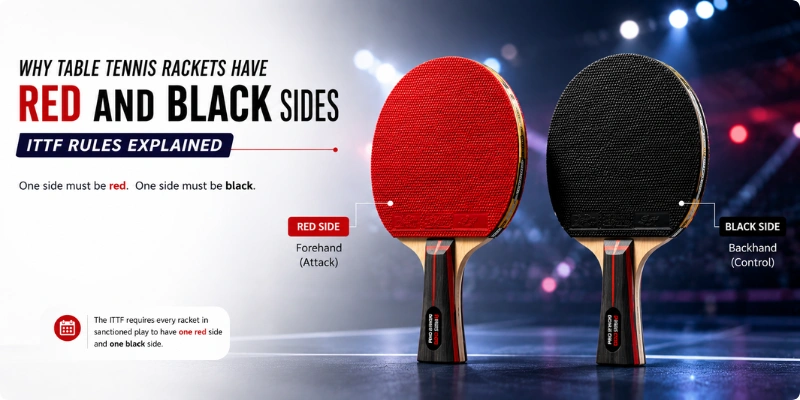
Table of Contents
The Official ITTF Rule: Why Table Tennis Rackets Have Red and Black Sides
Every legal table tennis racket has to pass one very specific visual test before it’s allowed on the table, and it has nothing to do with the blade, the brand, or how expensive it is. Under International Table Tennis Federation regulations, a legal racket must have one red rubber surface and one black rubber surface, one on each side of the blade. This isn’t a suggestion; it’s enforced in every sanctioned match, and umpires check for it before play begins.
- You can’t use two black sides, two red sides, or any other color combination in official competition
- Umpires physically inspect rackets before matches specifically to confirm this
- Casual and recreational rackets sometimes bend this rule, but anything built for tournament play follows it strictly
- The rule applies regardless of rubber type, whether it’s inverted, pips-out, or anti-spin; the color requirement stays the same
On paper, it’s a simple two-color requirement. But like most rules in the sport, it wasn’t written arbitrarily; it exists because of a real problem players were exploiting on the table, which is exactly where the story actually begins. For a complete breakdown of rubber types, see our Table Tennis Rubber guide.
The History Behind the Rule: A 1986 Fix
This rule didn’t exist from the sport’s start, and it wasn’t introduced for style reasons either. It came directly out of a loophole players were actively exploiting, one that had nothing to do with skill and everything to do with confusing opponents. What started as a clever trick eventually became a problem the sport had to solve at the rulebook level.
What Happened Before the Rule Existed
Before 1986, rackets could legally carry the same rubber color on both sides. Some players took full advantage of this, deliberately pairing two visually identical but functionally opposite rubbers, often a fast inverted sheet on one side and a slow, deceptive pips-out or anti-spin sheet on the other. Since both sides looked the same, an opponent had no way to tell which surface would make contact mid-rally.
- Players would flip their racket subtly between shots
- Opponents couldn’t visually track which rubber hit the ball
- Returns became a guessing game instead of a skill-based read
- Top-level matches were increasingly decided by deception rather than actual play
The sport needed a fix that removed the guesswork entirely, not one that just discouraged the behavior. Confused between long and short pips? See our Long pips vs Short pips guide.
How the ITTF Fixed It
The ITTF introduced the mandatory two-color rule in 1986, requiring one red side and one black side on every legal racket. This closed the loophole immediately, shifting matches back toward being decided by genuine skill rather than equipment tricks.
Red and black stayed the only two legal colors for the next 35 years, until a 2021 rule update allowed colors other than red on one side, as long as black remains mandatory on the other. This opened the door for combinations like black and blue or black and green, though red/black is still by far the most common setup at every level of play.
What Happens If Your Racket Breaks the Rule?
Knowing the rule exists is one thing; knowing what actually happens if you break it is another, and it’s not just a friendly reminder from the umpire. In the sanctioned ITTF and WTT events, rackets are checked before a match begins. If a racket doesn’t meet the two-color requirement, or uses colors outside the approved list, the player isn’t allowed to start the match with it.
- Caught before the match: the player must swap the non-compliant rubber or racket before play begins, no exceptions
- Caught mid-match: this is rare, since checks happen beforehand, but if it happens, the match can be paused until the racket is brought into compliance
- Repeated or deliberate violations: can result in a formal warning or, in serious cases, disqualification from the event
None of this is meant to scare you off your first tournament; checks take seconds, and most players pass without a second thought. It’s only a real concern if you’ve been experimenting with novelty colors beforehand, worth sorting out before you’re standing at check-in. Curious what the pros actually use? See our guide on Fan Zhendong equipment.
Does the Color Affect Performance?
No. Red and black rubber on a racket perform identically when everything else about the sheet is the same. Color is purely a compliance marker, not a performance indicator. A red inverted rubber and a black inverted rubber from the same product line, same sponge thickness, same hardness, will play the same.
- Speed comes from sponge density and surface tackiness, not color
- Spin potential comes from the rubber’s surface texture and grip, not color
- Control comes from sponge softness and rubber construction, not color
This trips up a lot of beginners who assume red rubber is naturally faster, or that black is somehow the control side. It isn’t. Speed, spin, and control come from the rubber’s construction, never from its color. For a deeper dive into this myth, see our Red vs Black table tennis rubbers guide.
Can You Customize Colors for Casual Play?
If you’re playing purely for fun, at home, with friends, with no plans to enter sanctioned events, the color rule isn’t enforced. Once you step outside competitive play, the choice becomes entirely about personal style rather than compliance. A few manufacturers offer custom-colored rubber for players seeking a unique look.
- Butterfly and DHS both offer standard red/black rubber lines almost exclusively
- Since the 2021 rule change, a small number of brands have started producing legal non-red colors like blue or green, though red/black still dominates the market
- Most beginner and intermediate rackets already ship in standard red/black by default, so it’s rarely something you need to think about unless you’re deliberately customizing your setup
Just keep in mind that casual only stays casual as long as you’re not planning to compete. If there’s even a chance you’ll enter a club night or local tournament down the line, it’s worth sticking to red/black from the start, so you’re not stuck rebuying rubber right before your first event.
Final Thoughts
Once you understand why table tennis rackets have red and black sides, the rule stops looking like a small, decorative detail and starts looking like a fairness fix that’s been quietly protecting the sport for almost 40 years.
It’s a good reminder that a lot of what looks like tradition in table tennis is actually a rule with a real reason behind it. Once you know that, you start noticing the color split differently, not as decoration, but as information: a visible signal of exactly which rubber is about to hit the ball.
If you’re building your own setup, remember the color itself is never the performance factor; the rubber type underneath it is. That’s the part actually worth spending time researching before your next purchase.
Building a complete setup? See our in-depth table tennis racket guide for blade and rubber pairings.
FAQs
Why do table tennis rackets have red and black sides?
It’s an ITTF rule, introduced in 1986 to stop players from using visually identical rubbers with completely different playing characteristics on each side. Requiring one red side and one black side lets opponents see which surface is about to hit the ball, keeping matches decided by skill rather than disguised equipment.
Which side is faster, red or black?
Neither, by default. Speed comes entirely from the rubber’s construction, not its color. A racket could have a faster red side and slower black side, or the reverse, depending on which specific rubbers are mounted, not because of the colors themselves.
Do professional players always use the same color combo?
Yes, every professional follows the red/black rule in sanctioned play, no exceptions. What varies between pros is which rubber type goes on which color side, not whether they follow the rule.
Can I mount two different rubbers as long as the colors are right?
Yes, this is actually standard practice. Many intermediate and advanced players intentionally pair different rubbers (one faster, one more control-oriented) on their forehand and backhand, as long as one side is red and the other is black.
When did the ITTF allow colors other than red?
Since 2021, non-red colors have been legal on one side as long as black remains on the other. Red/black is still the most common combination by far, but you may start seeing more color variety at the professional level going forward.
Please Write Your Comments