Mima Ito Playing Style: Inside Her Close-to-Table Attack
Updated: July 26, 2026
324
Most players of Mima Ito’s height learn to stay away from the table. The closer you stand, the less time you have to react, and the less reach you have to cover it. Ito does the opposite. She plants herself right on top of the table and dares the ball to get there first.
It shouldn’t work as well as it does. At 1.52m (5 ft 0 in), she’s shorter than almost everyone she plays against, yet she holds the best winning record against Chinese players in the sport’s modern history. That contradiction is the whole story of her game: unconventional equipment, a punchy backhand most coaches wouldn’t teach, and a habit of ending rallies before her opponent gets comfortable.
This guide breakdowns mima ito playing style, covering exactly how she plays: her grip and stance, the mechanics behind her backhand and forehand, her signature serve, and the tactical pattern that ties it all together.
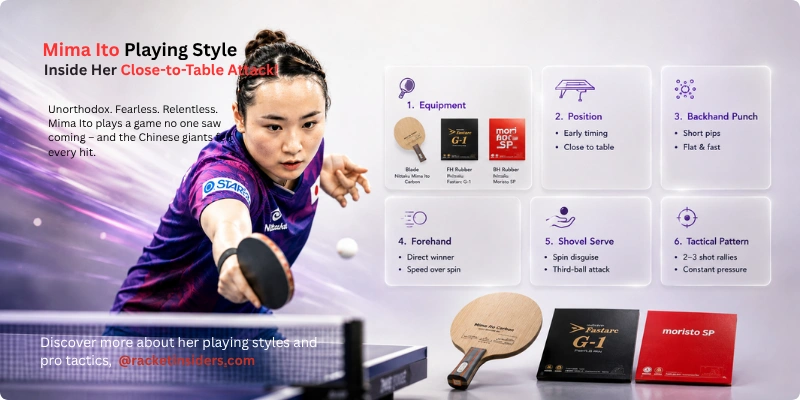
Table of Contents
Mima Ito’s Style at a Glance
Get to know the core stats behind one of the most aggressive close-to-table players in women’s table tennis.
- • Grip: Shakehand, right-handed
- • Player type: Counter-attacking, close-to-table aggressor
- • Signature shots: Short-pips backhand punch, flat forehand smash, shovel serve
- • Table coverage: Roughly 70–80% played from her backhand side
- • Career-high world ranking: No. 2 (April 2020)
These five stats tell the story of a player who built her entire game around speed, disruption, and finishing points before they have a chance to develop.
What Makes Mima Ito’s Playing Style Unique?
The short answer: unpredictability. Ito doesn’t play the way opponents expect, and that forces them to react instead of dictate. She’s often called the greatest threat to Chinese table tennis dominance, and she holds the best winning record against Chinese players in the modern history of the women’s game, including victories over world champion Liu Shiwen and former world No. 1 Zhu Yuling.
That success comes from a combination few players attempt at the same time:
- Short pips on her backhand, instead of the inverted rubber almost everyone else plays
- A flat forehand that skips the heavy topspin loop most rivals rely on
- A habit of ending points in two or three shots, rather than letting rallies develop
Each piece reinforces the others, and together, they’re what make her one of the hardest players in the world to prepare for. That’s the Ito formula, and it’s beaten the best in the world.
Mima Ito Playing Style: How Ito Actually Plays
Every piece of Ito’s game, her grip, her gear, her serve, exists to support four moves she leans on more than anyone else in the sport. None of them work in isolation; each one sets up the next. Understanding these four core moves is the key to understanding why she’s been one of the most feared players on the WTT circuit, and why her style remains nearly impossible to replicate.
1. The Equipment Behind the Style
Every move that follows starts here. Ito’s game runs on a specific, unconventional setup; without it, none of the mechanics below would be possible. This is the gear that lets her play faster, flatter, and more unpredictably than almost anyone else, and it’s the exact combination that amplifies her unique strengths.
- Blade: Nittaku Mima Ito Carbon (Acoustic Carbon base)
- Forehand Rubber: Nittaku Fastarc G-1 (2.0mm, black)
- Backhand Rubber: Nittaku Moristo SP (Max sponge, red)
The Moristo SP is the critical piece. It’s a short-pips rubber, rather than the smooth inverted rubber most professionals play on both sides, and it’s the reason the backhand punch, the flat forehand takes, and the spin disguise on her serve all work the way they do.
This is the foundation everything else in her game is built on top of; keep it in mind as you read through each move below. Explore her full equipment setup in our detailed Mima Ito gear breakdown.
2. Built Around Position, Not Power
Every other move in Ito’s game only works because of where she chooses to stand. It’s the one decision that shapes all the others. Ito can’t out-reach taller opponents, so she doesn’t try to. Instead, she takes the ball early, often right off the bounce, before it rises to a height where a longer-armed player would have the advantage:
- Standing close to the table cuts down her own reaction window
- But it cuts down her opponent’s recovery window even more
- She trades the safety margin of mid-distance play for tempo
When it’s working, opponents feel like they never get to set their feet. It’s a simple idea, executed at a level almost nobody else can sustain.
Position is the foundation everything else is built on: the backhand, the forehand, and the serve pattern all depend on her standing exactly where she does.
3. The Backhand Punch: Why Short Pips Change Everything
The Nittaku Moristo SP on Ito’s backhand is the single piece of equipment that makes her game possible. While most players chase maximum spin with inverted rubber on both wings, Ito made a calculated trade-off by choosing short pips instead: better control, flatter trajectory, and less spin sensitivity. Short pips grip the ball differently than inverted rubber:
- They generate less spin of their own
- They’re far less sensitive to whatever spin is coming in
- That means Ito can take a heavily spun ball and punch it flat, rather than having to read and counter the incoming rotation first
The stroke itself is short and minimal, which is exactly why it’s been compared to rapid gunfire: less wind-up, less time between shots, less time for an opponent to reset.
Short pips trade spin for speed and unpredictability, which is exactly why her backhand looks nothing like a textbook stroke.
4. The Forehand: Flat, Fast, and Rarely Complicated
If the backhand is Ito’s signature, the forehand is where she closes out points. Where her rivals loop heavy topspin from both wings, Ito’s forehand takes a different path entirely; she favors a flatter trajectory for one specific reason: finishing points faster without heavy rotation. She hits through the ball rather than around it, favoring flat, hard smashes over long spin-heavy rallies:
- She can loop when the point calls for patience
- But her default instinct is to end things quickly
- A flat, fast forehand is a faster way to do that than a rally of loops
Where most players choose spin, Ito chooses speed and finishes the point before spin would even matter.
5. The Shovel Serve: Her Signature Opener
Ito’s serve is the least imitated part of her arsenal on the WTT tour, and one of the most effective. While the pendulum serve dominates the pro game, Ito mostly skips it in favor of something far less common: her shovel serve. It lets her disguise spin more effectively at the top level, mixing backspin and topspin variations off a similar-looking toss to set up her preferred pattern:
- Serve: disguise spin off a similar-looking toss
- Read the return
- Attack fast on the third ball
The disguise is what makes it work; by the time an opponent reads the spin correctly, Ito’s already moved on to the next shot in the sequence.
The serve isn’t about winning the point outright; it’s about setting up the third-ball attack that usually does.
6. The Tactical Pattern: Win It in Two or Three Shots
In a 2021 essay, Ito described her own goal in blunt terms: finish the point in two or three shots. That single sentence is the organizing principle behind everything above it. She’d rather take a slightly riskier shot early than settle into a long rally where a taller, longer-armed opponent gets more chances to find an opening. That same short-rally instinct carries into her returns of serve too:
- She takes calculated risks on returns of serve
- She’ll sometimes force her opponent into serving long next time
- Trading a small risk now for a better opening later
Every part of her game: the rubber, the stroke shapes, the serve, even her return-of-serve gambles, is built around one instinct: shorten the rally, don’t extend it. It’s the same principle that shapes the other three moves, just applied to the point as a whole rather than a single shot.
The Strategy Behind the Style
Every technique above serves a bigger purpose; Ito’s game isn’t just fast; it’s designed to work on an opponent’s head as much as their reflexes. None of it happens by accident; every choice she makes at the table is aimed at one of three specific effects. Three effects define the pressure she creates:
- She takes time away: staying close to the table and hitting the ball at the top of the bounce cuts down an opponent’s reaction time before they even set up
- She creates uncertainty: short pips make spin difficult to read, so opponents never know if the ball will sink or float, which forces hesitation or outright errors
- She finishes points fast: she has no interest in long rallies, and her whole game is built to attack, attack, attack until the point is won in two or three shots
The proof is in who’s noticed. Both Liu Guoliang and Deng Yaping have praised Ito’s creativity and her willingness to experiment mid-match, and Deng Yaping has specifically pointed to her tendency to mount comebacks by taking risks and swinging at difficult shots even when she’s losing badly.
A Style With Real Lineage: Echoes of Deng Yaping
Ito didn’t invent this approach. The International Table Tennis Federation has drawn a direct line between her game and that of Chinese legend Deng Yaping, who dominated women’s table tennis in the 1990s using a similarly compact, close-to-table, pips-based attack. According to the ITTF, that style largely disappeared from the international game after Deng Yaping’s retirement, as the sport’s slower modern ball made close-range aggression a harder strategy to sustain, until Ito revived it at the top level.
The results back up the comparison. At the 2018 ITTF World Tour Swedish Open, Ito beat Liu Shiwen, Ding Ning, and Zhu Yuling back to back en route to the singles title, three of China’s most accomplished players, all in the same tournament.
Where the Style Gets Tested
Ito’s height forces her to play close to the table, and limits how much ground she can cover once a rally moves wide or fast. Her game is built to avoid that scenario, but against opponents who can extend rallies and open up the table, the margin for error narrows quickly.
That tension has shown up in her recent results:
- Ranking dip: Ito entered 2026 outside her career-high ranking
- Squad omission: Table Tennis England reported that Japan left her off the squad for the 2026 World Team Championships Finals in London, opting for younger players instead
- The trade-off: a style built on speed and risk can be devastating at its peak, but it leaves less room to absorb an off year than a more conservative, spin-heavy game might
It’s a reminder that even a style this dominant has a ceiling, one that’s tested more often as the competition catches up.
Where the Style Delivers: Signature Wins
Ito’s aggressive, close-to-table approach isn’t just a stylistic choice; it’s produced some of the biggest upsets in modern women’s table tennis. Her two most defining wins came against the exact kind of opponents her style is built to dismantle: dominant, high-ranked players used to dictating the pace of a rally.
- 2020 Qatar Open: Ito beat reigning Olympic champion Ding Ning 4–0, winning the third set 11–0 — the first time a non-Chinese player had taken a set 11–0 off a Chinese opponent.
- Tokyo 2020 Olympics: Partnered with Jun Mizutani, Ito won mixed doubles gold, making Japan the first non-Chinese team to win an Olympic table tennis title since 2004.
Both results remain reference points whenever her game plan comes up in analysis. These two results alone explain why her style is studied as closely as it is.
Can Amateurs Play This Way?
It’s a fair question, and the honest answer is: not easily. According to Alois Rosario of PingSkills, the short pimples give the backhand a simplicity, but the flatter stroke adds difficulty due to the low margin for error over the net. That trade-off, a simpler stroke with far less room for error, is exactly why this style rewards elite timing more than it forgives amateur inconsistency.
A few reasons this style is harder to adopt than it looks:
- Low margin for error: the flatter trajectory that makes her punches so fast also means there’s very little net clearance to work with; small timing errors turn into missed shots, not just weaker ones
- Reaction window shrinks, not grows: playing closer to the table cuts down your own decision time as much as your opponent’s, which punishes hesitation hard
- Short pips take real relearning: the rubber behaves nothing like standard inverted rubber, so even experienced players need dedicated practice time before it feels natural
- Elite timing is doing the heavy lifting: the “simplicity” of the stroke only holds up if your timing is already sharp; it doesn’t simplify the game for players still building consistency
For most club players, elements of this style, taking the ball a touch earlier, favoring flatter contact on certain shots, are more realistic to borrow than the full package.
Final Thoughts
Put together, these three angles tell the full story of Mima Ito playing style: elite competition can expose its physical limits, but at its best, it’s produced some of the most memorable upsets in the modern women’s game. What makes Mima Ito’s playing style so widely studied isn’t just the wins; it’s the honesty of the trade-off underneath them, a compact, high-risk approach that punishes hesitation as much as it rewards precision. That’s the real story behind her game: a style with a genuine ceiling, real vulnerabilities under pressure, and a payoff, when it’s firing, that few players in the sport have ever matched.
Want to know more? Read the complete Mima Ito profile for a deeper dive into her profile, career, and achievements.
FAQs
What is Mima Ito’s playing style?
Ito plays an aggressive, close-to-the-table counter-attacking style built around taking the ball early, a short-pips backhand punch, and a flat, direct forehand, aiming to finish points in two or three shots.
What grip does Mima Ito use?
She plays right-handed with a shakehand grip, the standard grip style used by most international players, rather than the penhold grip.
What equipment does Mima Ito use?
Mima Ito uses:
• Blade: Nittaku Mima Ito Carbon
• Forehand: Nittaku Fastarc G-1
• Backhand: Nittaku Moristo SP (short pips)Why does Mima Ito use short pips on her backhand?
Short pips are less sensitive to incoming spin, which lets her punch the ball flat immediately rather than having to read and counter heavy spin first. That suits her fast, close-to-table style far better than a conventional inverted rubber would.
What serve does Mima Ito use most often?
Mima primarily uses a shovel serve rather than the more common pendulum serve, mixing backspin and topspin variations off a similar toss to disguise what’s coming next.
How does Mima Ito’s style compare to Deng Yaping’s?
The ITTF has directly compared the two: both built their games around a compact, close-to-table attack using pips-based backhand rubber, a style that largely vanished from top-level women’s table tennis between Deng Yaping’s retirement and Ito’s rise.
Is Mima Ito’s playing style still effective against top opponents?
It remains capable of beating anyone on a given day, as her past wins over multiple top Chinese players show. But it’s a high-risk, high-reward approach, and her ranking has slipped outside the world’s top tier heading into 2026, suggesting the margin for error has narrowed as opponents adjust.
Please Write Your Comments