Best Table Tennis Rackets 2026: Tested and Ranked for Every Level
Updated: July 22, 2026
1660
Walk into any sporting goods store or browse online for five minutes, and you will quickly face the same problem: hundreds of table tennis rackets, all claiming to be the best. Confusing specs, misleading brand names, and slick marketing make it nearly impossible to separate a genuinely great racket from an expensive disappointment.
The wrong racket does not just waste your money. It actively slows your development, builds bad habits, and turns a sport that should be fun into a source of frustration. Finding the best table tennis racket for your level is not optional; it is the foundation on which everything else is built.
In this Racket Insiders guide, every racket has been hands-on tested by Sufyan Faizi, a competitive player and coach with eight years of club and collegiate experience, and ranked across every skill level from complete beginner to advanced competitor. No filler. No brand favourites. Just the best table tennis rackets for 2026
Table of Contents
Whatever stage you’re at, the right racket should match your current technique, not your ambitions. There’s no single best racket for everyone — the right choice depends on where you are right now, not where you hope to be.
Find your level above, then dive into the full breakdown below for more detail.
???? Before you choose your racket, make sure you’re playing with the right ball. Read the official table tennis ball guide: size, weight, types, and ITTF rules.
Why Trust This Guide
Every racket on this list has been technically evaluated by Sufyan Faizi, a competitive table tennis player and coach with hands-on club and collegiate experience spanning eight years. Testing involved sustained rally sessions, loop drilling against heavy backspin, multiball practice, and match play across multiple skill levels.
Racket Insiders‘ recommendations are based on real player performance, not manufacturer claims, brand sponsorships, or affiliate incentives. If a racket is on this list, it earned its place. Prices verified across major retailers in July 2026. All picks are ITTF-approved.
Rackets to Avoid: Read This First
Not every table tennis racket on the market deserves your money; some will actively sabotage your game. Before we get to the best options, here are the most common costly mistakes. These rackets look tempting, but will actively hurt your game.
- Cheap branded bats under $20 (Dunlop G-Force, Nitro, Blaster): Rubber is so dead it generates almost no spin. You develop compensatory habits to get the ball over the net.
- Cornilleau Tacteo plastic bats: Not ITTF approved and cannot be used in clubs or tournaments. The rubbers are designed for outdoor durability, not spin. You will build habits on a bat that behaves nothing like a real table tennis racket.
- Unbranded ‘professional’ sets: Pro player on the box, under $30, comes with balls and a case? Walk away. No quality control, no real performance.
- Counterfeit DHS and Butterfly products: Same logos, inferior rubber, and blades. If a premium racket is priced far below market value, it is almost certainly fake. Verified retailer details are listed under each relevant review below.
Spend under $20, and you are not buying a table tennis racket; you are buying a bad habit. Every racket on our recommended list starts at $30 and earns its place through real performance. For a more reliable option, check out our best premade table tennis rackets and start building the right habits from day one.
Best Table Tennis Racket: By Skill Level & Alternative Picks
Whatever stage you’re at, the right racket should match your current technique, not your ambitions; the wrong choice either holds back your progress or works against it. We’ve tested and ranked the best rackets for every skill level, beginner through pro, plus a solid alternative for each stage if your priorities differ. Each entry covers key specs and a clear bottom line, so you can compare fast. No fluff, just what you need to know.
1. Best for Beginners & Casual Play
If you’re just starting, prioritize control so you can keep the ball on the table. Beginners have three paths: control-focused rackets for forgiveness, attacking beginner rackets for extra speed, or a budget pick if you just want to try the sport without a big spend. All are premade and ready to play.
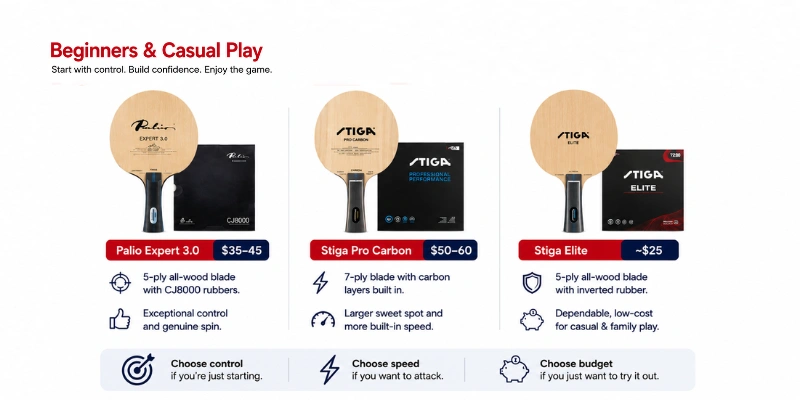
- Palio Expert 3.0 ($35–45): 5-ply all-wood blade paired with CJ8000 rubbers. Exceptional control and genuine spin, with a forgiving touch that builds correct technique instead of masking bad habits.
- Stiga Pro Carbon ($50–60): 7-ply blade with carbon layers built into the construction. A larger sweet spot and more built-in speed for beginners who already know they want to play an attacking style.
- Stiga Elite ($20+): 5-ply all-wood blade with inverted rubber. A dependable, low-cost option for casual and family play, not built for fast progression, but a genuine, forgiving choice if you’re not ready to invest yet.
Start with control. The Palio Expert 3.0 is the safest choice for most beginners. Choose the Stiga Pro Carbon if you already know you want to hit hard from day one. Choose the Stiga Elite if you just want to try the sport without committing much money.
???? Want more control-focused options at every price point? Our full Beginner Racket Guide breaks down every pick in detail.
2. Best Intermediate Rackets
If you’re upgrading to tournament-level gear, you need a balance of speed and spin. Intermediate players have three paths: all-round rackets for consistency, aggressive rackets for attacking play, or a value pick for a genuine upgrade without premium pricing. All are premade and ready to go.
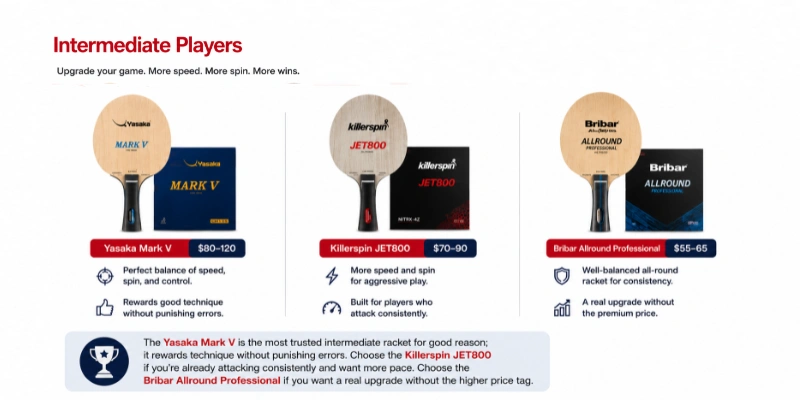
- Yasaka Mark V ($80–120): 5-ply all-wood blade paired with Mark V rubber. Perfectly balances speed, spin, and control, rewarding good technique without punishing small mistakes, trusted by coaches worldwide.
- Killerspin JET800 ($70–90): 7-ply carbon-reinforced blade with Nitrx-4Z high-tension rubbers. Noticeably more speed and spin than an all-round setup, built for players who are already attacking consistently.
- Bribar Allround Professional (~$55–65): A well-balanced all-round blade with a strong reputation among club-level players. Sits between the Mark V and JET800 in price, a genuine step up from beginner gear without reaching premium territory.
The Yasaka Mark V is the most trusted intermediate racket for good reason; it rewards technique without punishing errors. Choose the Killerspin JET800 if you’re already attacking consistently and want more pace. Choose the Bribar Allround Professional if you want a real upgrade without the higher price tag.
???? Still deciding between speed and control? Dive deeper in our full Intermediate Racket Guide for testing notes on every setup.
3. Best for Advanced & Pro Players
If you’re competing in leagues or tournaments, you need elite-level equipment. Advanced players have two paths: premade professional (factory-assembled) or custom (choose blade and rubbers separately). Both deliver elite performance; the right one depends on whether you value convenience or control.
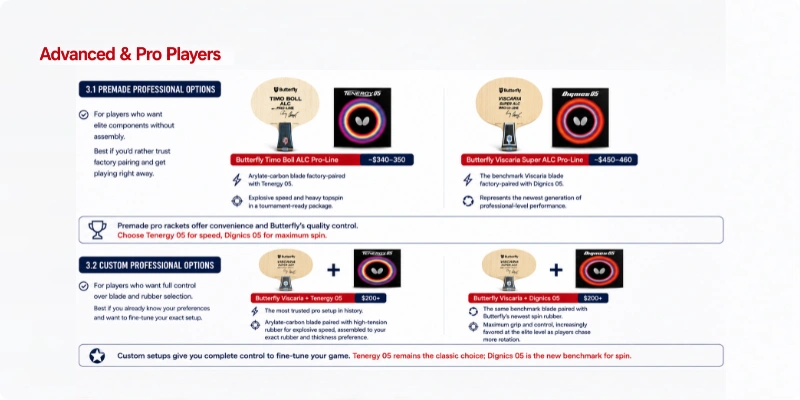
3.1 Premade Professional Options
For players who want elite components without assembly. Best if you’d rather trust factory pairing and get playing right away.
- Butterfly Timo Boll ALC Pro-Line + Tenergy 05 (~$340–350): Arylate-carbon blade factory-paired with Tenergy 05. Explosive speed and heavy topspin in a tournament-ready package, built around one of the most trusted names in the sport.
- Butterfly Viscaria Super ALC Pro-Line + Dignics 05 (~$450–460): The benchmark Viscaria blade factory-paired with Dignics 05 for maximum spin. Represents the newest generation of professional-level performance available premade.
Premade pro rackets offer convenience and Butterfly’s quality control. Choose Tenergy 05 for speed, Dignics 05 for maximum spin.
3.2 Custom Professional Options
For players who want full control over blade and rubber selection. Best if you already know your preferences and want to fine-tune your exact setup.
- Butterfly Viscaria + Tenergy 05 ($200+): The most trusted pro setup in history. An arylate-carbon blade paired with high-tension rubber for explosive speed, assembled to your exact rubber and thickness preference.
- Butterfly Viscaria + Dignics 05 ($200+): The same benchmark blade paired with Butterfly’s newest spin rubber. Maximum grip and control, increasingly favored at the elite level as players chase more rotation.
Custom setups give you complete control to fine-tune your game. Tenergy 05 remains the classic choice; Dignics 05 is the new benchmark for spin. If you’re ready to go all-in on performance, explore our complete Professional Racket Guide for the full premade vs. custom breakdown.
4. Best Alternative Pick for Each Level
Not every player fits neatly into one profile, and your main pick above isn’t the only good option out there. Sometimes the second-best racket is actually the better fit for how you play. If you want something with a slightly different balance of speed, spin, or price, here’s a solid alternative for every skill level.
- Beginner Alternative — DHS 4002 ($30–40): 5-ply all-wood blade paired with tacky, spin-friendly rubber. More demanding than the Palio Expert 3.0, but rewards players already taking regular coaching with genuinely better spin generation.
- Intermediate Alternative — Tibhar Stratus Power Wood + Rakza 7 ($110–150): A faster blade paired with high-tension rubber built for looping. More attacking than the Mark V, JET800, or Bribar Allround, ideal once your basic strokes are consistent and you’re ready to add real rotation.
- Advanced Alternative — Stiga Allround Classic + DNA Pro ($90–110): A well-balanced all-round blade with strong built-in speed. A genuine step into pro-level performance at a fraction of the Butterfly Viscaria’s price.
These aren’t downgrades; they’re different priorities. Choose the DHS 4002 for spin over control, the Tibhar Stratus if you’re ready to attack early, or the Stiga Allround if you want pro-tier performance without the pro-tier price. For the full story behind each of these picks, head to our Budget, Spin, and Professional Racket Guides.
How Do the Top Rackets Compare: Side-by-Side?
Still deciding between two or three rackets? This table puts every spec side by side so you can compare speed, spin, control, weight, and price at a single glance. No scrolling back and forth. Just the facts. If one racket keeps standing out across every column, that is your answer.
| # | Racket | Blade | Rubber | Sponge | Weight | Spin | Price Range |
|---|---|---|---|---|---|---|---|
| 1 | Palio Expert 3.0 | 5-ply all-wood | Palio CJ8000 (both sides) | 2.2mm | ~174g | High | $35–45 |
| 2 | Stiga Pro Carbon | 7-ply (5 wood + 2 carbon) | Stiga premium tensor (both sides) | 2.0mm | ~185g | 7.5/10 | $50–60 |
| 3 | Stiga Elite | 5-ply all-wood | Inverted rubber (both sides) | ~2.0mm | ~170g | Moderate | ~$20 |
| 4 | Yasaka Mark V | Yasaka Sweden Extra (5-ply all-wood) | Yasaka Mark V (both sides) | 2.0mm | ~180g | 8/10 | $80–120 |
| 5 | Killerspin JET800 | 7-ply (5 wood + 2 carbon) | Nitrx-4Z (both sides) | 2.0mm | ~180g | 8.5/10 | $70–90 |
| 6 | Bribar Allround Professional | Tibhar Falcon Allround (5-ply all-wood) | JOOLA Zack (both sides) | Max thickness | ~175g | 7.5/10 | ~$55–65 |
| 7 | Timo Boll ALC Pro-Line + Tenergy 05 | Timo Boll ALC (5-ply wood + 2 arylate carbon) | Tenergy 05 (both sides) | 2.1mm | ~180g | 9/10 | $340–350 |
| 8 | Viscaria Super ALC Pro-Line + Dignics 05 | Viscaria Super ALC (5-ply wood + 2 super arylate/carbon) | Dignics 05 (both sides) | 2.1mm | ~185g | 9.5/10 | $450–460 |
| 9 | Viscaria + Tenergy 05 | Butterfly Viscaria (5-ply wood + 2 arylate carbon) | Butterfly Tenergy 05 (both sides) | 2.1mm | ~180g | 9.5/10 | $200+ |
| 10 | Viscaria + Dignics 05 | Butterfly Viscaria (5-ply wood + 2 arylate carbon) | Butterfly Dignics 05 (both sides) | 2.1mm | ~180g | 9.5/10 | $200+ |
| ⚡ Click product names to purchase. All prices verified July 2026. All picks ITTF approved. | |||||||
When Should You Upgrade Your Table Tennis Racket: Progression Map?
One of the most common mistakes players make is upgrading too early, and the second most common is waiting too long. This map shows exactly which racket fits each stage, what to prioritise, and when to move up. At Racket Insiders, we’ve tested every racket on this list hands-on, so the budget ranges and upgrade triggers are based on real play, not manufacturer specs.
| Current Racket | Signs It’s Time to Upgrade | Upgrade To |
|---|---|---|
| Stiga Elite | You’re playing regularly, not just casually, and want to start building real technique | Palio Expert 3.0 (more control) or Stiga Pro Carbon (more speed) |
| Palio Expert 3.0 | Rallies feel too slow; you’re generating spin but can’t put opponents under pressure | Stiga Pro Carbon (more speed) or Yasaka Mark V (more all-round performance) |
| Stiga Pro Carbon | You’re consistently attacking first and want a bat that rewards technique instead of raw power | Yasaka Mark V |
| Bribar Allround Professional | You want more raw attacking speed than an all-round setup provides | Killerspin JET800 |
| Yasaka Mark V | You’re looping consistently and it feels like the bat is holding your pace back, not helping it | Killerspin JET800 |
| Killerspin JET800 | You want tour-level components without building a setup yourself | Butterfly Timo Boll ALC Pro-Line + Tenergy 05 (speed) or Viscaria Super ALC Pro-Line + Dignics 05 (spin) |
| Timo Boll ALC Pro-Line + Tenergy 05 | You want full control over blade/rubber choice and are ready to glue your own setup | Butterfly Viscaria + Tenergy 05 (custom) |
| Viscaria Super ALC Pro-Line + Dignics 05 | Same as above — you want the custom-build flexibility instead of a fixed premade sheet | Butterfly Viscaria + Dignics 05 (custom) |
| Butterfly Viscaria + Tenergy 05 | You’re chasing more spin against heavy incoming balls, especially in serve-receive | Butterfly Viscaria + Dignics 05 |
| Butterfly Viscaria + Dignics 05 | This is the ceiling in this guide — no further upgrade needed | — |
| ⚡ Click product names to purchase. All prices verified July 2026. All picks ITTF approved. | ||
Follow this path, and you will never buy a racket that is too fast or stay on one that is holding you back.
How Do You Choose the Right Table Tennis Racket?
Choosing the right ping pong racket is not about finding the most expensive option or the most popular brand. It is about matching equipment to your current skill level, playing style, and goals. The wrong racket will actively slow your development and build bad habits that take months to undo. The right one will make practice feel productive, and matches feel winnable.
1. Match Your Skill Level First
This is the single most important decision you will make. Buy a racket that is too fast, and every imperfect stroke gets punished. Buy one that is too slow, and your development hits a ceiling. Get this right, and everything else falls into place.
- Beginners need maximum control.
- Intermediates need a balance of speed and control.
- Advanced players need speed that rewards consistency.
When in doubt, choose one level below where you think you are.
2. Understand Blade Types
The blade is the engine of your racket. It determines how much speed, control, and feedback you get on every shot. Choose wrong here, and no rubber can save you.
- 5-ply all-wood: Excellent control and feel. Best for beginners through advanced.
- 7-ply all-wood: Stiffer and faster. Best for intermediate to advanced.
- Carbon fibre: Explosive speed, amplifies errors. Best for advanced players only.
Do not jump to carbon until your all-wood technique is solid. Confused between all-wood, carbon, and composite blades? Our full Table tennis blade guide breaks down materials, ply counts, and which one fits your playing style.
3. Choose the Right Rubber and Sponge
Rubber is where spin comes from. Too hard, and you will struggle to generate any rotation. Too soft, and you will lack the grip to load the ball. Match the rubber to your arm speed.
- Soft rubbers (36–40°) are more forgiving. Best for beginners.
- Hard rubbers (47–52°) require fast strokes. Best for advanced players.
- 1.8–2.0mm sponge provides the ideal balance for most players.
- Tacky rubbers (like DHS Hurricane) generate excellent spin but require a brushing technique.
Never pair a fast blade with hard rubbers as a beginner. From inverted to pips-out, tacky to non-tacky, thin to thick sponge; our complete table tennis rubber guide helps you choose the right surface for your game.
4. Budget Guide
Your budget determines how far up the performance ladder you can climb. Spending more does not always mean playing better, but spending too little guarantees bad habits. Here is where your money actually makes a difference.
- Under $20: Avoid completely.
- $20–34: Budget/family beginner. Best: Stiga Elite.
- $35–49: Quality beginner. Best: Palio Expert 3.0.
- $50–69: Attacking beginner or value intermediate. Best: Stiga Pro Carbon or Bribar Allround Professional.
- $70–120: Intermediate. Best: Yasaka Mark V or Killerspin JET800.
- $200+: Custom professional. Best: Butterfly Viscaria + Tenergy 05 or Dignics 05.
- $340–460: Premade professional. Best: Timo Boll ALC Pro-Line or Viscaria Super ALC Pro-Line.
If your budget sits right around $100, see our best table tennis racket under $100 guide for tested picks that deliver genuine performance without the pro price tag.
5. Premade vs Custom
This is the fork in the road. Premade rackets are ready to play out of the box, perfect for learning. Custom setups let you dial in every detail, but require knowledge and assembly. Start in the right lane.
- Premade: Best for beginners. Ready to play. $35–460. Replace the entire racket to upgrade.
- Custom: Best for defined playing styles. Requires assembly. $200+. Replace blades or rubbers independently.
Start with premade. Move to custom when your style is clearly defined, and you’re ready to fine-tune blade and rubber independently rather than replacing the whole racket.
The perfect table tennis racket does not exist, but the perfect racket for you does. Start with a control setup, match your blade to your skill level, and upgrade only when your current setup feels genuinely too slow. Follow this framework, and you will never waste money on a racket that holds you back. Not sure what blade, rubber, or sponge actually does? Start with our complete table tennis racket guide covering every component in detail
How Do You Maintain a Table Tennis Racket?
Even the best racket deteriorates quickly without proper care. Rubber is the most expensive and perishable part of your setup; protect it. A $200 racket plays like a $20 racket within months if you ignore basic maintenance. According to ITTF equipment guidelines, rubber degradation is one of the most common causes of unexpected performance drop-off in club players.
- Always store in a racket case. Exposure to dust degrades rubber performance within weeks.
- Clean the rubber after every session with a dedicated rubber cleaner and foam. Never use household products.
- Keep away from direct heat and sunlight. Both accelerate rubber deterioration significantly.
- Replace rubbers every 6–12 months, depending on play frequency. A dead rubber drastically reduces spin and speed.
- Never leave the racket in a hot car. Heat warps the blade and permanently ruins the rubber.
Clean after every session, store in a case, and replace rubbers yearly. Your equipment and your game will thank you. A clean racket plays better and lasts longer. Follow our complete step-by-step cleaning guide, including what to use, what to avoid, and how often to clean each part.
Verdict: Which One Should You Pick?
After testing every racket on this list, the Yasaka Mark V remains the best all-round choice for the widest range of players. It delivers the ideal balance of speed, spin, and control for intermediates, and is trusted by coaches worldwide for exactly that reason. At $80–120, it punches far above its price.
Recommendations by player type:
- Budget/family beginner: Stiga Elite
- Complete beginner: Palio Expert 3.0
- Attacking beginner / casual: Stiga Pro Carbon
- Value intermediate: Bribar Allround Professional
- Intermediate player: Yasaka Mark V
- Aggressive intermediate: Killerspin JET800
- Premade professional (speed): Butterfly Timo Boll ALC Pro-Line + Tenergy 05
- Premade professional (spin): Butterfly Viscaria Super ALC Pro-Line + Dignics 05
- Professional-level player: Butterfly Viscaria + Tenergy 05
- Next-gen spin professional: Butterfly Viscaria + Dignics 05
The right racket won’t win matches for you, but the wrong one will quietly cost you the match. Match your equipment to where your game is today, and your technique will do the rest. The right racket plus the right serve is unstoppable. Master your serve with our complete guide to table tennis serve, and master every point.
Conclusion
Finding the best table tennis racket is not about chasing the fastest blade or the most expensive rubber. It is about matching equipment to your current skill level, playing style, and budget. Every racket on this list earns its place through real, tested performance, not brand names or marketing budgets. We have covered everything from the best beginner bats to professional-grade setups, from what to avoid to how to maintain your gear. Whatever your level, your answer is somewhere in this guide.
Pick the racket that matches where you are now. Get your technique right. Then upgrade when the equipment is genuinely holding you back, not before. Once you’ve found your perfect racket, see how the pros do it. Read our full Mima Ito equipment guide to discover the unique blade and rubber choices behind one of table tennis’s most dangerous playing styles.
FAQs
What is the best table tennis racket overall?
The Yasaka Mark V. It delivers the ideal balance of speed, spin, and control for the broadest range of intermediate players, and is consistently recommended by coaches worldwide. At $80–120, nothing at this price comes close for all-round development.
What is the best table tennis racket for beginners?
The Palio Expert 3.0. Maximum control, genuine spin generation, and globally coach-recommended. At $35–45, it is the safest first purchase available. It is ITTF-approved, so it works in leagues and tournaments from day one.
What rackets do professionals use?
Almost universally, custom setups. The most common blade is the Butterfly Viscaria. Tenergy 05 was the dominant rubber for years; Dignics 05 is now taking over at the elite level. No professional uses a premade racket.
Are expensive rackets worth it?
For intermediate and advanced players, yes, within reason. For beginners, expensive rackets are actively counterproductive; they are too fast and too unforgiving for developing technique. The sweet spot: beginners $20–60, intermediates $70–120, advanced (custom) $200+, advanced (premade pro) $340–460.
What is the best table tennis racket under $50?
The Palio Expert 3.0 at $35–45 for most players. It’s the best-value option under $50 for players building correct technique from the start. If budget is the top priority, the Stiga Elite ($20+) is a lower-cost alternative for casual or family play, though it won’t develop technique as effectively.
When should I upgrade my table tennis racket?
When your current racket feels consistently too slow, when your strokes are reliable and repeatable under pressure, and when you are playing at club level or preparing for competition. When in doubt, wait longer. Upgrading too early is far more common and more damaging than upgrading too late.
Please Write Your Comments