Mima Ito Equipment: Blade, Rubbers & Full Setup (2026)
Updated: October 16, 2026
539
The world’s most unpredictable female table tennis player pairs a backhand rubber most club players wouldn’t consider with a signature blade built for close-to-table speed. Her setup is simpler than it looks, and every piece has a reason.
Mima Ito uses the Nittaku Mima Ito Carbon blade, with Nittaku Fastarc G-1 (2.0mm, black) on her forehand and Nittaku Moristo SP short pips (Max sponge, red) on her backhand (reviewed October 2026). This setup is built for close-to-table aggression: fast punches, flat hits and unpredictable spin variation. She is the Tokyo 2020 Olympic mixed doubles gold medalist and a women’s singles bronze medalist, with a winning record against several top Chinese players.
Whether you’re an advanced player looking to replicate her setup or simply curious about what drives her game, this guide covers the complete Mima Ito equipment setup: blade, rubbers, the reasoning behind each choice, and what you actually need to know before buying.
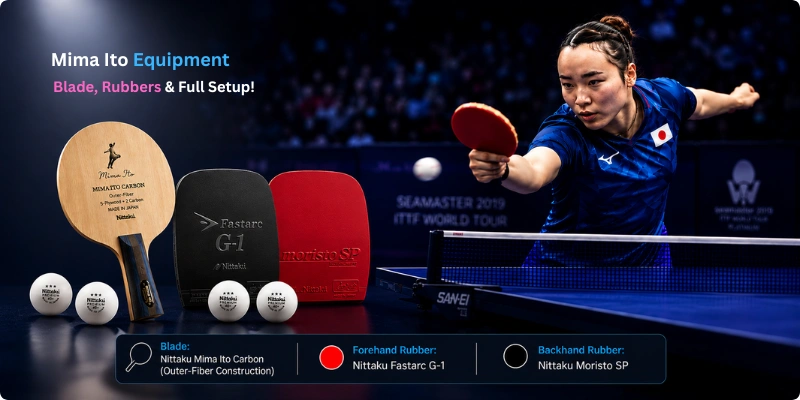
Table of Contents
Mima Ito’s Current Equipment Setup (2026)
Mima Ito’s current setup pairs her signature Nittaku blade with Fastarc G-1 on the forehand and Moristo SP short pips on the backhand. Her rubbers have stayed the same since the signature blade launched in 2020.
| Component | Equipment |
|---|---|
| Blade | Nittaku Mima Ito Carbon (5-ply wood + 2-ply FE carbon) |
| Forehand Rubber | Nittaku Fastarc G-1 (2.0mm, black) |
| Backhand Rubber | Nittaku Moristo SP (Max sponge, red) |
If you want to see how this compares to the game’s most dominant attacker, check out our guide to Sun Yingsha’s equipment setup.
Who Is Mima Ito?
Mima Ito (born 21 October 2000, Iwata, Shizuoka, Japan) is one of the most recognizable names in modern table tennis. She burst onto the international scene as a teenager and has since become one of Japan’s most successful female players. Her fearless, attacking style has made her a fan favorite and a nightmare for opponents, especially the dominant Chinese players who have long ruled the sport.
At ten, Mima Ito became the youngest player to win a match at the Japanese senior championships, and at 14 she became the youngest winner of an ITTF World Tour women’s singles title (2015 German Open). She reached a career-high ranking of World No. 2 in April 2020 and currently sits at World No. 8 as of 2026.
Major titles:
- Tokyo 2020: Mixed doubles gold, women’s singles bronze, women’s team silver
- Rio 2016: Women’s team bronze (youngest Olympic table tennis medalist)
- World Championships: Multiple silver and bronze medals
- ITTF World Tour: Multiple singles and doubles titles
Often termed the greatest threat to Chinese dominance, Ito is credited with the highest winning rate against Chinese players in women’s table tennis history. In March 2020, she beat reigning Olympic champion Ding Ning 4-0 in the Qatar Open semifinals. For a deeper look at her journey, achievements, and personal background, read our complete Mima Ito profile and career overview.
Mima Ito’s Playing Style
To understand Mima Ito’s equipment choices, you first need to understand how she plays. Her game is built on speed, unpredictability, and relentless aggression, a style that demands a very specific setup to execute effectively.
Mima Ito’s game is defined by close-to-table aggression, short-pips backhand punches, flat forehand smashes, and lethal shovel serves. The key characteristics of her playing style are:
- Close-to-table dominance: Plays close to the table and relies heavily on her backhand
- Short-pips backhand: Hits flat, fast punches with minimal backswing instead of conventional backhand loops
- Finish points quickly: Her style is to finish rallies in two or three shots
- Creative serve and returns: Shovel serves and spin variation make her hard to read
Ito is known for her creativity, her willingness to experiment, and her comebacks when taking risks while trailing. For a complete tactical breakdown, check out the full Mima Ito’s Playing Style guide
Mima Ito’s Equipment Breakdown
Ito’s setup looks simple on paper: one blade, two rubbers. But that simplicity is deceptive. The FE carbon placement changes how the blade flexes. The forehand rubber’s grip and firm sponge change how the ball launches. The short pips change the entire dynamics of her backhand game. Behind every choice lies a reason tied directly to how Ito wins matches.
1. The Blade: Nittaku Mima Ito Carbon
The Nittaku Mima Ito Carbon is Mima Ito’s signature blade, a 5+2 offensive blade released for her 20th birthday in October 2020. It is based on the Acoustic Carbon she had been using for years, with FE carbon fibre layers near the surface plate. The result is a blade that delivers genuine offensive speed without sacrificing the touch that close-to-table play demands.
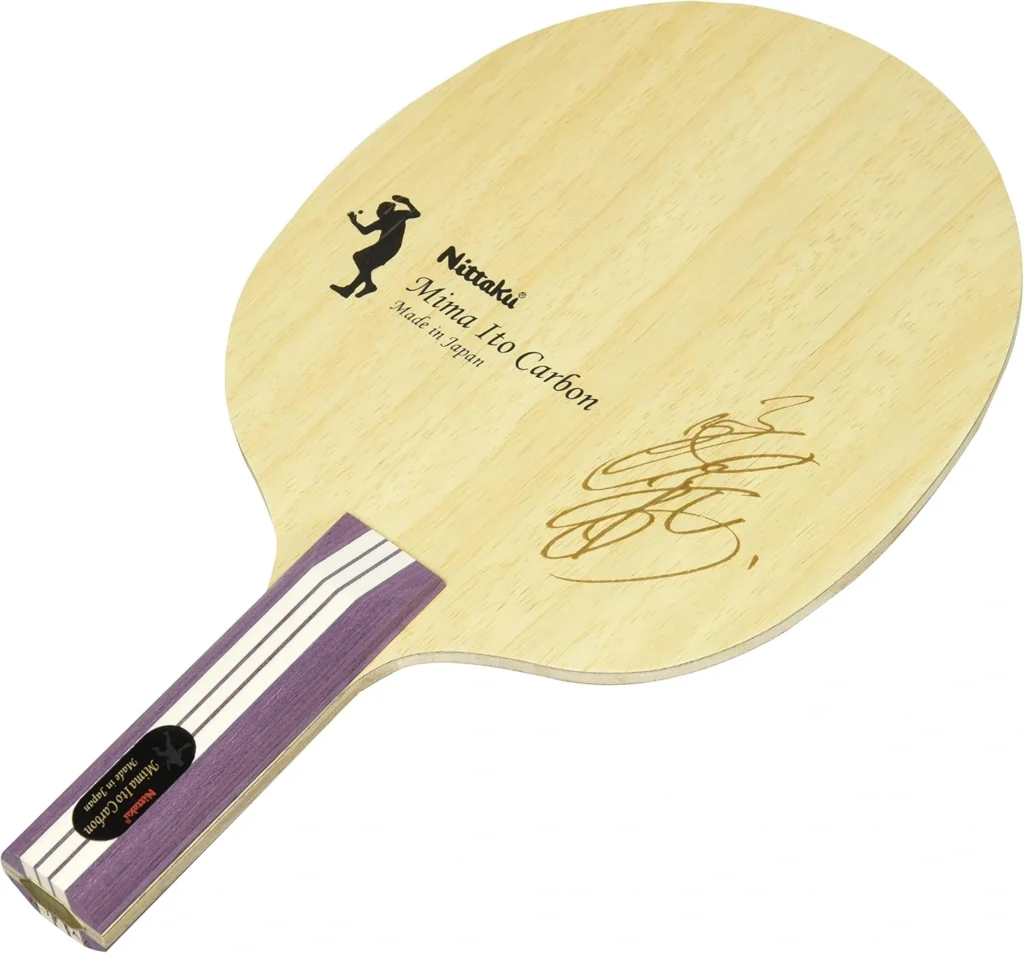
Key Specifications:
- Construction: 5-ply wood + 2-ply FE carbon (5+2)
- Blade size: 157 x 150mm
- Thickness: 5.5mm
- Weight: approx. 90g (blade only)
- Handle options: straight or concave (flared)
- Shot feeling: firm and crisp
- Speed rating: OFF (offensive); some retailers list OFF+
Note: This is the outer-fiber version of the Acoustic Carbon platform. Don’t confuse it with Nittaku’s separate Acoustic Carbon Inner model, a different product with a softer, all-wood-like feel from its carbon layers being placed nearer the core rather than the surface. The commercial blade ships with either handle. Pick based on your own grip, not hers.
What’s Special About It
The FE carbon construction is what sets this blade apart from standard all-wood blades. Here’s what makes it unique:
- Outer-type FE carbon near the surface plies adds speed and attack power on both wings
- Gold Mima Ito autograph on the forehand face
- Grip slightly modified at Ito’s request to make forehand-backhand switches easier
- Based on the Acoustic Carbon platform she used for years
Why Ito Uses It
Ito’s game is built around close-to-table aggression, lightning-fast punches, and relentless pressure from the moment she receives serve. The Mima Ito Carbon matches that style precisely.
- The FE Carbon accelerates the ball on attacking strokes, keeping enough feel for short pushes and her backhand punch
- The firm feel gives sharp, direct contact for punch shots
- The offensive speed finishes points, while the linear response keeps close-table play controlled
- At about 90 grams, it balances power with quick wrist action
The Nittaku Mima Ito Carbon is purpose-built for close-table attackers. It’s fast and firm, which suits Ito’s aggressive style but demands solid technique. If you stay close to the table and rely on quick punches and flat hits, this blade will amplify your strengths. If mid-distance looping, a more flexible blade will probably suit you better.
2. Forehand Rubber: Nittaku Fastarc G-1
The Nittaku Fastarc G-1 is Mima Ito’s forehand rubber, a grippy offensive inverted rubber with a 47.5° sponge, little catapult, and a high arc. It is one of the best-selling rubbers in Japan, and the most direct and stable of the three rubbers in Nittaku’s Fastarc series. For a player like Ito, who relies on both flat smashes and spinny loops, this rubber provides the versatility she needs.
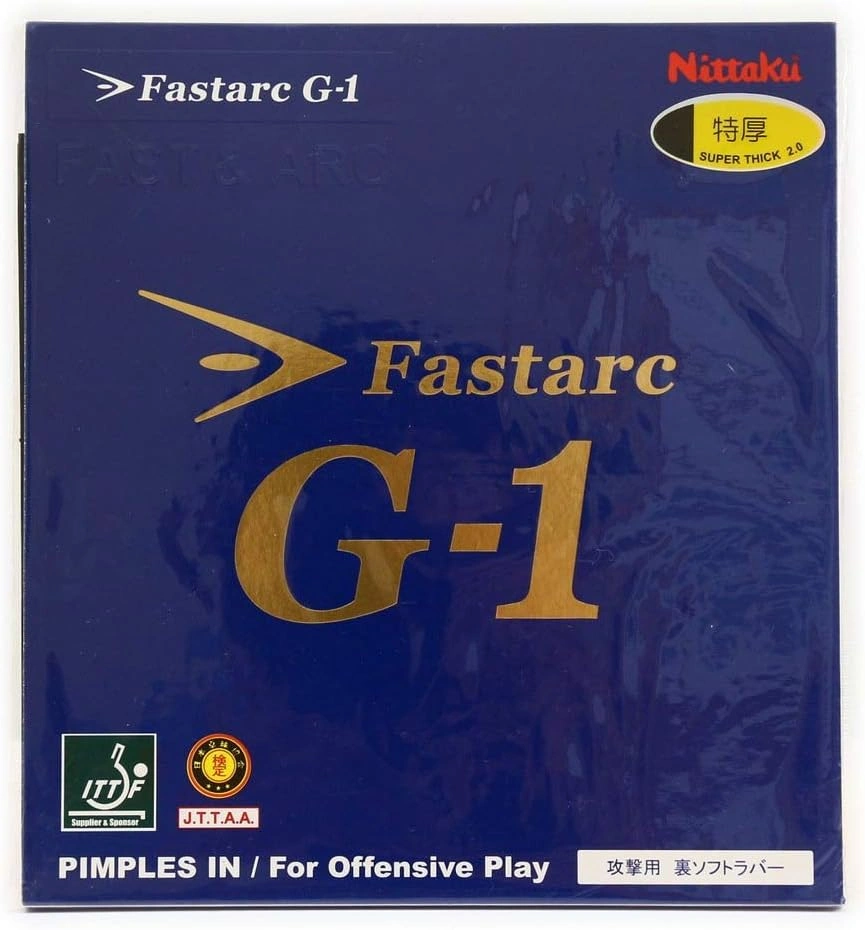
Key Specifications:
- Type: Inverted rubber (made in Germany)
- Sponge hardness: 47.5° (medium-hard)
- Nittaku ratings: speed 15.0, spin 12.5
- Ito’s thickness: 2.0mm
- Ito’s colour: Black
- Category: OFF (offensive)
Both of her rubbers stay within the ITTF’s 4mm combined-thickness limit (topsheet + sponge), the maximum for any legal rubber, so sponge thickness and hardness are what players tune for speed versus control.
What’s Special About It
The Fastarc G-1’s Grip First philosophy sets it apart from other tensor rubbers. Here’s what makes it special:
- Grippy surface for extra spin
- High ball trajectory which adds safety over the net
- Firm sponge with little catapult, so contact feels direct
- High speed that stays controlled
- Stable under pressure
Why Ito Uses It
Flat smashes and spinny loops define Ito’s forehand game, and the Fastarc G-1supports both. Its grip and direct response suit that mix, and Nittaku lists it as the forehand half of her setup, paired with Moristo SP on the backhand.
- Direct, predictable response for flat hits
- Grippy topsheet for spin on loops
- High arc gives a safety margin for aggressive shots
- Little catapult keeps placement controlled
The Fastarc G-1 is a grippy, direct rubber for offensive players with an active topspin game. Nittaku says it is a poor fit if you want a very powerful catapult or a very slow surface.
3. Backhand Rubber: Nittaku Moristo SP
The Nittaku Moristo SP is Mima Ito’s backhand rubber, a short-pimple offensive rubber with a 40° sponge, very high speed, and above-average spin for short pips. It brings Nittaku’s Tension Technology to short pimples, making it a specialist rubber for players who want to attack quickly and disrupt opponents with speed and variation.
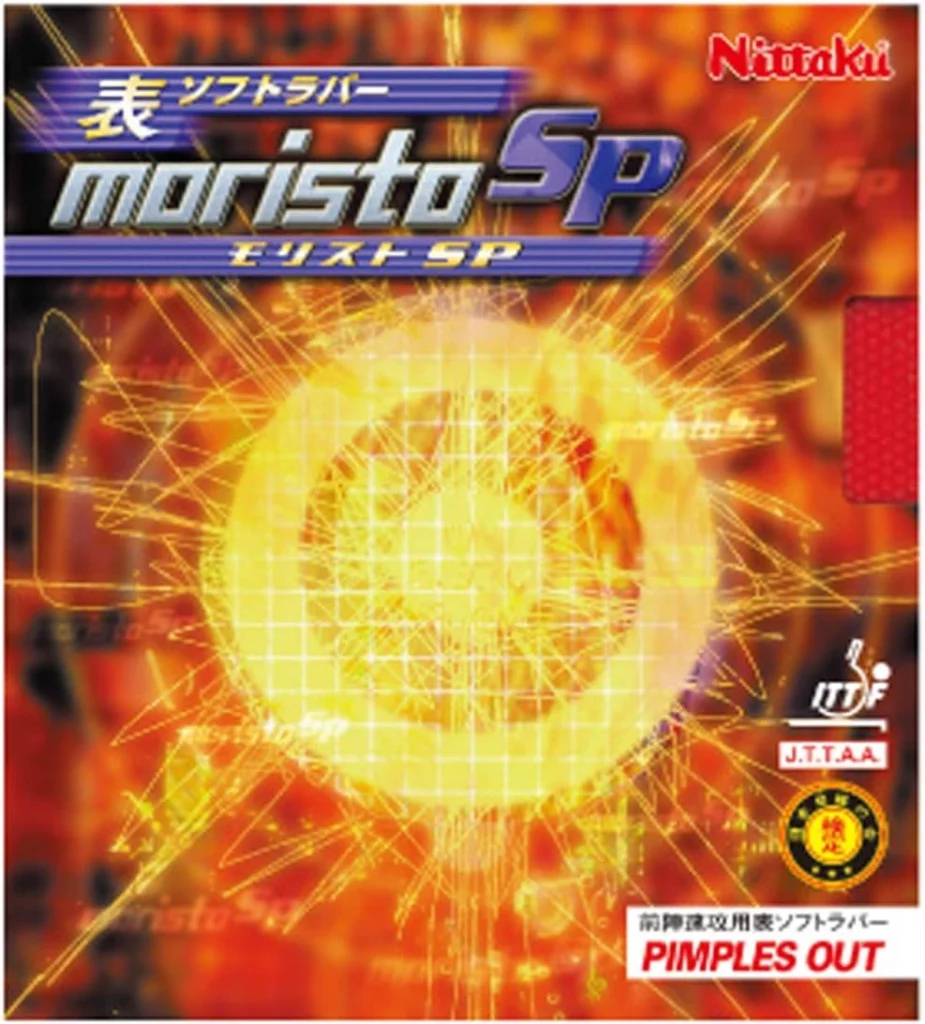
Key Specifications:
- Type: Short pips (pimples out), vertically arranged
- Sponge hardness: 40°
- Nittaku ratings: speed 12.5, spin 7.5
- Ito’s thickness: Max sponge
- Ito’s colour: Red
- Category: Offensive(OFF)
Don’t confuse it with the Moristo SP AX, which has closer, horizontally arranged pimples and more spin.
What’s Special About It
Short pips are rare at the professional level, and the Moristo SP is one of the most advanced examples. Here’s what makes it special:
- Very high speed for counter-attacks and early attacks
- Above-average spin for a short-pimple rubber
- Direct contact with a flat trajectory
- Low susceptibility to cuts, for safe blocks and counters
- Elastic 40° sponge adds dynamics without losing control
Why Ito Uses It
The backhand side demands different qualities from the forehand. Where the Fastarc G-1 is built for spin and arc, the Moristo SP delivers fast punches, controlled blocks and variation at the table, all essential to Ito’s game.
- Short pips enable flat, fast punch shots with minimal backswing, so she can build pressure early
- Stable blocks against heavy spin
- High tension gives speed and spin while staying controllable
- Flips and openings stay safe and precise
The Moristo SP is not for everyone, since short pips demand a different technique. Nittaku positions it for players who want to attack quickly, directly, and in a controlled manner close to the table.
Rubbers That Pair Well With This Blade
The Nittaku Mima Ito Carbon is not limited to Ito’s own rubbers. If you don’t want to copy her exact rubbers, one reviewer recommends pairing the blade with a spin-focused tensor rubber on the forehand, and says Moristo remains the best backhand choice. The pairings below come from that single review, so treat them as suggestions rather than tested recommendations.
- Forehand options: Andro Rasanter 48, DHS Goldarc, Nittaku Fastarc G-1
- Backhand option: Nittaku Moristo SP
This makes the blade a flexible platform even without Ito’s exact rubbers, but it is built for close-to-table attackers, so it suits that style best.
Mima Ito’s setup comes down to three parts: the Nittaku Mima Ito Carbon blade, Fastarc G-1 (2.0mm) on the forehand and Moristo SP (Max sponge) on the backhand. The blade and forehand rubber give her speed and spin, and the short-pips backhand adds fast punches and variation.
How This Setup Works Together
Ito’s equipment is not a random collection of premium gear; it is a unified system designed to execute her finish the point in two or three shots strategy. Each component complements the others, creating a setup that is greater than the sum of its parts.
The blade provides the firm, fast platform that bridges the two very different rubbers. The forehand rubber delivers spin and power for flat smashes and loops. The backhand rubber enables the signature punches and spin variation that make Ito so unpredictable.
- Blade (~90g): firm, fast, controlled platform that bridges the two very different rubbers
- FH G-1 (Firm): Enables flat smashes and spinny loops on the forehand
- BH Moristo SP (Elastic, short pips): Enables signature backhand punches and spin variation
Every piece connects to the tactical needs of close-table quick attacks and rhythm changes, which is why the setup works as a system rather than three separate products. For more on how a blade and two rubbers combine, see our complete guide to the official table tennis table dimensions and measurements.
Mima Ito Equipment History
Mima Ito’s equipment setup has been remarkably stable for years. Her rubbers have been the same two Nittaku models for years, and the one major change was the 2020 move to her signature blade. Tracking that history shows how a close-to-table attacking game can rest on a setup that barely changes as a player matures at the elite level.
| Period | Blade | Forehand | Backhand |
|---|---|---|---|
| 2018 to 2020 | Nittaku Acoustic Carbon | Nittaku Fastarc G-1 | Nittaku Moristo SP |
| 2020 onwards | Nittaku Mima Ito Carbon | Nittaku Fastarc G-1 | Nittaku Moristo SP |
The most significant change was the move to her signature blade in 2020. It uses the same construction as the Acoustic Carbon she had played for years, with a slightly modified grip and her gold signature on the forehand face.
The consistency is the story: she has kept the same two rubber models and refined only the blade. Want to compare Mima Ito’s choices with other elite players? Read our detailed breakdown of Fan Zhendong’s equipment to see how different playing styles demand completely different setups at the highest level.
Can You Buy Mima Ito’s Exact Equipment Setup?
Commercially, yes. The Nittaku Mima Ito Carbon, Fastarc G-1, and Moristo SP are all sold at retail, and Nittaku Deutschland even sells the blade and both rubbers as a bundle. However, unlike Butterfly’s double-code system for Fan Zhendong, we found no publicly documented personal version of Ito’s blade. The blade on sale is her signature model.
Nittaku does not say whether her tournament rubbers differ from retail stock, so treat any claim of an “exact” match with caution.
1. Budget Replica (~$200): Intermediate Advancing Players
Nittaku Acoustic (all-wood) blade, Fastarc C-1 on forehand, Moristo SP (1.8mm) on backhand. A solid entry point into the Ito platform without the cost or technique demands of the full setup. You still get the short-pips backhand that defines her game, with a softer, more forgiving blade and forehand rubber.
2. Tournament Ready (~$350): Advanced Club Players
Nittaku Mima Ito Carbon blade, Fastarc G-1 (2.0mm) on forehand, Moristo SP (Max) on backhand. This matches Ito’s listed setup, and the bundle above makes it the simplest way to buy it. It is fast and demanding, so it suits players who already have solid close-to-table technique. If you can only choose one tier, this is the one.
3. Pro Personal (~$400+): Elite and Collectors Only
Nittaku Mima Ito Carbon chosen by weight and assembled by a specialist dealer, with fresh rubbers fitted to your preferred sides. Some dealers, including Nittaku Deutschland, will weigh blades on request and assemble the rubbers for you. For most players, this tier is academic. For serious collectors and elite competitors, it represents the outer edge of what’s practical to buy.
You can buy the same models Ito plays, and for most players the retail versions are more than enough to experience what makes her setup work. If Mima Ito’s setup seems too advanced for your current level, browse our complete table tennis racket guide to find options better suited to your playing style and skill level.
To Get Closest to Ito’s Actual Playing Setup
The commercial versions are the same models Ito’s setup is built on. If you’re serious about replicating her setup, here’s what you need to do. Start with the blade; it’s the foundation of the entire system. Then add the rubbers in the correct thicknesses and colours. Finally, make sure the handle fits your hand.
- Buy the commercial Nittaku Mima Ito Carbon: available at major retailers
- Buy Nittaku Fastarc G-1 at 2.0mm, in black: closest commercial match to her forehand
- Buy Nittaku Moristo SP at Max thickness in red: her listed backhand rubber
- Check the handle shape before purchasing: straight or concave; try in person if possible
Pre-assembled option: Nittaku Deutschland sells the blade, Fastarc G-1 and Moristo SP as one Mima Ito bundle, and will glue the rubbers on if you say which goes on each side. Check the thicknesses (2.0mm and Max) before ordering. Once you’ve got the racket sorted, our guide to maintaining your table tennis equipment helps it last.
Final Thoughts
Mima Ito plays the Nittaku Mima Ito Carbon blade with Fastarc G-1 (2.0mm, black) on the forehand and Moristo SP (Max, red) on the backhand, a setup built for close-to-table attack. The Nittaku Mima Ito Carbon gives her the speed-control balance she needs. The Fastarc G-1 delivers forehand spin with control. The Moristo SP delivers backhand speed and variation.
It is built for offensive players, so it suits advanced players best. For those players, understanding Mima Ito equipment, exactly what she uses and why, is a useful starting point for refining your own equipment choices.
Still unsure which setup is right for you? Start with our comprehensive best table tennis racket guide to find the perfect match for your game.
FAQs
What blade does Mima Ito use?
Mima Ito plays with the Nittaku Mima Ito Carbon, a 5-ply wood + 2-ply FE carbon blade weighing about 90g and 5.5mm thick, rated OFF (offensive), available with a straight or concave handle.
What rubbers does Mima Ito use?
Mima Ito plays Nittaku Fastarc G-1 (black, 2.0mm) on her forehand and Nittaku Moristo SP, a short-pips rubber (red, Max sponge), on her backhand.
What sponge thickness does Mima Ito use on each side?
Mima Ito uses 2.0mm sponge on her forehand (Fastarc G-1) and Max sponge on her backhand (Moristo SP).
Is the Nittaku Mima Ito Carbon the same as the Acoustic Carbon Inner?
No. The Nittaku Mima Ito Carbon is built on the outer-fiber Acoustic Carbon platform, with carbon right under the outer plies. Acoustic Carbon Inner is a separate blade with carbon placed nearer the core.
What grip does Mima Ito use?
Mima Ito uses a shakehand grip. Her signature blade comes with a straight or concave handle, and Nittaku says the grip was slightly modified at her request to make switching between forehand and backhand easier.
How much does Mima Ito’s full setup cost?
At Nittaku Deutschland, the Mima Ito Carbon blade, Fastarc G-1 and Moristo SP cost €239.90 as a bundle (regular €250.80, October 2026); the blade alone is €169. Prices vary by retailer and region.
Can amateurs use Mima Ito’s equipment setup?
Mima Ito’s setup is best suited to advanced players who play close to the table. The blade is fast, and the rubbers reward solid technique, so beginners are better served by a more forgiving setup.
Is there a pre-assembled version of Mima Ito’s racket?
Yes. Nittaku Deutschland sells the Mima Ito Carbon blade, Fastarc G-1 and Moristo SP as one bundle and will glue the rubbers on if you say which goes on each side. Check the thicknesses (2.0mm and Max) before ordering.
Do Mima Ito’s rubbers meet ITTF regulations?
Yes. Fastarc G-1 and Moristo SP are the rubbers she plays in competition, and the ITTF limits a rubber’s combined topsheet and sponge thickness to 4mm.
What rubbers pair well with the Mima Ito Carbon blade besides her own setup?
One reviewer recommends a tensor rubber on the forehand, such as Andro Rasanter 48, DHS Goldarc or Nittaku Fastarc G-1, and says Moristo SP remains the best backhand choice. These pairings come from a single review, so treat them as suggestions.
Please Write Your Comments