Table Tennis Rubber Hardness Explained: What It Is and How It Affects Your Game
Updated: September 15, 2026
77
Pick up two rubbers with the same hardness rating, and they can still feel nothing alike on the table, even at the same price point. One grips the ball and lets you brush heavy topspin from nowhere. The other feels like hitting a brick.
That contradiction trips up more players than any other spec on a rubber’s sheet. Table tennis rubber hardness sounds like the simplest number to compare, yet it’s also the one most likely to mislead you if you don’t understand how it’s actually measured and what it’s measuring in the first place.
This article breaks down what rubber hardness is, how it’s rated, and exactly how it changes speed, spin, control, and ball trajectory once you start playing with it.
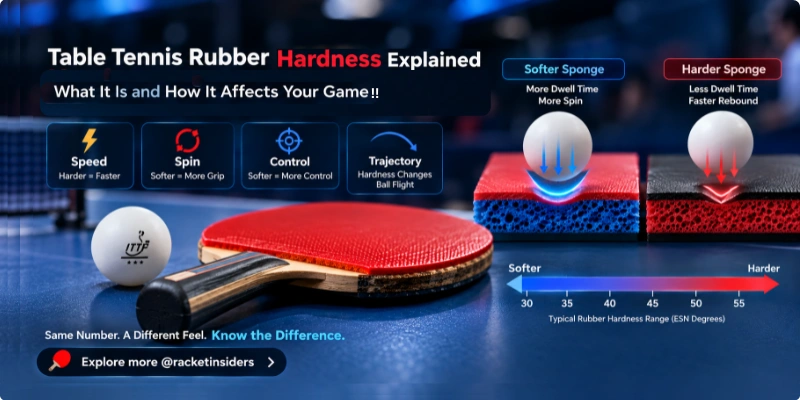
Table of Contents
What Is Table Tennis Rubber Hardness?
Table tennis rubber hardness measures how firm or soft the sponge layer beneath the topsheet is, rated in degrees on a scale that varies by manufacturer. The higher the number, the harder the sponge, and the less it compresses when the ball strikes it.
Every rubber has two layers: the topsheet that touches the ball, and the sponge underneath it. Hardness describes only the sponge, and it controls how much that sponge squashes on contact.
A harder sponge barely compresses and springs back fast, sending the ball out quickly. A softer sponge squashes more, holding the ball against the topsheet a fraction longer so the surface has time to grip and spin it. That fraction of a second is called dwell time, and it’s the reason hardness changes how a rubber plays:
- A softer sponge in the 30 to 40 ESN-degree range typically produces a dwell time of around 5 to 8 milliseconds
- A harder sponge in the 45 to 55 ESN-degree range compresses for only about 2 to 4 milliseconds
In short, hardness measures how long the ball stays in contact with the rubber, not just how firm the sponge feels to the touch, and that distinction drives everything else covered here.
The Table Tennis Rubber Hardness Scale Explained
Hardness isn’t measured on one universal scale, which is the detail most comparison charts leave out, and it trips up even experienced shoppers. It’s the reason two rubbers with identical numbers can play so differently.
Brands using a European or Japanese scale, often shorthanded as the ESN scale, and brands using a Chinese or DHS scale, rate the same physical sponge very differently. A 38° rating on the DHS scale plays as a genuinely hard rubber, while 38° on the ESN scale plays as noticeably soft; the same number, opposite ends of the spectrum.
A few points worth keeping in mind before comparing numbers across brands:
- Check which scale a manufacturer uses before assuming a 40 from one company plays anything like a 40 from another
- Even within the same general scale family, individual brands sometimes print their own internal hardness figures that don’t map cleanly onto a shared European standard
- Commercially available sponge hardness spans roughly 32.5° at the softest end up to 55° or higher at the hardest end, depending on which scale the manufacturer uses
Treat hardness ratings as useful for comparing within a brand, not as an absolute measurement across every brand on the market, especially when switching between Chinese and European rubbers.
Table Tennis Rubber Hardness Chart: DHS vs. ESN vs. Butterfly Scale
The table below shows how specific hardness ratings compare across three commonly referenced scales, pulled from documented brand comparisons rather than estimates. It’s a quick way to sanity-check a rating before assuming it matches a rubber you’ve already played:
| Category | Brand / Rubber | Printed Rating | Scale Used | Approx. ESN Equivalent |
|---|---|---|---|---|
| Medium-hard | DHS (generic) | 36° | DHS | ~45° |
| Hard | DHS (generic) | 39° | DHS | ~51° |
| Hard | DHS Hurricane 3 | 40° | DHS | ~53° |
| Medium-hard | Butterfly Tenergy 05 | 37° | Butterfly | ~47° to 48° |
| Hard | Butterfly Dignics 05 | 40° | Butterfly | ~51° to 53° |
| Hard | Butterfly Dignics 09C | 44° | Butterfly | ~55°+ |
Because DHS and Butterfly both use denser scales than the general ESN standard, a high-30s to low-40s rating on either brand’s packaging typically plays like a 47° to 55° ESN rubber.
Table Tennis Rubber Hardness List by Category
As a rough reference on the more common European-style scale, sponges are generally grouped into four broad bands, and most rubbers on the market fall clearly into one of them, regardless of brand or price. This list gives you a quick way to place any rubber once you know its rating.
1. Extra-soft: (under 37° ESN)
Extra-soft sponges are associated with elastic, high-dwell topspin exchanges at mid distance. Sponges in this range and the soft tier below also offer a larger sweet spot and can bottom out, losing power, on very fast or powerful strokes. Examples include the Tibhar Nimbus Sound and Gewo Proton Neo 325.
2. Soft: (37°–41° ESN)
Soft sponges are more forgiving and spin-friendly at moderate swing speeds. These sponges also produce a duller sound on contact and absorb slow, passive shots easily, which is part of why they suit players still building consistency. Examples include the Yasaka Rakza 7 Soft and Donic Baracuda.
3. Medium (42°–47° ESN)
Medium sponges occupy the market’s most common range, balancing spin, speed, and control. This middle ground avoids both extremes: it won’t bottom out, but it also doesn’t demand the fast, technically precise swing. Examples include the Andro Rasanter R42 and Yasaka Rakza 7.
4. Hard (47.5°+ ESN, or 37°+ DHS)
Hard sponges are built around high swing speed and maximum power output. Without that swing speed behind it, a hard sponge can feel dead and unresponsive rather than powerful. Examples include the Yasaka Rakza Z, Tibhar Evolution MX-P, and Xiom Omega 7 Tour.
Treat these as a sorting tool, not a precise cutoff, since a rubber at the edge of two bands can behave like either one depending on its topsheet.
How Hardness Changes Speed, Spin, Control, and Trajectory
Every hardness level shifts the balance between these four qualities rather than simply making a rubber better or worse, and no single number wins across every situation. This is why there’s no single table tennis rubber hardness that outperforms every other one across the board. Here’s how each one plays out on the table:
1. Speed
Harder sponges reward a fast, committed swing, since they store more usable energy at high impact force. Because the sponge resists compression, more of the incoming energy converts directly into ball speed, but only once the player generates enough racket speed to compress it properly.
2. Spin
Softer sponges often generate more usable spin at moderate swing speeds, since the longer dwell time lets the topsheet grip and rotate the ball before it leaves the rubber. Harder sponges can still produce very high spin, but typically require a faster, more committed stroke to unlock it.
3. Control
Softer sponges tend to be more forgiving on off-center or lower-effort contact, which is one reason they suit blocking and short game. Harder sponges offer less cushioning for a mistimed stroke, since there’s less compression to absorb an imperfect hit, and can feel dead or unresponsive on passive, slow-paced blocks where the sponge never fully compresses.
4. Trajectory
Sponge hardness also affects the ball’s throw angle, or the angle at which it launches off the rubber. Softer sponges tend to produce a higher throw angle, often in the 40 to 55 degree range, resulting in a loopier arc suited to topspin from mid-distance. Harder sponges tend to produce a lower throw angle, generally 25 to 35 degrees, resulting in a flatter trajectory more suited to drives and fast counter-hitting.
In short, a softer rubber wins on light shots, while a harder rubber pulls ahead once the swing gets fast enough to fully load it, the same trade-off behind every hardness decision.
Why Sponge Thickness Changes How Hardness Feels
Hardness and thickness are often confused, but they measure two different things, and mixing them up is one of the more common mistakes players make when comparing rubbers on paper, especially when shopping by spec sheet alone. Here’s how the two specs actually differ:
- Hardness describes the density of the sponge material itself, independent of how much sponge sits under the topsheet
- Thickness describes how much sponge sits under the topsheet, typically ranging from around 1.5mm up to the maximum allowed under competition rules
- Energy transfer increases with sponge thickness at a given stroke speed, regardless of how hard or soft that sponge is
- The relationship: thickness scales the size of the sponge’s energy reserve, while hardness determines how quickly that reserve releases its energy on contact
A thin, hard sponge and a thick, soft sponge can end up feeling surprisingly similar, so a hardness rating alone only tells half the story; thickness fills in the rest.
Forehand vs. Backhand: Does Hardness Differ by Side?
Many players deliberately run different hardness levels on each wing rather than matching both sides, since the two strokes place very different demands on the sponge during a rally. It’s a deliberate choice, not an accident of what came pre-installed. The two strokes ask for different things from the sponge:
- Forehand: typically runs harder, often 45° to 52.5° ESN, to power heavy loop drives with a longer, faster swing
- Backhand: typically runs softer to medium, around 40° to 47° ESN, for quicker reaction and better blocking control
- Why the split works: the forehand stroke is longer and built for generating pace, while the backhand relies on quicker, more compact contact where a forgiving sponge helps more than raw power does
This isn’t a fixed rule, but it’s the most common way experienced players divide hardness across the two sides of the racket.
Does the ITTF Regulate Rubber Hardness?
No, the ITTF does not regulate rubber hardness, and this is worth clarifying directly, since it’s a common point of confusion among players comparing equipment across different competitive levels and even different countries. ITTF equipment rules regulate rubber thickness and friction instead:
- Sandwich rubber, meaning topsheet plus sponge plus adhesive, is capped at a maximum of 4.0mm
- Pips-out rubber without a sponge is capped at a maximum of 2.0mm
- Every approved rubber must also meet a minimum coefficient of friction to be legal for competition
Hardness itself isn’t capped or standardized by the ITTF, which is exactly why hardness scales vary widely between manufacturers, with no shared standard to force them to align.
How Hardness Typically Aligns With Playing Level and Style
Sponge hardness is often discussed in terms of arm speed, meaning how fast and consistently a player can generate racket speed on their strokes, rather than experience level alone, since two players with years apart in experience can share the same arm speed. That distinction matters because two players at the same skill level can still need very different hardness ranges depending on how they generate power.
1. Lower arm speed
Commonly, beginners and some intermediate players tend to get more out of soft to medium sponges, generally in the 38° to 44° ESN range. The ball penetrates the sponge and produces a catapult effect even without a fast, committed swing. This makes soft sponges a practical starting point for building consistent technique.
2. Well-rounded players
The well-rounded players who mix power shots with placement and touch tend to sit in the medium range, which is why it remains the most widely sold category on the market. This balance suits players still refining their overall playing style and shot selection.
3. High, well-trained arm speed
Typically, the advanced attacking players get the most out of hard sponges, generally 48° to 55°+ ESN, since a hard sponge has effectively no upper speed limit; the ceiling is set by the player’s own technique rather than the rubber. This is why elite loopers can reach speeds most players simply can’t match.
4. Defensive and all-round playing styles
The defensive and all-round styles also tend to favor softer to medium sponges, since hard sponges produce less catapult effect on the slower, more controlled strokes used in blocking and short game. This forgiving feel helps defensive players control incoming spin more reliably.
Treat these as a starting point for narrowing your range, not a fixed label, since players cross over as their technique develops, often trending toward harder sponges over time.
Final Thoughts
Table tennis rubber hardness isn’t a difficulty setting or a badge of skill; it’s a physical property that interacts directly with how fast and how consistently a player swings, nothing more mystical than that. A harder sponge doesn’t automatically mean more spin or more speed in a given player’s hands. It means a higher ceiling that only gets reached once the technique behind it catches up.
Understanding dwell time, throw angle, and the scale differences between brands turns table tennis rubber hardness from a confusing number on a package into a genuinely useful spec. Refer to the hardness scale, hardness chart, and hardness list above whenever you’re comparing a new sheet to one you’ve already played, especially when crossing between brands.
FAQ
What does rubber hardness measure in table tennis?
It measures the density of the sponge layer beneath the topsheet, which determines dwell time, or how long the ball stays in contact with the rubber, and in turn affects speed, spin, control, and trajectory.
Why do two rubbers with the same hardness number feel different?
Different brands use different hardness scales. A number from a Chinese-scale rubber and the same number from a European-scale rubber can represent very different actual sponge densities.
Does a harder sponge always produce more speed?
Only once the player generates enough swing speed to compress it. Below that threshold, a softer sponge can feel faster and more responsive in practice, since it produces a catapult effect even on slower strokes.
Does the ITTF set rules on rubber hardness?
No. The ITTF regulates thickness and friction, not hardness. Hardness scales and hardness ratings are set independently by each manufacturer.
How does hardness affect ball trajectory?
Softer sponges tend to produce a higher throw angle, generally in the 40 to 55 degree range, creating a loopier arc. Harder sponges tend to produce a lower throw angle, generally 25 to 35 degrees, creating a flatter trajectory.
Does rubber hardness affect how long a rubber lasts?
Yes. Harder sponges generally resist wear better and hold their playing characteristics longer, while softer sponges tend to compress and lose grip sooner, especially under heavy training volume. This makes hardness worth factoring into replacement cost, not just initial feel.
Should forehand and backhand rubber hardness be different?
Often, yes. Many players run a harder sponge on the forehand, roughly 45° to 52.5° ESN, for powering loop drives, and a softer to medium sponge on the backhand, roughly 40° to 47° ESN, for quicker reaction and blocking.
Please Write Your Comments