Indoor vs Outdoor Table Tennis Table: Is There Really a Difference? (2026)
Updated: October 6, 2026
40
An indoor vs outdoor table tennis table looks almost identical: same top, same net, same size. So does it actually matter, or is outdoor just a label that adds money to the price? Most buyers learn the answer only after a damp garage warps the top.
The honest answer is that the difference between an indoor and outdoor ping pong table is real, but it depends far more on where the table will live than on the table itself. An indoor table is the better player in a dry, stable room. An outdoor table is the only safe choice once weather, humidity, or temperature swings enter the picture.
In this guide, we break down the indoor vs outdoor table tennis tables (also called ping pong tables), explaining when the difference matters and when it doesn’t, and give you the practical advice you need to choose the right one.
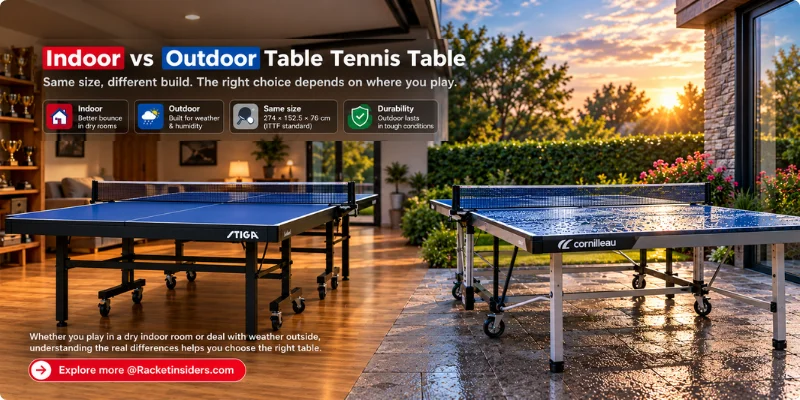
Table of Contents
Indoor vs Outdoor Table Tennis Table: Does It Really Matter?
Yes, but how much it matters depends on where the table will live and how seriously you play. The material under the paint is what separates the two, and that material decides how the table handles moisture, sun, and temperature changes, and how it bounces. Get that one choice right and everything else falls into place.
- In a dry, stable room, an indoor table plays better and costs less.
- In any damp or exposed space, an outdoor table is the only type that lasts.
- For casual play, the bounce difference is small; for serious practice, indoor wins.
- Some premium outdoor tables close most of the bounce gap with thick tops.
The practical rule: choose by location first. If the table stays in a stable, dry room, buy indoor. If it will ever face weather or humidity, buy outdoor.
The Official ITTF Rules for Table Tennis Tables
The International Table Tennis Federation (ITTF) sets one size and one bounce standard for tables, and only indoor tables are used in official competition. Size is identical for both types, so the rules matter mainly for bounce and approval. Here’s what the rulebook actually says.
- Size: 274 cm long, 152.5 cm wide, and 76 cm high (9 ft x 5 ft x 30 in)
- Bounce: A uniform rebound of about 23 cm when a standard ball is dropped from 30 cm.
- Thickness: Commonly 25 mm; sources disagree on a minimum, so treat 22 to 25 mm as typical.
- Approval: Official events require ITTF-approved tables. Outdoor tables generally cannot meet the bounce requirements, and concrete tables are not approved for international play.
That covers the legal side. For recreational, backyard, and outdoor play, ITTF approval is not required, so this article focuses on what the rules don’t answer: how the two types actually differ in use. For the full breakdown of table dimensions, see our guide to table tennis table dimensions.
Indoor Table Tennis Tables: Characteristics and Who Uses Them
Indoor tables are built for the best possible bounce in a controlled environment. They use wood-based tops, usually painted chipboard, MDF, or HDF, which give a consistent, predictable ball response but are not designed to handle weather. The trade-off is clear: better feel indoors, no protection outdoors.
[Image alt text: Indoor table tennis table with a thick wood-based top in a dry playing room.]
Key Characteristics
- Top material: Painted chipboard, MDF, or HDF (wood-based)
- Top thickness: Commonly 19 to 25 mm
- Bounce: Consistent and true, the closest to tournament conditions
- Weather resistance: None; moisture, sun, and temperature swings cause damage
Pros
- Better, more consistent bounce, especially on thick 19 to 25 mm tops
- Lower price at the same quality level
- Closer to club and tournament playing conditions
- Lighter frames on many models, so they are easier to move and fold
Cons
- Not weatherproof: humidity, rain, and sun can warp, swell, or fade the top
- Condensation from temperature swings can damage wood-based tops
- Not suited to patios, open spaces, or damp, unheated garages
- Some manufacturers explicitly state indoor tables are not rated for garage storage
Indoor tables are the standard choice for clubs, training halls, basements, and living or game rooms, and for anyone who practices for league or tournament play. They are also the best-value pick for a family with a dry, stable indoor space.
Outdoor Table Tennis Tables: Characteristics and Who Uses Them
Outdoor tables are built to survive the weather first and bounce second. They use aluminum composite, melamine, or resin-laminate tops, paired with rust-resistant frames and hardware, so they can stay outside through rain, sun, and temperature swings. The trade-off runs the other way: durability first, a slightly less refined bounce.
[Image alt text: Outdoor table tennis table with a weatherproof top and anti-glare finish on a patio.]
Key Characteristics
- Top material: Aluminum composite, melamine, or resin laminate
- Top thickness: Often 5 to 10 mm; up to 22 mm on premium models
- Bounce: Slightly firmer or softer; varies by model
- Weather resistance: Built for rain, UV, and temperature swings
Pros
- Weather-resistant top and frame designed for rain, UV, and temperature changes
- Anti-glare finishes (Cornilleau’s SOFTMAT and MATTOP coatings) that improve ball visibility
- Heavier frames that stay put better in light wind
- Large, rugged wheels on many models for lawns and uneven surfaces
- Usable indoors as well, with no risk to the table
Cons
- Slightly firmer, slower, or less consistent bounce on most models
- Higher price at the same quality level
- Heavier and bulkier to move and store
- Thin tops (often 5 to 10 mm) feel different from a thick indoor top
Outdoor tables are the standard choice for patios, yards, decks, damp or unheated garages, and public spaces. Permanent models use welded steel or concrete with a solid metal net, and Cornilleau even recommends its outdoor tables indoors, a manufacturer position, not a universal rule.
Indoor vs Outdoor Tables: Key Differences
Put the two types side by side, and the pattern is consistent across manufacturers, retailers, and player discussions. Nearly every difference traces back to one choice: wood-based tops for indoor tables and weather-resistant composites for outdoor tables. Here is how they compare, point by point.
1. Material and Construction
Indoor table tennis tables use wood-based boards that give a true bounce but absorb moisture, while outdoor tables use aluminum composite, melamine, resin laminate, or, for permanent models: concrete and steel. Frames follow the same split: standard powder-coated steel indoors, rust-resistant or galvanized hardware outdoors.
2. Bounce and Playing Feel
Indoor tables bounce more consistently, and this is the difference serious players notice most, while outdoor tops tend to feel slightly firmer or softer and less uniform. Thickness drives much of this: premium outdoor tops around 22 mm approach the bounce of a typical 19 mm indoor table, while concrete tables have the weakest bounce of any type.
3. Size, Weight, and Folding
Regulation tables of both types share the same size: 9 ft x 5 ft x 30. So, an outdoor table needs the same floor space, despite claims that outdoor tables are larger. The real difference is weight: outdoor models run from roughly 130 lb to 265 lb, both types fold in half at the net with playback mode, and many outdoor tables add large wheels for rough ground.
4. Cost
The outdoor ones usually cost more at the same quality level, but estimates of the gap vary widely, from entry-level indoor tables near $200 against outdoor tables near $400, to a couple of hundred dollars more for comparable quality. A high-end indoor table can still cost more than a mid-range outdoor table, since the premium comes from weatherproof materials and rust-resistant hardware.
5. Weather Durability
Outdoor tables are built for rain, sun, and temperature swings, while indoor tables are not, and indoor tops can warp, swell, fade, or separate when exposed to moisture. Even a covered patio does not guarantee safety, because wind-driven rain and humidity still reach the table.
6. Glare and Visibility
Outdoor tables are usually finished with matte, anti-glare, and UV-resistant coatings so the ball stays visible in bright sun, and Cornilleau markets its SOFTMAT and MATTOP coatings as reducing glare significantly, a manufacturer claim, not an independent test result. Indoor tables are designed for controlled lighting and usually carry no special glare treatment.
7. Maintenance and Storage
Indoor tables need a dry, temperature-stable space, and a cover helps against dust but can trap moisture against the top in a damp garage and cause warping or blistering. Outdoor tables need less care: cover them when not in use, clean with mild soap, and tighten hardware occasionally, though a cover on an open table can blow away, so folded storage with straps works best.
In short, indoor tables win on bounce and price, while outdoor tables win on weather durability, glare control, and flexibility. The comparison table below puts all of these differences side by side.
Indoor vs Outdoor Tables: Full Comparison Table
This table pulls the key differences into one place so you can compare both types at a glance and see which fits your situation.
| Feature | Indoor table | Outdoor table |
|---|---|---|
| Top material | MDF, HDF, chipboard, or particleboard | Aluminum composite, melamine, resin laminate, concrete or steel (permanent) |
| Typical top thickness | About 12 to 25 mm | Often about 5 to 10 mm; up to 22 mm on premium models |
| Bounce | Consistent and true | Slightly firmer or softer; varies by model |
| Weather resistance | None | Built for rain, UV, and temperature swings |
| Glare control | Usually none | Often anti-glare and UV-coated |
| Size | 9 x 5 x 2.5 ft | 9 x 5 x 2.5 ft |
| Weight | Generally lighter | Generally heavier |
| Wheels and folding | Standard wheels; folds with playback mode | Often larger wheels; folds with playback mode; permanent options available |
| Net | Standard mesh net | Weather-resistant net; solid metal net on permanent tables |
| Cost | Lower at the same quality level | Higher at the same quality level |
| ITTF competition approval | Yes, on approved models | Generally no |
| Maintenance | Keep dry and temperature-stable | Cover, clean, check hardware |
| Best for | Dry rooms, clubs, competitive practice | Patios, yards, damp garages, public spaces |
| Difference most noticeable | In bounce and playing feel | In weather and moisture exposure |
| Difference least noticeable | In casual family play | In a dry, stable indoor room |
Indoor tables win on bounce and value; outdoor tables win on durability and flexibility.
Can You Use an Indoor Table Outside, or an Outdoor Table Inside?
An outdoor table works fine indoors, but an indoor table should not be used or stored outside. The risk runs in one direction only, which makes this one of the most searched questions about the two types. The short answers are below, followed by the garage, where the rules are less clear-cut.
1. Can you use an indoor table tennis table outside?
Only briefly, in dry weather, and only if you bring it back inside afterward. Rain, humidity, direct sun, and temperature swings can all cause warping, swelling, or fading, and even short exposure carries risk. Leaving it out overnight or through wet weather can damage the wood-based top beyond repair, so treat outdoor use as temporary, never as storage.
2. Can you use an outdoor table tennis table indoors?
Yes, with no risk to the table. Outdoor tables are built to handle worse conditions than any indoor room will throw at them, so temperature swings and humidity pose no threat. The trade-off is feel: the bounce may be slightly firmer or less consistent than a higher-end indoor table, so it suits casual play and damp rooms, though serious players may notice the difference.
3. Can you keep an indoor table tennis table in a garage?
An indoor table tennis table can stay in a garage only if the garage remains dry and at a moderate temperature. If the garage gets damp, hot, cold, or swings between them, buy an outdoor table instead, because condensation can warp or blister wood-based tops. Sources disagree on this: some manufacturers don’t rate indoor tables for garage storage at all, and Cornilleau recommends outdoor tables for garages.
If you can’t guarantee a dry, stable garage all year, buy an outdoor table. It costs more up front, but it won’t warp or blister when the weather turns, and it still plays fine if you ever move it indoors.
Which Should You Actually Choose?
The choice comes down to where the table lives and how seriously you play, not which type sounds better on paper. Use the breakdown below as a starting point, then check the specific model’s rating for your conditions. Find the situation that matches yours, and you have your answer.
1. Choose an indoor table if:
The table will live in a dry, temperature-stable room such as a basement, living room, or club, or you play league or tournament table tennis and want the truest bounce. Indoor also gives the best value if you have the space.
2. Choose an outdoor table if:
The table will sit on a patio, deck, yard, or covered porch, or in a damp, unheated, or very hot garage. Choose outdoor, too, if you want to move the table between indoor and outdoor use, or if the table is for a school or public space.
3. In a garage, choose by conditions:
In a dry, insulated, and moderate temperature: indoor can work. Damp, unheated, or changing temperature: outdoor. When in doubt, buy for the worst conditions the table will face. A $200 mistake here costs more than the $200 you’d save.
4. Don’t overthink it if:
You’re a casual or family player. At that level, the bounce difference is small, and location matters far more than the spec, so buy the type that suits your space and move on. The table you actually play on beats the perfect one you keep researching.
Whichever you pick, buy for the conditions the table will actually face, not the ones you wish it had. Treat an indoor/outdoor label as marketing, not a guarantee. If the listing doesn’t specify the top material and an outdoor storage rating, buy by location, not by label. Get that right, and the question answers itself.
Final Thoughts
The indoor vs outdoor table tennis table debate isn’t a myth, but it’s also not about one type being better. The difference is real and comes down to material: wood-based tops for the best bounce, and weather-resistant composites for durability. Which matters more depends entirely on where your table will live. If you take one thing from this, stop asking which table is better and start asking: what conditions will this table face? That is the question that actually has a useful answer.
Once you’ve chosen a type, the next step is picking the model. See our guide to the best outdoor table tennis table to compare tops, warranties, and prices.
FAQs
Is an indoor or outdoor table tennis table better?
Neither is better in every situation. Indoor tables bounce more consistently and cost less at the same quality level, while outdoor tables survive weather, humidity, and temperature swings.
What is the difference between an indoor and outdoor ping pong table?
The main difference is the top material. Indoor tables use wood-based tops that give a consistent bounce but are not weatherproof, while outdoor tables use aluminum composite, melamine, or resin laminate tops that handle rain, sun, and temperature changes.
Can you use an indoor ping pong table outside?
Not for long. Short, dry-weather use is usually fine if you bring the table back in, but rain, humidity, and temperature swings can warp or swell the wood-based top.
Can you use an outdoor ping pong table indoors?
Yes. Outdoor tables work fine indoors, although the bounce may feel slightly less precise than a good indoor table.
Can I keep an indoor ping pong table in the garage?
Only if the garage is dry, insulated, and holds a moderate temperature. In a damp, unheated, or very hot garage, moisture and condensation can warp an indoor table, and an outdoor table is the safer choice.
Are outdoor table tennis tables the same size as indoor tables?
Yes. Regulation tables of both types are 9 ft long, 5 ft wide, and 30 in high (274 x 152.5 x 76 cm). Outdoor tables are usually heavier, but they take the same floor space.
Which is cheaper, an indoor or outdoor table tennis table?
Indoor tables are cheaper at the same quality level. Outdoor tables cost more because weatherproof materials and rust-resistant hardware are more expensive, although a high-end indoor table can cost more than a mid-range outdoor table.
Is an “indoor/outdoor” ping pong table a good compromise?
It can be, but only if the top is a genuinely weather-resistant material and the listing states a rating for outdoor storage. The label alone does not guarantee weatherproofing.
Please Write Your Comments