Fan Zhendong Training Routine: Drills, Diet & Pro Secrets (2026 Guide)
Updated: January 11, 2026
200
What makes Fan Zhendong a table tennis powerhouse? It’s relentless technical drills, explosive conditioning, flawless footwork, razor-sharp focus, and smart recovery, all executed with purpose. This is Fan Zhendong training in action: turning effort into victory.
Fan Zhendong, often regarded as the most dominant player of the modern table tennis era, is known for his explosive forehand, lightning-fast reflexes, and unshakable consistency. Behind this success lies his daily training routine, built on precision, endurance, and repetition. According to the International Table Tennis Federation (ITTF), Fan spends over six hours each day on technical and physical drills. His dedication from a young age has transformed him into a model of discipline and resilience, qualities every aspiring table tennis player can adopt.
In this guide, we break down Fan Zhendong training step by step, covering his drills, conditioning, mental preparation, and recovery habits that make him one of the sport’s most complete champions. By the final section, you’ll know exactly which drills to prioritize, how to structure your sessions, and the recovery habits that separate champions from amateurs.
Let’s get started.
Key Takeaways
- Fan Zhendong training targets technique, fitness, footwork, mental focus, and recovery.
- Discipline and repetition are at the core of Fan Zhendong’s training routine.
- Consistency and purposeful practice are more important than raw talent.
- Mental preparation enhances focus and performance under pressure.
- Structured drills build resilience and refine skills.
- Recovery and nutrition are crucial for maintaining peak performance.
- Even partial adoption of his methods can significantly improve overall gameplay.
Fan Zhendong: A Brief Profile
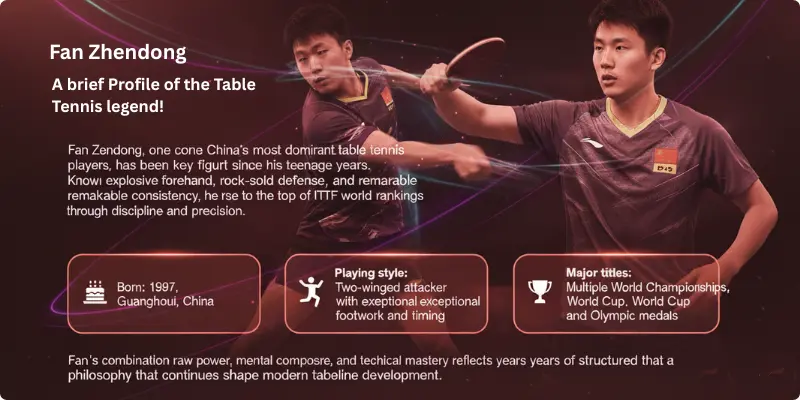
Fan Zhendong, one of China’s most dominant table tennis players, has been a key figure in the sport since his teenage years. Known for his explosive forehand, rock-solid defense, and remarkable consistency, he rose to the top of the ITTF world rankings through discipline and precision. Explore Fan Zhendong’s ranking history to see how he climbed to the No.1 position.
- Born: 1997, Guangzhou, China
- Playing style: Two-winged attacker with exceptional footwork and timing
- Major titles: Multiple World Championships, World Cup, and Olympic medals
Fan’s combination of raw power, mental composure, and technical mastery reflects years of structured training, a philosophy that continues to shape modern table tennis development. For a deeper look at his career milestones and achievements, you can explore our complete Fan Zhendong profile.
The Foundation of Fan Zhendong’s Training System
Before diving into Fan Zhendong’s training philosophy, it’s important to understand the roots of his discipline. Raised within China’s elite table tennis system, Fan developed his game around precision, repetition, and mental control, traits that continue to define his playing style today. Key factors shaping this foundation include:
- Structured discipline: Building consistency by mastering fundamentals through strict daily routines.
- Technical precision: Refining stroke mechanics in detail before increasing speed and power.
- Mental focus: Training calm decision-making and emotional control under match pressure.
Over time, Fan blended these traditional methods with modern sports science, incorporating data analysis, physical metrics, and recovery tracking into his routine. This balance between disciplined tradition and data-driven innovation forms the backbone of Fan Zhendong’s training system, a framework that any serious player can learn from and adapt.
Fan Zhendong’s Training Philosophy
Fan Zhendong believes true mastery comes from disciplined repetition and purposeful training. His philosophy combines traditional Chinese table tennis methods with modern sports science, placing strong emphasis on consistency, precision, and adaptability in every session.
At the core of Fan’s routine is a simple principle: progress comes from repetition with intent. Rather than chasing complexity, he focuses on refining fundamentals and using data-driven feedback to guide improvement. The key principles behind his training philosophy include:
- Consistency over complexity: Repeating core strokes under pressure until they become instinctive.
- Continuous improvement: Reviewing each session to identify small but meaningful adjustments.
- Adaptability: Adjusting tactics and techniques to counter evolving opponents and changing equipment trends.
In interviews, Fan has often emphasized that success isn’t solely about raw power; it’s about maintaining clarity, precision, and calm execution under pressure, qualities that any player can develop through their training approach. For more insights beyond his career, you can also explore Fan Zhendong’s personal life.
Inside Fan Zhendong Training: Drills, Mindset, Techniques & Conditioning
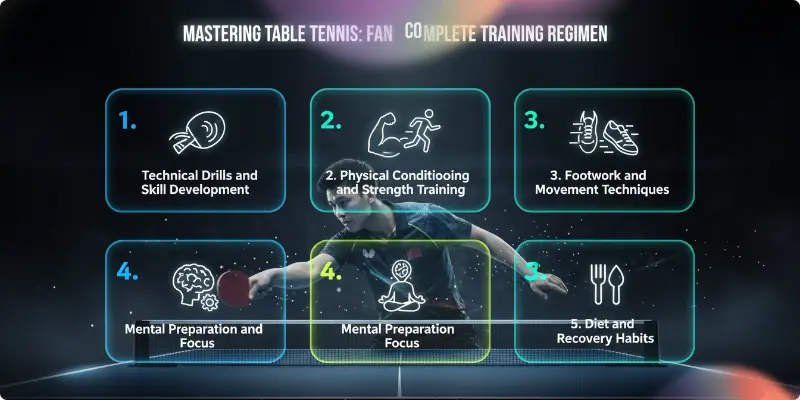
Fan Zhendong’s training is a refined blend of technical precision, physical conditioning, and mental discipline. Every session is built around a specific purpose, whether sharpening stroke accuracy, improving movement efficiency, or strengthening competitive focus. From mastering complex spin variations to maintaining composure under pressure, Fan’s training reflects a balance between effort, strategy, and control. The following sections break down the core components of Fan Zhendong training, showing how he consistently operates at the highest level of modern table tennis.
1. Technical Drills and Skill Development
Fan’s technical practice forms the backbone of his competitive edge, combining precision, timing, and adaptability. His drills are carefully structured to reinforce both offensive and defensive stability while maintaining consistency under pressure. He balances explosive forehand power with precise backhand control, ensuring every stroke contributes to his world-class performance.
I. Fan Zhendong’s forehand training
Fan Zhendong training Forehand, emphasizes explosive loops, controlled spin variation, and rapid recovery between shots. He spends extended hours on multi-ball drills, where coaches deliver high-speed feeds to test timing, footwork synchronization, and stroke durability. Key forehand drills include:
- Forehand loop against backspin: Refining spin generation, arc control, and consistency
- Forehand–backhand transition drills: Developing seamless coordination during fast rallies
- Serve-return forehand practice: Enhancing placement accuracy and deceptive follow-ups
II. Fan Zhendong’s backhand training
Fan Zhendong training Backhand, focuses on precision, placement, and maintaining stability during high-speed exchanges. His backhand routines allow him to neutralize aggressive attacks while sustaining pressure throughout rallies:
- Backhand blocking and countering drills: Improving reaction speed and balance
- Backhand loop against varying spins: Sharpening control under changing conditions
- Short-game backhand practice: Refining flicks, pushes, and touch near the net
By integrating both forehand and backhand routines, Fan Zhendong training ensures every stroke is executed with power, accuracy, and consistency, a defining trait of his world-class play. To see how these techniques translate into competition, explore our in-depth analysis of Fan Zhendong’s playing style.
2. Physical Conditioning and Strength Training
Fan’s physical conditioning builds the explosive speed and endurance that define his match dominance. Each workout targets leg strength, core stability, and agility, ensuring sustained performance across long, high-intensity encounters.
Physical strength plays a crucial role in Fan Zhendong’s success. His compact yet powerful build allows rapid directional changes and explosive topspin production without sacrificing balance. His conditioning program includes:
- Leg-strengthening exercises: Squats, lunges, and resistance training for stability and footwork
- Core workouts: Planks, rotational movements, and controlled strength drills to enhance spin power
- Agility training: Ladder drills, cone movements, and short sprints for quick reactions
- Endurance sessions: Cycling and interval running to sustain intensity during extended matches
According to a 2023 report by the Chinese Sports Science Institute, Fan’s endurance metrics rank among the highest on China’s national team, highlighting the long-term consistency of his conditioning approach rather than short training peaks.
3. Footwork and Movement Techniques
Fan Zhendong’s movement allows him to control rallies from almost any position. His footwork training emphasizes rhythm, recovery, and balance, enabling smooth transitions even during high-pressure exchanges.
Fan’s movement around the table is fluid yet aggressive, serving as one of his most recognizable strengths. His footwork allows him to generate maximum power while staying stable and well-positioned. Key footwork drills include:
- Side-to-side shuffles: Maintaining stability during rapid exchanges
- Crossover steps: Covering mid- to long-distance balls efficiently
- Short-distance lunges: Improving reach for short balls and net play
- Recovery drills: Returning quickly to a neutral stance after each stroke
What separates Fan’s footwork from others is not speed alone, but timing and rhythm. His movements remain synchronized with the ball trajectory, creating an appearance of effortlessness even during physically demanding rallies.
4. Mental Preparation and Focus
Fan Zhendong trains his mind with the same discipline as his body, relying on focus, calmness, and emotional control to perform under pressure. His mental preparation supports decision-making, resilience, and tactical clarity during matches.
Training for Fan Zhendong extends far beyond physical execution. Mental resilience plays a central role in his consistency at elite levels. He regularly uses visualization techniques before major tournaments, mentally rehearsing successful patterns to reinforce confidence. Fan also practices controlled breathing and mindfulness to remain composed during long, momentum-shifting matches.
A peer-reviewed MDPI study on mindfulness in sports performance found that table tennis players demonstrate improved focus and decision-making under pressure, reinforcing the importance of mental training within elite-level routines.
5. Diet and Recovery Habits
Fan maintains peak performance through a structured nutrition and recovery system. His focus on diet, hydration, and rest ensures that his body can withstand multiple intense training sessions each day.
Nutrition and recovery are essential components of Fan Zhendong training. Sustaining energy and reducing fatigue require a carefully monitored diet and structured recovery schedule. His routine generally includes:
- High-protein meals: Supporting muscle repair and strength maintenance
- Balanced carbohydrates: Replenishing glycogen for endurance and training volume
- Hydration strategies: Regular electrolyte intake during and after sessions
- Recovery protocols: Physiotherapy, stretching routines, and adequate sleep
Fan follows a disciplined recovery framework to prevent overtraining, ensuring that every session contributes to performance improvement rather than accumulated fatigue. Together, these five pillars, technical precision, physical conditioning, footwork efficiency, mental resilience, and structured recovery, form the complete Fan Zhendong training system.
Fan Zhendong Training Lessons for Table Tennis Players
Fan Zhendong’s approach offers valuable lessons for athletes of all skill levels. His journey proves that progress relies on consistency, focus, and balancing both mental and physical preparation. The principles behind his training provide actionable insights that any player can apply.
- Embrace repetition: Mastering fundamentals is the foundation for growth.
- Balance offense and defense: Don’t just attack; build stability first.
- Stay disciplined: Consistent effort beats occasional intensity.
- Prioritize mental strength: Effective pressure management separates good players from great ones.
These lessons extend beyond professional athletes. For recreational players, applying even one or two of these principles can lead to measurable improvement while building the strong habits needed for long-term development.
How to Incorporate Fan Zhendong’s Training Methods?
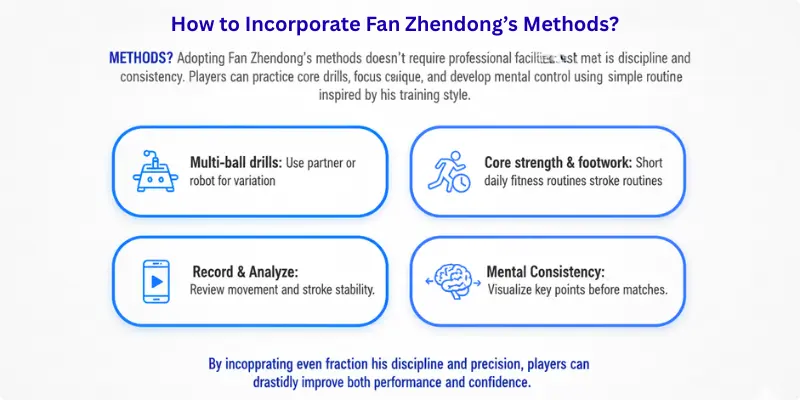
Incorporating Fan Zhendong’s training methods doesn’t require elite facilities or full-time coaching. What truly matters is discipline, consistency, and purposeful practice. By adapting core elements of Fan Zhendong training, players can build better technique, stronger footwork, and improved mental control through simple, repeatable routines.
You don’t need professional-level resources to train like Fan Zhendong. Many of his methods can be scaled for everyday players and home practice. Apply his training approach by focusing on these practical steps:
- Practice multi-ball drills with a partner or robot to improve timing, consistency, and reaction speed
- Build core strength and footwork through short daily fitness and agility routines
- Record practice sessions to analyze stroke mechanics, balance, and movement patterns
- Train mental consistency by visualizing key points and staying composed under pressure
Start with just one element this week, whether it’s daily footwork drills or recording your practice. By consistently applying even a small portion of Fan Zhendong’s discipline, you’ll see measurable gains in performance, confidence, and match consistency over time.
The Future of Fan Zhendong’s Training Legacy
As table tennis continues to evolve, Fan Zhendong keeps refining his approach to stay ahead of emerging playstyles and technologies. His training philosophy, rooted in discipline, adaptability, and innovation, is setting new benchmarks for how modern players prepare and compete. By blending traditional Chinese training principles with data-driven methods, Fan has created a model that remains effective in a rapidly changing sport.
Looking ahead, Fan Zhendong’s influence extends far beyond his competitive career. His commitment to precision, continuous improvement, and smart adaptation offers a blueprint for future generations of players. This balance between innovation and tradition ensures that Fan Zhendong’s training legacy will continue shaping elite table tennis, offering lessons and inspiration for players at every level for years to come.
Final Thoughts
Fan Zhendong’s training routine shows how discipline, precision, and balance come together to produce a world-class table tennis player. From technical skill development and physical conditioning to elite footwork, mental focus, and structured recovery, every element of Fan Zhendong training is designed to build consistency, strength, and long-term resilience. His journey proves that success isn’t driven by talent alone, but by dedication, purposeful practice, and continuous improvement.
For aspiring players, the takeaway is clear: you don’t need to copy his routine exactly to benefit from it. By applying even a portion of Fan Zhendong’s training principles, you can sharpen technique, improve focus, and develop the mental and physical habits required to perform at a higher level.
Ready to elevate your game? Start applying Fan Zhendong’s training principles today, begin with just one drill or habit, and experience measurable gains in control, speed, and match confidence.
FAQs
How many hours a day does Fan Zhendong train?
Fan Zhendong trains approximately 6–7 hours per day, combining technical table practice with physical conditioning. According to ITTF reports, his routine typically includes around 4 hours of technical drills, 2 hours of strength and conditioning, and 1 hour dedicated to match simulation or tactical analysis.
What is the most important exercise in Fan Zhendong’s fitness routine?
Explosive leg training is the cornerstone of Fan Zhendong’s conditioning. Exercises such as squats, lunges, and plyometrics develop the lower-body power needed for lightning-fast footwork and strong ground-force generation, which directly fuels his explosive forehand loops.
Can amateur players realistically follow Fan Zhendong’s training methods?
Yes, with smart adaptation. Instead of copying his full professional workload, amateur players should focus on the principles behind Fan Zhendong training: consistent daily practice, precise repetition of fundamentals, and balanced development of technique and fitness. Even 30–60 minutes of focused practice using these principles can produce meaningful improvement.
What mental training techniques does Fan Zhendong use?
Fan Zhendong uses visualization, mindfulness, and pressure simulation. Before major events, he visualizes successful rallies and key point patterns. During training, coaches recreate high-pressure match scenarios, while breathing techniques help him stay calm and focused during critical moments.
How does Fan Zhendong’s training differ from earlier Chinese champions like Ma Long?
While both follow the Chinese system’s emphasis on discipline and repetition, Fan Zhendong’s training is more data-driven and sports-science focused. His approach prioritizes quality over sheer volume, using biomechanical analysis, recovery tracking, and personalized load management to optimize performance.
What is one Fan Zhendong drill beginners can start immediately?
A great starting point is the multi-ball forehand consistency drill. Use a partner or robot to feed 40–50 balls while focusing on clean technique, quick recovery, and controlled placement. Begin at 70% power, aiming for accuracy and balance, mirroring Fan’s emphasis on precision before speed.
What is Fan Zhendong’s playing style, and how does it connect to his training?
Fan Zhendong plays a modern two-winged attacking style, built around explosive forehand loops, a stable backhand counter, and elite footwork. His training directly supports this style through drills that enhance power generation, fast transitions, and full-table coverage. For a deeper breakdown, see our analysis of Fan Zhendong’s playing style.
Is table tennis a good workout, and how does Fan Zhendong’s training maximize fitness?
Yes, table tennis offers excellent cardiovascular benefits, improves reflexes, and builds functional strength. Fan Zhendong’s training amplifies these benefits through targeted conditioning that develops explosive power, rotational core strength, and match endurance, showing how table tennis can serve as both a high-performance sport and a complete fitness activity.
Please Write Your Comments