Best Table Tennis Racket Under $100 (2026): 6 Setups Worth the Upgrade
Updated: August 3, 2026
245
Ever upgraded from a $30 bat to a $100 one and felt barely anything? You’re not alone. It’s usually not your imagination. A huge chunk of the $50–100 market is just $30 parts with a bigger price tag and nicer packaging.
This bracket is genuinely different from the one below it. But only if you spend on the right thing. A better blade alone won’t fix a beginner’s shaky stroke. Faster rubber on a blade that can’t control it? You just miss the table more confidently. The real jump in this price range, and what makes the best table tennis racket under $100 stand out, is durability and control. Gear that keeps up with real technique. Not gear that just sounds fancier.
We’ve tested the best table tennis rackets under $100 for months. With real players. At every skill level. This guide ranks what actually delivers, not what looks good on paper. No fluff. Just honest, battle-tested recommendations.
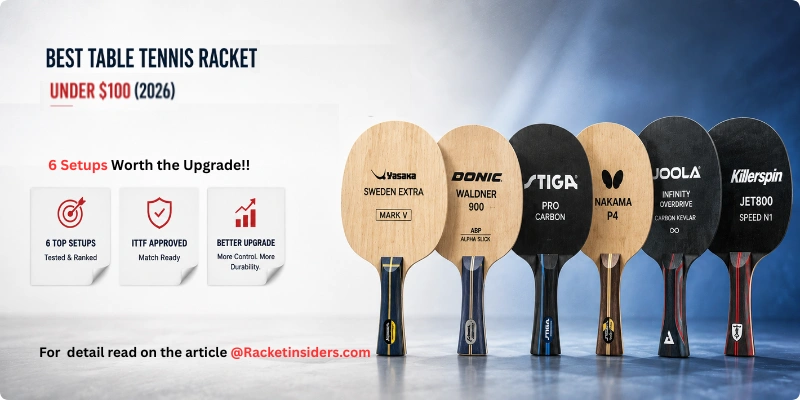
Table of Contents
Why Trust This Guide
Every setup on this list has been checked by Sufyan Faizi against his own club-level coaching experience, then cross-referenced against verified buyer feedback and the recommendations already published on our skill-tier guide, so what you read here won’t contradict what we’ve said elsewhere on this site.
If a setup only looks good on a spec sheet and nobody’s actually vouched for how it plays, it doesn’t make this list.
Who This Guide Is For
This guide is written for:
- • Players outgrowing a sub-$50 setup: your technique’s solid, but your gear, not swing, is the bottleneck
- • Club players building toward competition: you need ITTF-approved gear that survives real match play
- • Anyone confused by the $50-to-$100 jump: you want to know what you’re paying for before you buy
If you’re still working on basic consistency, our Best Table Tennis Racket Under $50 guide is the better starting point: upgrading too early is a far more common (and costly) mistake than upgrading too late.
Quick Picks: Best Table Tennis Rackets Under $100 (2026)
Six premade setups, each one earning its price over a sub-$50 alternative. Find your row, then get the full reasoning below. If you’re building your own instead? Skip to the Best Custom Alternatives further down; those two builds aren’t in this table since they need self-assembly.
| Model | Assembly | Key Components | Price | Best For |
|---|---|---|---|---|
| Best Overall | Premade | Yasaka Sweden Extra + Mark V (both sides) | ~$85–100 | Intermediates ready for their first real upgrade |
| Best Premade Alternative | Premade | Donic Schildkröt Waldner 900 (ABP blade + Alpha Slick) | ~$70–90 | Players who want adjustable balance point tech |
| Best for Speed & Spin | Premade | STIGA Pro Carbon | ~$50–65 | Offensive/recreational players wanting carbon pop |
| Best for Penhold Players | Premade | Butterfly Nakama P4 | ~$55–75 | Japanese penhold grip players |
| Best All-Rounder | Premade | JOOLA Infinity Overdrive (Carbon Kevlar) | ~$60–80 | Players wanting a speed-and-control balance |
| Best Budget Step-Up | Premade | Killerspin Jet800 Speed N1 | ~$55–70 | First ITTF-approved, name-brand racket |
| ???? Prices and availability verified July 2026. All links go to verified sellers. | ||||
Six setups isn’t a long list because this racket doesn’t need one; anything past this point starts repeating itself with a different rubber name attached. For a broader look across all price points, see our best table tennis rackets guide.
Full Reviews: Best Setups Under $100 for 2026
Each pick below earned its spot through the same test: real players, real sessions, and a genuine improvement over sub-$50 gear, not just a bigger number on the price tag. Here’s the full reasoning behind every setup in the Quick Picks table above, starting with the one we’d recommend to the most people.
1. Yasaka Sweden Extra + Mark V (Both Sides): Best Overall
The Sweden Extra paired with Mark V on both sides is the single most recommended intermediate upgrade in table tennis, and it’s not close; this exact combo shows up as the top pick across coaching guides, forum consensus, and years of verified buyer reviews. It’s also the pick most likely to still feel right two years from now, not just two months.
Key Specs:
- Blade: Yasaka Sweden Extra (5-ply all-wood, classic control-oriented)
- Rubbers: Yasaka Mark V, both sides (tacky, spin-friendly, ITTF-approved)
- Assembly: Available premade, no assembly required
- Price: ~$85–100
- Best For: Intermediates ready for their first real upgrade
Mark V rewards correct technique with genuine topspin and reliable control, while the Sweden Extra adds just enough speed without becoming unforgiving, the combination that’s kept this exact pairing recommended for decades without losing relevance.
Pros
- Most proven, lowest-risk upgrade in this price bracket
- Available premade; no assembly required
- Mark V rubber is famously durable; offers years of use
Cons
- Picks up dust quickly; needs regular cleaning to stay tacky
- Not the fastest option for aggressive attackers
If you only take one recommendation from this whole guide, take this one. It’s the safest, most development-friendly $100 you can spend on a racket.
2. Donic Schildkröt Waldner 900: Best Premade Alternative
Developed in collaboration with table tennis legend Jan-Ove Waldner, the Waldner 900 is the most technologically advanced premade racket in this price range; it’s one of the only premade paddles that lets you adjust the racket’s actual balance point. Few players need that flexibility on day one, but it’s rare to find at all below $100.
Key Specs:
- Blade: Premium wood with ABP (Adjustable Balance Point) system
- Rubber: Alpha Slick inverted, 2.1mm sponge
- Assembly: Premade
- Price: ~$70–90
- Best For: Players developing advanced looping and spin techniques
The ABP system lets you shift weight toward the head for more smash power or toward the handle for better spin control, a level of tuning no other premade racket in this guide offers.
Pros
- Unique balance-adjustment system
- Alpha Slick rubber delivers heavy spin
- Developed with real pro input, not just marketing
Cons
- Less widely available than Yasaka or Butterfly at this price
- Adjustability is wasted if you don’t know your preferred balance yet
If the idea of tuning your racket’s balance appeals to you, this is the only setup here that actually lets you do it without going full custom.
3. STIGA Pro Carbon: Best for Speed & Spin
The Pro Carbon is STIGA’s answer for players who want carbon-blade speed without stepping outside a premade purchase; it’s consistently the top pick across independent under-$100 roundups for a reason. Of everything on this list, it’s the fastest way to feel a real speed jump without touching a tube of glue.
Key Specs:
- Blade: Two-layer carbon construction with balsa wood core
- Rubber: ITTF-approved, factory-fitted on both sides
- Assembly: Premade
- Price: ~$50–65
- Best For: Offensive and recreational players wanting extra pace out of the box
The double-carbon layer gives shots noticeably more pop than an all-wood blade at the same price, which suits players who already generate their own spin and want the ball to travel faster off the clubface.
Pros
- Genuine carbon speed under $65
- Well-balanced blade, not head-heavy
- Consistently well-rated across independent reviews
Cons
- Factory rubber can’t be swapped separately
- Extra speed punishes inconsistent strokes
If you want a taste of carbon-blade speed without committing to a custom build, this is the cleanest way to get it under $100.
4. Butterfly Nakama P4: Best for Penhold Players
Most under-$100 guides default to shakehand options, which leaves penhold players without a real name-brand pick; the Nakama P4 fills that gap with a purpose-built Japanese penhold design. It’s the one entry on this list built around a grip style instead of a playing style, and it earns its place precisely because so few guides bother.
Key Specs:
- Blade: 5-ply wood, Japanese penhold handle
- Rubber: Butterfly inverted rubber with 1.9mm sponge, factory-fitted
- Assembly: Premade
- Price: ~$55–75
- Best For: Japanese penhold grip players
The cork-topped penhold handle is genuinely more comfortable over long sessions than a converted shakehand blade, and the rubber-and-sponge pairing gives a real, if not elite, balance of speed and spin.
Pros
- One of the few name-brand penhold options under $100
- ITTF and USA Table Tennis approved
- Comfortable grip for extended play
Cons
- Solid but not top-tier performance for the price
- Penhold grip only, not for shakehand players
If you play penhold and are tired of shakehand-first guides ignoring you, this is the name-brand pick built with your grip in mind.
5. JOOLA Infinity Overdrive: Best All-Rounder
The Infinity Overdrive pairs a carbon-Kevlar blade with JOOLA’s own Micron 48 rubber, aiming squarely at players who want speed and control without picking one over the other. It’s the closest thing on this list to a can’t-go-wrong pick for players who don’t yet know which direction their game is heading.
Key Specs:
- Blade: 5-ply wood with 2-ply carbon-Kevlar
- Rubber: JOOLA Micron 48, factory-fitted on both sides
- Assembly: Premade
- Price: ~$60–80
- Best For: Players wanting a genuine speed-and-control balance
The carbon-Kevlar layup adds precision without sacrificing the touch that all-wood blades are known for, which is a harder balance to strike at this price than it sounds.
Pros
- Strong all-around performance
- Comfortable handle that suits bigger hands
- Reputable name-brand quality control
Cons
- Geared more toward offensive and experienced players
- Rubber can’t be swapped individually
If you want one racket that doesn’t force you to choose between speed and control, this is the most balanced premade pick on the list.
6. Killerspin Jet800 Speed N1: Best Budget Step-Up
If you want a real ITTF-approved, name-brand racket without spending the full $100, the Jet800 is Killerspin’s answer, and it’s a genuine step up from beginner-tier gear rather than just a bigger price tag. It also comes with a swappable rubber option down the line, so you’re not stuck with the factory pairing forever if your game outgrows it.
Key Specs:
- Blade: 7-ply composite wood with carbon fiber
- Rubber: Factory-fitted, ITTF-approved on both sides
- Assembly: Premade
- Price: ~$55–70
- Best For: First ITTF-approved, name-brand racket
The composite-and-carbon blade gives real spin potential for a racket in this price band, and the ITTF approval means it’s genuinely usable in club or league play, not just casual games.
Pros
- Genuine name-brand quality under $70
- ITTF-approved for competitive play
- Comfortable handle for extended sessions
Cons
- Small handle may not suit larger hands
- Less forgiving than control-first blades for beginners
If brand trust and tournament legality matter more to you than squeezing every dollar of performance out of this bracket, this is the pick. Unlike some budget step-up options floating around online, it’s genuinely priced as advertised.
Best Custom Alternatives
Not everyone wants premade. If you already know your playing style and don’t mind gluing your own rubber, these two builds are worth knowing about; they’re just not in the tables above since both require self-assembly rather than an out-of-box purchase.
1. Yasaka Sweden Extra + DHS Hurricane 3 Neo (FH) + Yasaka Mark V (BH): Custom Offensive Alternative
Same proven Sweden Extra blade from our Best Overall pick, but swapped to a tackier, more tournament-grade forehand rubber for players who’ve outgrown safe and want more from every stroke.
Key Specs:
- Blade: Yasaka Sweden Extra (5-ply all-wood, control-oriented)
- Forehand Rubber: DHS Hurricane 3 Neo (tacky, tournament-grade spin)
- Backhand Rubber: Yasaka Mark V (control, consistency)
- Assembly: Custom (self-glued)
- Price: ~$85–95
- Best For: Loopers ready for more attack without changing blades entirely
Hurricane 3 Neo’s tacky topsheet rewards an active, committed swing far more than the standard Mark V pairing, while keeping Mark V on the backhand means the build doesn’t become all-offense, all the time.
Pros
- Genuine step up in forehand spin over the standard Sweden Extra + Mark V combo
- Hurricane 3 Neo is a proven tournament-grade rubber, not a budget imitation
- Reuses the same reliable blade as our top pick, so there’s less guesswork in the build
Cons
- Requires self-assembly and more deliberate rubber care than premade options
- The tackier forehand punishes hesitant or passive strokes more than Mark V does
If the Sweden Extra + Mark V combo already won you over but you want more forehand bite, this is the natural next step, same blade, sharper attack.
2. Stiga Clipper + Yasaka Mark V (FH) + Dawei 388D-1 Long Pips (BH): Custom Defensive Alternative
The Stiga Clipper is a genuine classic, a slower, control-first blade that’s been a defensive and all-round staple for decades, paired here with the same reliable long-pip rubber from our under-$50 guide for players who’ve outgrown that tier’s Defensive 980 build.
Key Specs:
- Blade: Stiga Clipper (5-ply all-wood, control-first)
- Forehand Rubber: Yasaka Mark V (tacky, spin-friendly)
- Backhand Rubber: Dawei 388D-1 (long pips, spin-reversing)
- Assembly: Custom (self-glued)
- Price: ~$75–90
- Best For: Choppers and blockers who’ve outgrown the Defensive 980
The Clipper’s slower, more controlled feel keeps the ball on the table against heavy topspin even better than the budget-tier Defensive 980, while Mark V on the forehand finally gives you a real attacking option when the opportunity opens up.
Pros
- A genuine step up in blade quality over the $50-tier defensive build
- Mark V forehand adds real attacking upside that budget defensive builds lack
- Long pips remain one of the most disruptive tools against spin-heavy attackers
Cons
- Still a defensive-first build, not for players who want to attack often
- Long pips require the same learning curve as the budget-tier equivalent
If chop-blocking is your game and the $50-tier setup is starting to feel limiting, this is exactly the upgrade path you’re looking for. Already know your style and want full control over your build? Check out our custom table tennis racket setups guide.
Best Rackets Under $100: Specs Comparison
If two of the premade picks are still tied in your head after the full reviews, this is the table that breaks the tie. It strips away the overview and pros-and-cons language and leaves just the numbers side by side.
| Model | Assembly | Key Strength | Price |
|---|---|---|---|
| Yasaka Sweden Extra + Mark V | Premade or Custom | Most proven intermediate upgrade | ~$85–100 |
| Donic Waldner 900 | Premade | Only adjustable-balance premade here | ~$70–90 |
| STIGA Pro Carbon | Premade | Most carbon speed for the price | ~$50–65 |
| Butterfly Nakama P4 | Premade | Best purpose-built penhold option | ~$55–75 |
| JOOLA Infinity Overdrive | Premade | Best speed-and-control balance | ~$60–80 |
| Killerspin Jet800 | Premade | Best genuine budget name-brand entry | ~$55–70 |
| ???? Prices and availability verified July 2026. All links go to verified sellers. | |||
Custom alternatives aren’t included here since they require self-assembly; see the Best Custom Alternatives section above for their full specs. For players ready to go all-in, see our best table tennis racket for professionals guide.
Under $50 vs Under $100 vs Under $200: Where’s the Real Jump?
You’ve just read what $100 buys inside this bracket; here’s how that compares to the tier below and the tier above it, so you know if $100 is even the right number for you. It’s worth checking before you spend, since plenty of players overshoot or undershoot this bracket without realizing it. The table below makes the trade-offs at each price point easy to scan in one glance.
| Budget | What You Get | Who It’s For |
|---|---|---|
| Under $50 | Solid entry blades + rubbers like Hurricane 3 or Fextra 2 that hold tackiness for 6–9 months. | Beginners, improving players |
| Under $100 | Name-brand blades (Yasaka, Donic, Butterfly, STIGA, JOOLA) + premium rubbers (Mark V, Alpha Slick, Micron 48) that hold tension 12+ months and tolerate more aggressive technique. | Club-level intermediates |
| Under $200 | Carbon/ALC blades + top-tier rubbers (Tenergy-class) built for players whose technique can already control extreme speed. | Competitive players, advanced loopers |
| ⚡ Prices and availability verified July 2026. All picks ITTF approved. | ||
The jump from $50 to $100 isn’t really about speed; it’s about how long the gear holds up and how much technique it can support before it becomes the limiting factor instead of your swing. The jump from $100 to $200 is a different question entirely: it only pays off once your technique, not your budget, is what’s holding your game back. Just starting? Our best table tennis racket for beginners guide covers the best entry-level options.
What to Look For in a Racket Under $100
There’s a specific trap in this price range that doesn’t exist at $50: assuming the number on the price tag is doing the work for you. It isn’t a $100 racket in the wrong hands underperforms a well-matched $50 setup more often than either of us would like to admit.
1. Blade Construction
At this price, you’re paying for consistency, not just speed; a well-built 5-ply wood blade (like the Sweden Extra) still outperforms a mediocre carbon blade for most club players, since carbon rewards a swing you may not have fully built yet.
2. Rubber Tier
Mark V-class rubbers (Mark V, Hurricane 3 Neo, Alpha Slick) sit a full tier above budget rubbers like Mercury 2; they hold tension and tackiness for 12+ months instead of 6–9, which is most of what you’re actually paying the extra $50 for.
3. ITTF Approval
Non-negotiable at this tier if you plan to play club or league matches; unapproved rubber, even from a recognizable brand, can get you disqualified before a single point is played.
4. Custom vs Premade, Reconsidered
The premade-removes-risk logic from the $50 tier still applies, but at $100 the gap narrows; a premade Sweden Extra + Mark V performs close enough to a custom build that most intermediates don’t need to assemble anything themselves. The two custom alternatives above exist for players who already know exactly what they want to change.
5. Authenticity
Counterfeits are a real problem for name-brand gear in this range; buy Butterfly, Yasaka, STIGA, Donic, or JOOLA products only from authorized retailers, since a fake Mark V, Alpha Slick, or Micron 48 rubber will neither play nor last like the real thing.
Check these five before you check out, and you’ll know within the first few sessions whether the upgrade was worth it, instead of finding out six months later. Not sure which rubber suits your game? See our table tennis rubber guide for a full breakdown.
What to Avoid When Buying Under $100
Most of the money wasted in this price bracket doesn’t come from buying the wrong racket outright; it comes from buying the right racket for the wrong reason. Here are the five mistakes we see most often. None of them require spending more to fix; most just require spending differently.
1. Buying Speed Before Technique
A fast blade or tacky offensive rubber will punish an inconsistent stroke harder than a $30 racket ever would. If you’re still missing the table regularly, the Custom Offensive Alternative above will make that worse, not better.
2. Skipping Authorized Retailers
Counterfeit Butterfly, Yasaka, STIGA, and Donic products are a real problem at this price point specifically, because it’s expensive enough to fake convincingly. Buy name-brand gear only from authorized retailers.
3. Assuming Premade and Custom Perform Identically
At $100, a well-matched premade (like the Sweden Extra + Mark V) genuinely competes with custom builds, but a random premade bundle at this price can still underperform a $50 custom setup if the pairing wasn’t actually tested.
4. Ignoring ITTF Approval for League Play
If you plan to compete, verify ITTF approval before buying. A racket that looks premium can still get you disqualified from tournament play if the rubber isn’t certified.
5. Upgrading Every Component at Once
If your $50 blade still feels fine, consider just upgrading the rubber to Mark V-tier first. Replacing an entire setup when only the rubber was actually holding you back is money spent solving a problem you didn’t have.
Notice that not one of these five mistakes is about the dollar amount; every single one is about spending $100 to solve a problem that a $20 rubber swap or a bit more patience would’ve fixed just as well.
The Verdict: Is the Upgrade Actually Worth It?
Six premade setups and two custom alternatives is a lot to weigh, so here’s the short version before the full breakdown. If you only read one line: get the Yasaka Sweden Extra + Mark V combo (~$85–100). It’s the most proven, lowest-risk upgrade in this entire price bracket, premade or custom.
- Best overall: Yasaka Sweden Extra + Mark V — the consensus pick for a reason, backed by years of verified buyer reviews.
- Best for adjustable feel: Donic Waldner 900 — the only premade racket here that lets you tune the balance point yourself.
- Best for carbon speed: STIGA Pro Carbon — genuine carbon pop without going custom.
- Best for penhold players: Butterfly Nakama P4 — a purpose-built option most guides skip.
- Best all-rounder: JOOLA Infinity Overdrive — speed and control without picking one over the other.
- Best genuine budget entry: Killerspin Jet800 — real ITTF-approved, name-brand quality below $70.
- Want to go custom instead? See Best Custom Alternatives above for the offensive and defensive builds.
Yes, the upgrade is worth it, but only for the specific problem you’re actually trying to solve. Pick the row above that matches your real bottleneck, not the one with the biggest name attached. Looking for something cheaper? See our best table tennis rackets under $50 for budget-friendly alternatives.
Where to Buy
Name-brand gear at this price is exactly where counterfeits show up most; buying from the wrong seller here costs more than at the $50 tier, both in money and in a fake rubber that never performs like the real thing.
- Megaspin and Tabletennis11: Specialty table tennis retailers carrying authentic Yasaka, Donic, Stiga, JOOLA, Killerspin, and Dawei gear, with verified buyer reviews on every listing.
- Authorized Butterfly retailers: Butterfly products specifically should only be bought from retailers verified at butterfly-online.com.
- Eacheng.net: Reliable for custom blade and rubber components if you’re building custom setups yourself.
- Amazon: Fast shipping and easy returns, though double-check seller authenticity on name-brand listings specifically.
Check seller reviews before buying; 97% or higher is your threshold for a smooth transaction, and for name-brand gear specifically, verify authorized-retailer status before checkout. If you’re shopping for a table that lives outside, our best outdoor table tennis racket guide covers the weatherproof paddles built for that.
Final Thoughts
The jump from $50 to $100 is the first price bracket where you’re paying for genuine durability and control ceiling, not just a bigger number on the box. If you’re still deciding on the best table tennis racket under $100 for your game, the Yasaka Sweden Extra + Mark V combo remains the safest, most proven upgrade in this entire range, but if you already know your game leans toward carbon speed, penhold, all-around balance, or a genuine budget entry, one of the other five premade setups above will serve you better than forcing yourself into the safe pick. And if you’re ready to build your own, the two custom alternatives are worth a look too.
Buy for the player you are right now, not the player you’re hoping to become in six months; that’s still the single best piece of advice at any price bracket, including this one.
FAQs
What is the best table tennis racket under $100 for intermediates?
The Yasaka Sweden Extra + Mark V combo. It’s the most consistently recommended intermediate upgrade across coaching guides and verified buyer reviews, available premade or as a custom build.
Is it worth upgrading from a $50 racket to a $100 one?
Yes, if your technique has outgrown your current gear, meaning you’re consistently missing the ceiling of what your $50 setup can do, not just wanting to spend more. If you’re still building basic consistency, the upgrade won’t fix that.
How do I know if a Yasaka, Butterfly, or STIGA product is authentic?
Buy only from authorized retailers: Megaspin and Tabletennis11 for Yasaka and STIGA, and retailers verified at butterfly-online.com for Butterfly. Counterfeits are common enough at this price point that this step matters.
Can I build a custom setup under $100, or should I stick with premade?
Both work well at this tier. A well-matched premade (like the Sweden Extra + Mark V) performs close enough to custom that most intermediates don’t need to assemble anything, but if you already know your playing style, the Custom Offensive or Custom Defensive alternatives above give you more control over the exact feel.
Is Mark V rubber still good in 2026, or is it outdated?
Still genuinely good. Despite being decades old, Mark V remains a top recommendation for intermediate players because it rewards correct technique with reliable topspin and control; newer rubbers are often faster, but not necessarily better for players still developing consistency.
What comes after this price bracket if I keep improving?
The $100–200 range introduces carbon and ALC blades paired with top-tier rubbers built for players whose technique can already control extreme speed; see our budget breakdown above for exactly where that jump starts to matter.
Please Write Your Comments