Table Tennis Racket Guide: Parts, Types, Performance & How to Choose
Updated: February 27, 2026
1023
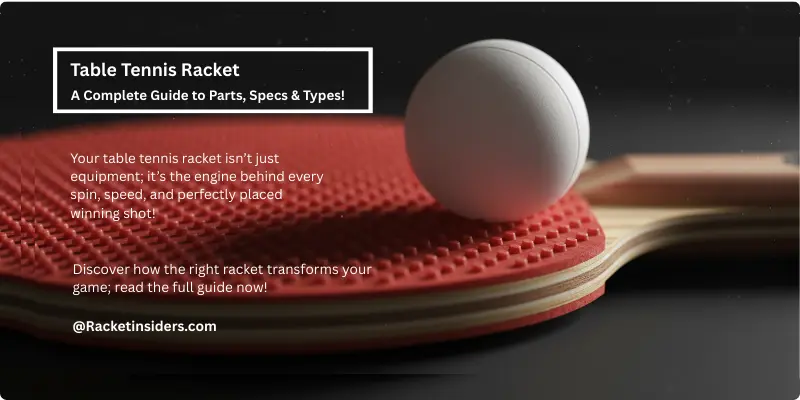
At first glance, a table tennis racket looks simple: a handle, a blade, and some rubber. It isn’t. Small variations in blade construction, sponge thickness, or rubber type directly determine how the ball responds, the difference between a winning loop and an unforced error.
Known as a paddle in the US and a bat in the UK, this is the one piece of equipment that translates your technique directly into ball contact on every single shot. Its blade construction shapes power and feel. Its rubber surface controls spin generation and response. Its sponge layer determines the balance between speed and control. Its handle connects all of it to your hand. These four components work as a system; change one, and you change everything.
Here you’ll find everything about table tennis rackets that actually matters: how each component works, which racket type suits your playing style and skill level, what the specifications mean in real terms, and how to avoid common mistakes when choosing your racket.
Key Takeaways
- A table tennis racket is a four-part system: blade, rubber, sponge, and handle, where every component directly affects your speed, spin, and control.
- Racket performance depends on how these four parts work together, not on any single component in isolation.
- Racket size, weight, and thickness follow ITTF guidelines and affect balance and control.
- All-wood blades prioritize control and feel; carbon blades deliver greater speed and power.
- Rubber and sponge thickness determine spin, speed, and control.
- Offensive, defensive, and all-round rackets are designed for different playing strategies.
- Pre-made rackets suit beginners, while custom rackets offer advanced players greater precision.
- Matching your racket to your current skill level and playing style is the single most important equipment decision you can make.
What is a Table Tennis Racket?
A table tennis racket is the primary equipment used to strike and control the ball in play. Officially defined as a “racket” by the ITTF, it’s commonly called a paddle in the US and a bat in the UK and Asia; all three terms refer to the same piece of equipment.
At its core, a racket is a four-part system rather than a single object:
- Blade: the wooden core that provides structure, stiffness, and the overall feel of the racket.
- Rubber: the outer surface that generates spin and determines how the ball leaves the racket.
- Sponge: the foam layer between the blade and the rubber that balances power, rebound, and control.
- Handle: the grip that connects everything to your hand and affects stability throughout play.
These four components don’t work independently; they interact as a system. Change one, and the behaviour of the others shifts with it. When the combination is right for your style and level, the racket stops feeling like equipment and becomes an extension of your arm. Full breakdown of every component, specifications, and what to look for: Parts of a Table Tennis Racket.
Types of Table Tennis Rackets
Rackets are not one-size-fits-all. The right racket depends on how you play and where you are in your development. A racket that suits your style makes every shot feel more natural; the wrong one can hold you back no matter how hard you practice. Here’s a structured breakdown of the main types:
By Playing Style: Offensive, Defensive, All-Round
Your playing style is your identity on the table. Whether you overwhelm opponents with power, outlast them with precision, or adapt to whatever comes your way, there’s a racket built to amplify your strengths.
I. Offensive (Attack) Rackets
Offensive rackets are built for players who want to dominate rallies through speed, powerful topspin loops, and aggressive shot-making.
- Best for: Looping, smashing, and counter-attacking
- Blade: Stiffer, often carbon-reinforced for power
- Rubber: Thicker sheets for heavy topspin generation
These rackets demand solid technique. In beginner hands, the speed amplifies errors. For players with strong fundamentals who want to attack relentlessly, they’re extremely effective.
II. Defensive Rackets
Defensive rackets prioritise touch, precision, and control over raw power. They’re built to absorb and redirect pace rather than generate it.
- Softer rubbers that absorb pace and allow greater touch on chops and blocks
- Slower, more flexible blades for precise shot placement
- Ideal for chopping from mid-distance, pushing, and controlled blocking returns
This style demands patience and tactical intelligence. These rackets help you neutralise aggressive opponents and win through consistency, not speed. To see the comparison, see: Offensive vs Defensive Table Tennis Racket.
III. All-Round Rackets
All-round rackets sit between the two extremes, versatile enough to attack when opportunity arises, controlled enough to defend under pressure.
- Medium-speed blades for balanced performance across shot types
- Moderate rubber thickness for controlled spin and speed
- Smooth transitions between attacking and defensive play
These rackets are particularly well-suited to developing players building a complete game, and to recreational players who want one racket that handles everything reasonably well.
By Skill Level: Beginner, Intermediate, Professional
Your skill level determines what you need from a racket. Beginners need forgiveness to develop proper technique. Intermediates need balance for their expanding shot variety. Professionals need precision to execute at the highest level.
I. Rackets for Beginners
Beginner rackets prioritise consistency and ease of use over raw performance, giving new players room to develop proper technique without being punished for small errors.
- All-wood blades for better feel and control
- Softer rubbers to reduce unforced errors and simplify spin management
- Lightweight setups with larger sweet spots for off-centre contact
The most common beginner mistake is choosing a fast, powerful racket too early. Ironically, this slows down skill development; a controlled setup builds better fundamentals.
II. Rackets for Intermediate Players
Intermediate players have a consistent technique and are refining their stroke repertoire. Intermediate rackets reflect a balance between control and expanding capability:
- Wood or entry-level carbon blades for a blend of feel and added power
- Medium rubber thickness for improving spin generation
- Moderate weight offering stability without being cumbersome
At this stage, players often experiment with their first custom assembly, choosing blade and rubbers separately to match their emerging playing style.
III. Rackets for Professionals
Professional setups are high-performance tools that demand and reward advanced technique. There is little margin for error; these rackets amplify both good and bad strokes.
- Carbon or advanced composite blades for explosive, consistent power
- High-speed, high-spin rubbers with thicker sponge layers
- Heavier setups for stability during hard exchanges
At this level, equipment becomes highly personalised, from regular rubber changes to blade choices shaped by years of competitive experience. For a full guide by skill level, see: How to Choose a Table Tennis Racket.
Pre-made vs Custom Table Tennis Rackets
The final choice is how your racket is assembled: the convenience of a factory-built model or the precision of a custom-tailored setup. Both have their place depending on where you are in your journey.
I. Pre-made Rackets (Factory-Assembled)
- Convenience: Immediately playable with no assembly required
- Consistency: Balanced by the manufacturer for a specific skill level
- Affordability: Generally more budget-friendly than buying components separately
- Best for: Beginners, casual players, and those still discovering their style
For players just starting, a quality pre-made racket removes the overwhelming variables of component selection, letting you focus entirely on developing your game.
II. Custom Rackets (Hand-Assembled)
- Personalisation: Tailored combinations of blade, rubber type, and sponge
- Longevity: Individual components replaced as they wear out
- Performance: Unlocks maximum potential matched to your specific technique
- Best for: Intermediate to professional players who know their technical needs
The upgrade to a custom racket is a significant milestone; it signals you’ve developed a clear style and are ready to build equipment around it rather than adapting your game to fit what you have. For a full breakdown, check out our guide: Pre-made vs Custom Table Tennis Rackets.
Table Tennis Racket Parts: Blade, Handle, Rubber & Sponge
Every component of a table tennis racket has a specific job, and understanding what that job is changes how you approach every equipment decision you’ll ever make. These parts don’t operate in isolation; change one, and the others shift with it. Here’s what each part does and why it matters:
1. Blade
The blade is the wooden core and structural foundation of the racket. Most are constructed from multiple wood layers (plies) laminated together, often reinforced with carbon or glass fibre for added power. This construction shapes how the racket feels, absorbs vibration, and generates power.
- All-wood blades: Favor control, feel, and a softer touch.
- Carbon/composite blades: Sacrifice some feel for greater speed and explosive power.
The blade’s construction is the single most important factor in defining your racket’s overall character. Get this right, and everything else follows. For blade materials, ply counts, and how to choose the right one for your style, see Table Tennis Blade Guide.
2. Handle (Grip)
The handle is your physical connection to the racket. While it doesn’t touch the ball, it critically affects comfort during long matches and how naturally you can generate wrist snap. A well-fitted handle helps you maintain consistent grip pressure throughout every rally.
- Flared: Widens toward the base for a secure grip; the most popular shape worldwide.
- Straight: Uniform width throughout, allowing for easy grip repositioning during play.
- Anatomic: Features a contoured middle designed to fit the natural curve of your palm.
Choose the wrong shape, and even the best blade will never feel quite right in your hand. Full handle shape comparison and how grip affects your game, see: Parts of a Table Tennis Racket.
3. Rubber
The rubber is your primary interface with the ball. Its texture and tackiness determine how effectively you can generate spin and how you respond to your opponent’s shots. The right rubber can transform a good stroke into a winning shot.
- Inverted (Pips-In): Smooth surface for maximum spin; the standard for 90% of players.
- Pips-Out: Tiny pimples face outward to reduce spin sensitivity and create unpredictable behavior.
- Anti-Spin: A low-friction surface that neutralizes incoming spin, ideal for defensive play.
The ITTF regulations require one side tobeblack and the other a contrasting colour (red, blue, green, pink, or purple), ensuring opponents can identify which rubber surface is in play at all times. For a full rubber types guide, performance differences, and which suits your style: Table Tennis Rubber Guide.
4. Sponge
The sponge is the foam layer bonded between the blade and the rubber sheet. It acts as the “engine” of your racket, determining the balance between power and control. Getting the sponge right means finding your ideal balance between speed and feel.
- Thickness: A thinner sponge favours control and feel, a thicker sponge favours speed and power.
- Hardness: Soft sponges offer longer dwell time for consistent topspin, while hard sponges provide explosive power for advanced attackers.
Together, these four components define your racket’s speed, spin, control, and overall feel. Getting the combination right for your style and level is the foundation of every smart equipment decision you’ll make. For a full breakdown of every component, specifications, and what to look for: Parts of a Table Tennis Racket.
Table Tennis Racket Specifications: Size, Weight & Dimensions
While the ITTF does not mandate a single fixed racket size, it establishes maximum thicknesses for rubber and sponge, along with general guidelines that competitive players follow. These regulations ensure fair play while giving manufacturers room to innovate. Here’s what the standard specifications look like across all four components:
Overall Racket Dimensions (Blade, Handle, Rubber, and Sponge)
These measurements define the total size and weight of the racket, which in turn influence balance, swing feel, and control. Proper overall dimensions ensure the racket fits comfortably in your hand while supporting speed, spin, and shot precision.
- Length: 25–26 cm (9.8–10.2 inches)
- Width: 15–16 cm (5.9–6.3 inches)
- Weight: 150–200 g (including blade, handle, and rubbers)
1. Blade Dimensions
The blade is your racket’s foundation; its size and thickness directly affect precision and power.
- Length: 15–17 cm (5.9–6.7 inches): determines reach and swing arc
- Width: ~15 cm (~5.9 inches): defines the primary hitting surface
- Thickness: 5–7 mm (0.2–0.3 inches): affects stiffness and power transfer
- Sweet Spot: The optimal centre hitting area, a larger sweet spot is more forgiving on off-centre hits
2. Handle Dimensions
The handle is your physical connection to the racket. Proper sizing ensures comfort and control during long rallies.
- Shakehand grip length: ~10 cm (~4 inches)
- Penhold grip length: ~8 cm (~3.1 inches)
- Circumference: 8–9 cm (3.1–3.5 inches) for a secure, comfortable hold
3. Rubber & Sponge Thickness
The rubber and sponge layers directly control your racket’s speed, spin, and responsiveness.
- Rubber thickness (including sponge): Common range 1.0–2.2 mm per side; ITTF maximum 4.0 mm per side
- Sponge thickness: Common range 1.5–2.5 mm
- Thicker sponge (2.0 mm+): More speed and spin, suited to offensive play
- Thinner sponge (1.5–1.8 mm): More control and feel, suited to defensive and all-round play
For official racket size rules and full dimensional breakdown, see: Size of Table Tennis Racket.
Table Tennis Racket Specification Summary
The table below brings all key specifications together, showing how each measurement interacts to shape real-world performance.
| Specification | Standard / Common Range | Impact on Play |
|---|---|---|
| Overall Length | 25–26 cm (9.8–10.2 in) | Affects leverage, reach, and swing arc |
| Overall Width | 15–16 cm (5.9–6.3 in) | Determines hitting surface size |
| Total Weight | 150–200 grams | Lighter = speed; Heavier = stability |
| Blade Thickness | 5–7 mm (0.2–0.3 in) | Thicker = more power; Thinner = more control |
| Blade Plies | 5-ply or 7-ply | More plies = stiffer/faster; Fewer = more flex/control |
| Sponge Thickness | 1.5–2.5 mm | Thicker = offensive power; Thinner = control |
| Total Rubber Thickness | 1.0–2.2 mm per side | Greater thickness = more speed/spin potential |
| Handle Length (Shakehand) | ~10 cm (~4 in) | Balanced control and comfort |
| Handle Length (Penhold) | ~8 cm (~3.1 in) | Flexibility and wrist movement |
| Sweet Spot Size | Varies by blade shape | Determines the hitting surface size |
Think of this table as your racket’s blueprint. No single measurement works in isolation; it’s the combination of blade thickness, sponge hardness, rubber type, and handle shape that determines the overall character of your setup.
Table Tennis Racket Materials: Wood, Carbon & Composites
The materials in a racket’s blade have a direct and measurable effect on how shots feel and how quickly the ball responds. Choosing the right combination can elevate your game by matching the racket’s behavior to your instincts. Manufacturers combine different materials to target specific playing characteristics:
- Wood: The traditional core. Softer outer layers offer controlled, feeling-rich response; harder layers create faster, crisper rebounds. Most blades laminate multiple wood species to balance both qualities.
- Carbon: Woven carbon layers between wood plies boost stiffness and power while dampening vibration. The result is a crisp, direct feel with explosive speed, the top choice for modern offensive players.
- Arylate, Kevlar & Glass Fibre: Advanced composites sit between wood and carbon, faster than pure wood, softer than full carbon. Ideal for players wanting added speed without fully sacrificing touch and feel.
For a full breakdown of blade materials, construction, and how to choose the right one for your style, see Table Tennis Blade Guide.
ITTF Rules & Regulations for Table Tennis Rackets
For any official competition, the ITTF imposes clear rules governing racket design to ensure fair play. These standards level the playing field, so matches are decided by skill, not equipment loopholes. The key requirements are:
- Surface & Color: One side must be black, while the other side can be red, blue, green, pink, or purple to ensure opponents can distinguish between the two surfaces.
- Rubber Thickness: Maximum 4.0 mm per side, including the sponge and glue layers.
- Flatness & Coverage: Rubber must lie flat and cover the entire striking surface of the blade.
- Approval: Rubbers must appear on the ITTF’s official Authorized List and display the ITTF logo.
- No Performance Alterations: Permanent chemical treatments that alter rubber performance after manufacture (such as “boosting”) are prohibited.
For casual play, these rules aren’t mandatory, but they provide a useful quality benchmark. If you ever plan to compete, using ITTF-compliant equipment from the start ensures your transition to tournament play is seamless. To read full ITTF regulations, governing body history, and official guidelines, check out: International Table Tennis Federation.
Common Racket Setup Mistakes to Avoid
Even a quality racket underperforms when misused. Small mistakes can sabotage your progress without you realizing it. Most players make at least one of these errors without knowing better. The good news? They’re all easy to fix once you know what to look for. Here’s what to avoid:
- Over-gearing too early: Fast blades punish poor form; prioritize control first.
- Neglecting cleaning: Dust kills spin. Wipe your rubbers after every session.
- Mismatched components: Extreme differences in rubber speed ruin consistency.
- Poor handle fit: The wrong grip causes hand strain and reduces precision.
- Using “dead” sponges: Worn-out sponges lose feel and predictable bounce.
- Bad storage habits: Protect your racket from heat and moisture in a case.
- The “Gear Trap”: Upgrading equipment to fix technique problems is the single most expensive mistake in the sport. A faster blade won’t fix an inconsistent loop. Tackier rubber won’t fix poor footwork.
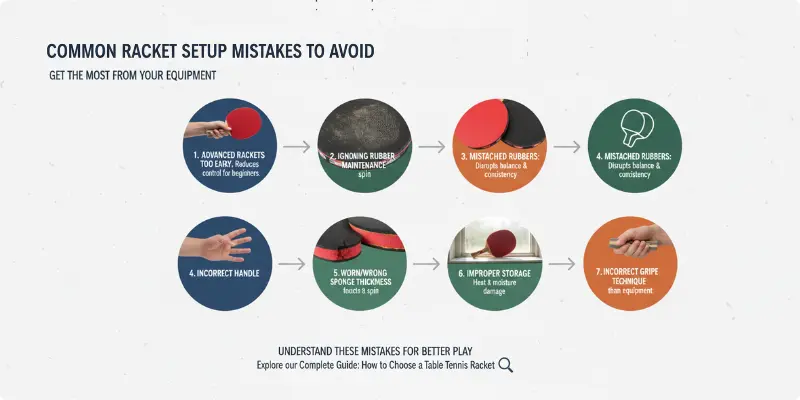
Avoid these pitfalls and your racket will perform exactly as intended, helping you improve rather than hold you back. For step-by-step buying advice and skill-level recommendations, see our How to Choose a Table Tennis Racket guide.
Which Racket Should You Actually Choose?
You now understand how blade construction influences feel, how sponge thickness affects speed and control, and why certain rubbers suit specific playing styles. More importantly, you know the common pitfalls to avoid, which puts you ahead of most players who choose equipment based on guesswork.
The direction from here is straightforward:
- Beginners need a forgiving all-wood all-round setup that builds technique without punishing small errors. Control at this stage matters far more than speed.
- Intermediate players are ready to explore their first custom assembly, matching blade and rubber to their emerging style. This is where equipment starts reflecting who you are as a player.
- Advanced players need precision-tuned equipment that rewards and demands consistent technique. At this level, small component differences produce measurable results on the table.
The rule that applies at every stage: match your racket to where you are right now, not where you want to be. Upgrading equipment to fix technique problems is the single most expensive mistake in the sport. For specific recommendations at every level, see our Best Table Tennis Rackets: Our Picks for Every Level.
Maintenance & Care: Keeping Your Racket in Top Shape
A well-maintained racket performs consistently session after session. Table tennis rubber degrades quickly without proper care; the spin and grip you depend on can disappear so gradually that you won’t notice until your game starts to suffer. Protect your investment with these simple post-play maintenance tips:
- Use protective films: Apply a cover to the rubber between sessions to block dust and preserve tackiness.
- Clean after play: Gently wipe the rubber with water or specialized cleaner, then air-dry before storing.
- Use a hard-sided case: A solid case prevents physical damage and shields the racket from environmental debris.
- Avoid heat and moisture: Never leave your racket in a car or a damp area, as both accelerate the decay of glue and rubber.
- Track your play hours: Most rubbers need replacing every 50–80 hours of play as the spin performance declines.
- Keep the handle dry: Wipe down the wood handle to maintain your grip and prevent sweat from soaking into the blade.
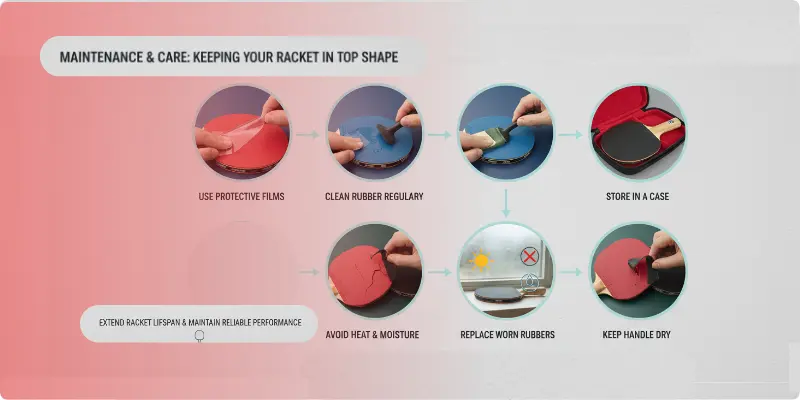
These habits significantly extend the lifespan of your gear. When you take care of your equipment, you ensure that every shot feels exactly like the last, keeping your game and your confidence predictable. For detailed cleaning methods and step-by-step care instructions: How to Clean Your Table Tennis Racket.
Conclusion
A table tennis racket is more than a piece of equipment; it’s the direct extension of your playing style and technical development. Every component works together as a system. Understanding that system is what separates players who choose equipment intentionally from those who buy on instinct and wonder why progress stalls. The knowledge you now have changes that. You understand what each component does, which racket type suits your style and level, what the specifications actually mean, and the mistakes worth avoiding before spending a penny. That foundation makes every equipment decision, now and as your game evolves, a confident one. The right racket, matched to the right player, makes every rally feel more natural.
FAQs
What is a table tennis racket called?
The official ITTF term is racket. In everyday use, it’s called a paddle in the US and a bat in the UK and Asia. All three are correct; the word typically reflects where you learned to play.
How to Hold a Table Tennis Racket?
Two primary grips:
- Shakehand: Resembles shaking hands. Index finger along the rubber’s bottom edge, thumb on the other. Offers balanced forehand and backhand power. The most widely used grip worldwide.
- Penhold: Handle between thumb and index finger, like holding a pen, with remaining fingers curled behind the blade. Enables agile wrist movement and explosive forehand play, but requires better footwork to cover the backhand.
Less common variations include the Seemiller and V-grip. Choose what feels most natural and gives you the best control. Choose what feels most natural and gives you the best control.
What’s the difference between red and black table tennis rubber?
The ITTF rules require one side to be black, the other a contrasting colour (red, blue, green, pink, or purple), so opponents know which rubber you’re using.
Traditionally, black rubber offers more grip and spin, while red is slightly faster with marginally less spin. However, this varies by manufacturer. The color rule is about visibility and fair play, not a reliable performance indicator across all brands.
How do I make my table tennis rubber sticky again?
If your rubber has lost its tacky feel:
- Clean thoroughly with a dedicated cleaner or water and a soft sponge.
- Use ITTF-approved rejuvenators for casual play (not tournament legal), works best on tacky Chinese-style rubbers.
- Prevent, don’t just restore: Clean after every session and use a protective film.
How often should I replace my rubber?
Depends on play frequency:
- Competitive players: Every 50–80 hours (roughly 2–3 months)
- Recreational players: Longer, but watch for spin drop-off
The clearest sign? The ball no longer grips; your topspin loops feel flat. Consistent cleaning and protective film extend rubber life.
Can my table tennis racket touch the table during play?
Yes, no penalty for racket contact. But these are illegal:
- Moving the table with your body or equipment
- Touching the playing surface with your non-playing hand during a rally
Either loses the point.
How do I clean and maintain my table tennis racket?
Proper cleaning extends your rubber’s life and performance.
- Clean: Wipe rubber with water or a specialized cleaner after each session
- Dry: Air dry completely before applying protective film
- Store: Hard case, away from heat and direct sunlight
- Handle: Keep it dry to prevent wood from absorbing moisture
Simple habits preserve spin, extend rubber life, and ensure consistent performance.
Please Write Your Comments