20 Essential Table Tennis Tips for 2026: From Equipment Selection to Elite Match Tactics
Updated: January 15, 2026
169
Struggling to win against modern, spin-heavy players in 2026? You’re not alone. Today’s table tennis demands more than fast reflexes; it requires pro-level tactics, 2026-ready equipment knowledge, and smart, data-backed training. The game has evolved, and if your training hasn’t, you’re already a step behind.
Table tennis is no longer just about speed. It’s a game of strategic thinking, refined technique, and mental sharpness. To dominate in 2026, players need a structured improvement plan that sharpens footwork precision, optimizes serve-and-return strategies, and adapts quickly during match play, blending strong fundamentals with advanced table tennis techniques. Without this balance, even talented players struggle to turn practice hours into consistent match wins.
In this 2026 guide, you’ll discover 20 proven table tennis tips designed to elevate every aspect of your game. You’ll learn how to choose the right equipment, build match-winning tactics, and develop the mental toughness needed to consistently outplay and outperform today’s competition.
Let’s break down the exact skills, tactics, and mindset you need to win in modern table tennis.
Key Takeaways
- Table tennis in 2026 prioritizes tactics, positioning, and adaptability, not just speed or reflexes.
- Fundamentals: grip, stance, footwork, and spin awareness remain essential for advanced performance.
- Selecting the right equipment for your playing style directly improves consistency and control.
- The serve–return–third ball sequence decides most points and determines match momentum.
- Smart tactics like targeting the crossover point and mixing shot patterns create high-percentage wins.
- Mental toughness and focus are critical in close, pressure-filled matches.
- Recording and reviewing matches accelerates improvement more than unstructured practice alone.
- Structured, incremental training turns techniques into reliable, match-winning habits.
Why Table Tennis Tactics Matter in 2026
Why do some players improve rapidly while others plateau year after year? In 2026, the answer lies in structured adaptation, not just repetition.
Modern table tennis is faster, more spin-heavy, and highly strategic. Players no longer rely only on reflexes, but on equipment knowledge, precise footwork, and sharp mental analysis. Understanding the nuances of serves, spin variation, and positioning can dramatically improve match results:
- Equipment has evolved: The 40+ plastic ball, combined with modern carbon blades and tensor rubbers, has made the game more spin-oriented, demanding better timing, touch, and stroke adjustment.
- Footwork and positioning win points: Efficient movement is non-negotiable against faster, stronger opponents who constantly exploit open space.
- Modern training demands structured intensity: Building the explosive speed and stamina for long rallies requires high-intensity multi-ball drills and data-driven feedback from match recordings, not just casual play.
- Mental sharpness separates champions: Consistent winners use match analysis and in-game tactical adaptation, while others rely on instinct alone.
Mastering these elements is what prepares you for competitive table tennis in 2026, where smart tactics, adaptable training, and informed equipment choices define who consistently wins at the table.
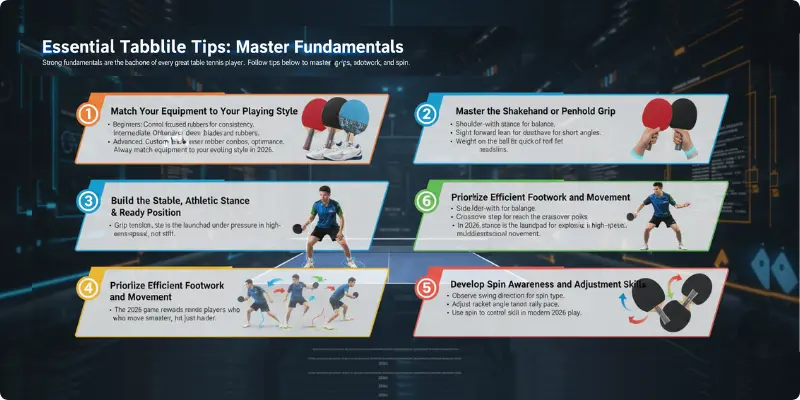
Essential Table Tennis Tips: Master the Fundamentals
Strong fundamentals are the backbone of every great table tennis player. Without a solid base, even advanced techniques can fail under pressure. Follow the tips below to master grips, stance, footwork, and spin.
1. Match Your Equipment to Your Playing Style
Choosing the right racket and gear shapes every aspect of your game. Beginners should use all-round rackets, intermediates choose offensive or defensive setups, and advanced players can customize blade-rubber combos. Footwear is equally critical for balance and movement. Focus on these key elements:
- Beginners: Control-focused rubbers for consistency.
- Intermediate: Offensive or defensive blades and rubbers.
- Advanced: Custom blade and tensor rubber combos, optimized shoes.
Proper gear gives you a tangible advantage and ensures your training translates into real match performance. Always match equipment to your evolving style in 2026. The right setup compensates for faster rallies and higher spin dynamics.
2. Master the Shakehand or Penhold Grip
A proper grip is the foundation of every stroke. The versatile shakehand grip suits most modern, two-winged attack styles. The penhold grip offers superior wrist flexibility for short-game dominance but requires more technical dedication. Keep your grip relaxed yet firm; white knuckles kill touch, and slow your wrist snap. Pay attention to these aspects:
- Shakehand: Balanced control for forehand and backhand.
- Penhold: Wrist flexibility, effective for short angles.
- Grip tension: Relaxed, not stiff.
Mastering your grip ensures your strokes are powerful, precise, and ready for high-speed 2026 gameplay, providing consistency under pressure.
3. Build a Stable, Athletic Stance & Ready Position
Your stance dictates your reach and reaction speed. Stand with feet shoulder-width apart, knees bent, weight on the balls of your feet. Lean slightly forward from the hips. This “ready position” should be your default between shots. Avoid standing upright or flat-footed; it adds crucial milliseconds to your reaction time. Focus on these adjustments:
- Shoulder-width stance for balance.
- Slight forward lean for quicker reaction.
- Weight on the balls of the feet for movement readiness.
A strong stance improves both defense and attack while reducing injury risk during fast rallies. In 2026, stance is the launchpad for explosive, multidirectional movement.
4. Prioritize Efficient Footwork and Movement
A great technique is useless out of position. Drill the side shuffle for wide balls, the crossover step for recovering to the center, and the pivot step to unleash your forehand from the backhand corner. Focus on short, explosive movements and always recover to your ready position. Balance is more important than raw speed. Consider these drills:
- Side shuffle for lateral coverage.
- Crossover step to reach the crossover point.
- Pivot step for strong forehand attacks.
Efficient footwork allows you to reach more balls with less effort, keeping you in control throughout the match. The 2026 game rewards players who move smarter, not just harder. To improve speed, balance, and recovery, see our complete guide on table tennis footwork with Tips for better Gameplay!
5. Develop Spin Awareness and Adjustment Skills
Spin wins rallies. Learn to read your opponent’s racket: a low-to-high swing creates topspin, a high-to-low swing creates backspin, and a sideways brush generates sidespin. Adjust your racket angle accordingly, close your angle against topspin, open it against backspin. Use your own spin to dictate the rally’s pace and placement. Apply these techniques:
- Observe swing direction for spin type.
- Adjust racket angle to counter spin.
- Use spin to control rally pace.
Understanding and applying spin allows you to manipulate opponents and dominate exchanges in modern 2026 play. Spin interpretation is now a non-negotiable core skill.
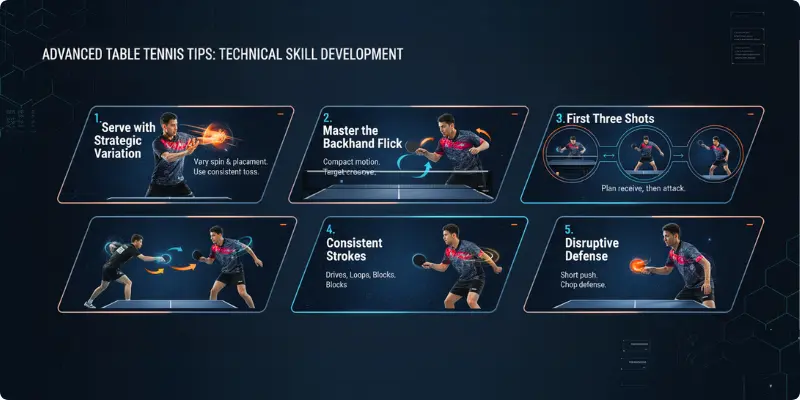
Advanced Table Tennis Tips: Technical Skill Development
Technical skills turn potential into performance. They allow you to control the pace of rallies, execute precise strokes, and adapt to any shot. Use these essential techniques to dominate serves, loops, flicks, and defense.
1. Serve with Strategic Variation and Deception
A predictable serve is a liability. Mix short serves that bounce twice with fast, deep serves to the elbow. Vary your spin between heavy backspin, topspin, sidespin, and no-spin, using a similar toss and motion to disguise your intent. The sidespin-backspin combo is particularly effective at forcing weak, pop-up returns. Pay attention to:
- Short vs. long serves to alter timing.
- Spin variations: backspin, topspin, sidespin.
- Consistent toss to disguise serve.
A deceptive serve creates scoring opportunities and sets the tone for the point, keeping opponents guessing. In 2026, serve deception is the first layer of tactical warfare. Want to go deeper into serve mechanics and spin control? Check out our detailed guide: Serves in Table Tennis: Types and Techniques Explained.
2. Master the Backhand Flick Against Short Serves
This underused weapon can dominate the short game. Against a short serve, step in and use a compact wrist-forearm snap to lift the ball with pace and topspin, targeting the crossover point or wide angles. A medium-paced flick can win the point or set up a third-ball attack. For a more aggressive forehand-side option, develop the banana flip, using a sharp wrist snap for heavy sidespin and topspin. Focus on executing:
- Step in close to short serves.
- Compact wrist-and-forearm motion.
- Target crossover or wide angles.
The backhand flick turns defensive situations into offensive opportunities, especially against predictable opponents. This is now a baseline requirement in 2026’s short-game meta.
3. Perfect Your First Three Shots: The Serve-Return-Attack
Most points are decided in the first three shots. Your receiving tactics, choosing a short ball or long ball attack, determine if you defend or attack first. Plan your “third-ball attack“: serve short with backspin to force a long return, then loop-kill the third ball. When receiving, neutralize the server with a deep, well-placed push to their backhand. Consider these steps:
- Plan third-ball attack sequences.
- Place returns strategically to neutralize the opponent’s advantage.
- Combine serve, spin, and placement for control.
Mastering the first three shots dramatically increases point-winning consistency and match control. In 2026, controlling the rally’s inception is controlling the match.
4. Build Consistent, Reliable Strokes: Drives, Loops, and Blocks
Consistency beats occasional brilliance. Practice forehand and backhand drives in continuous cross-court and down-the-line rallies. Develop a powerful, spinny loop against backspin. Master the block, a short, controlled stroke used to redirect an opponent’s attack, changing its pace and direction to disrupt their rhythm. Practice these core strokes:
- Forehand and backhand drives for control.
- Loops with spin to counter backspin.
- Blocks to neutralize aggressive shots.
Consistent strokes form the backbone of every successful 2026 player, reducing unforced errors and controlling rallies. Precision under pressure defines the modern competitive tier.
5. Develop a Disruptive Short Push and Chop Defense
A defensive variation can win matches. The short push keeps the ball low and short after a serve, denying attack opportunities. The chop is a defensive stroke played away from the table, imparting heavy backspin to force errors from impatient attackers. Use these to reset rallies and frustrate offensive players. Focus on:
- Short push for low, short placement.
- Chop for heavy backspin defense.
- Force errors from aggressive opponents.
Strong defensive skills keep you in rallies longer and create counter-attack opportunities. In 2026, a versatile defense is the hallmark of resilience.
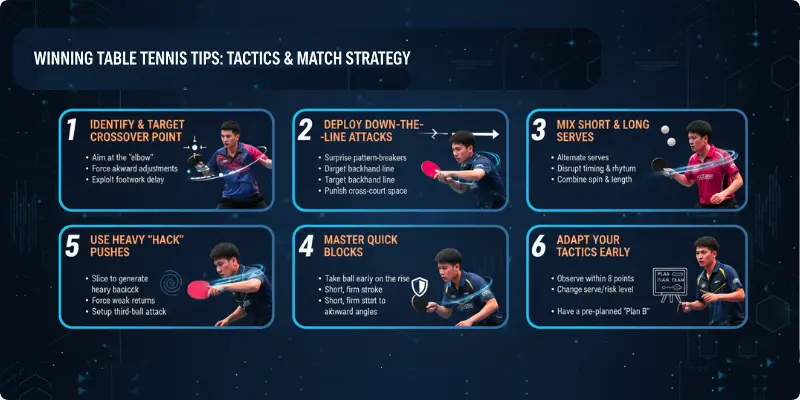
Winning Table Tennis Tips: Tactics & Match Strategy
Winning matches is about outsmarting your opponent, not just hitting hard. The strategies below are designed to give you an edge in today’s spin-heavy table tennis tactics, where controlling the rally’s pace and placement is more critical than raw power. Use these smart tactics to create openings, exploit weaknesses, and gain the upper hand.
1. Identify and Target Your Opponent’s Crossover Point (Elbow)
Every player has weak spots, but the crossover point, the area between forehand and backhand, is a commonly overlooked vulnerability. Many players fail to exploit it, leaving points on the table. By consistently targeting this zone, you can force awkward adjustments, disrupt timing, and create scoring opportunities. Focus on exploiting:
- Aim at the “elbow” to induce forehand/backhand confusion.
- Follow crossover shots with wide-angle balls to exploit poor recovery.
- Exploit the footwork delay that often follows a ball to this zone.
Weak zones like the crossover point create consistent errors and high-percentage scoring chances. This remains a foundational tactical play in 2026 competition.
2. Deploy Down-the-Line Attacks to Open the Table
Breaking predictable patterns is a hallmark of advanced players. Cross-court rallies are common, but a sudden down-the-line attack can catch opponents off guard, shorten their reaction time, and open space on the table for follow-up winners. By using this shot strategically, you can control points and dictate the rally flow. Integrate this tactic by:
- Use down-the-line shots as surprise pattern-breakers.
- Target the opponent’s backhand line to exploit a weaker side.
- Punish the newly opened cross-court space once they guard the line.
Changing attack patterns keeps opponents off-balance. Down-the-line shots are a key strategic weapon in the modern 2026 meta.
3. Mix Short and Long Serves to Break Rhythm
A good serve can win points before the rally even starts. Alternating between short serves and fast, deep serves keeps your opponent guessing, forces constant footwork adjustments, and disrupts their timing. By mastering both length and spin variation, you gain immediate control of the point’s pace. Focus on these variations:
- Alternate short and deep serves to disrupt timing.
- Use a deep, fast serve to catch a leaning opponent.
- Combine spin and length variation for maximum disruption.
Serve length variation makes your service game unpredictable, giving you control from the first shot. Rhythm disruption is a central strategy in 2026 table tennis.
4. Use Heavy, “Hack” Pushes to Force Weak Returns
Defense can become offense when executed correctly. A heavy backspin push, known as a “hack” push, disrupts opponents’ loops and often provokes weak returns. By turning a defensive shot into a tactical weapon, you can seize control and create easy scoring opportunities. Apply this technique by:
- Slice to generate heavy, disruptive backspin.
- Target opponents with inconsistent opening loops.
- Use the weak return for a decisive third-ball attack.
The hack push transforms passive defense into a proactive offense. Exploiting technical gaps with this shot adds strategic depth to your 2026 game.
5. Master Quick Blocks to Neutralize Attacks
Being reactive isn’t enough against aggressive loopers. A well-timed block allows you to redirect pace, disrupt rhythm, and turn an opponent’s attack into your advantage. With proper timing and racket angle, you can control fast exchanges and create counter-attacking opportunities. Perfect this skill by emphasizing:
- Step in to take the ball early, on the rise.
- Use a short, firm stroke with a closed racket angle.
- Redirect the ball to awkward angles to break the attacker’s rhythm.
The quick block transforms an opponent’s offensive strength into controlled counterplay. Modern table tennis views the block as offensive, not merely defensive.
6. Adapt Your Tactics Within the First 8 Points
Early points often set the tone for the rest of the match. Sticking rigidly to a failing plan allows opponents to take control, but adapting quickly gives you a strategic edge. By observing patterns and making small adjustments within the first few points, you can influence the match before it’s too late. Implement adaptation by:
- Observe and diagnose opponent patterns within the first few points.
- Be willing to change serve types, placements, or risk level by the 8-point mark.
- Have a pre-planned “Plan B” ready to deploy before falling too far behind.
- Challenge yourself with diverse practice opponents to expose weaknesses and build adaptive skills.
Early tactical adaptation prevents being outplayed in a fixed strategy and maximizes match control. Practicing against varied styles is what separates contenders from champions.
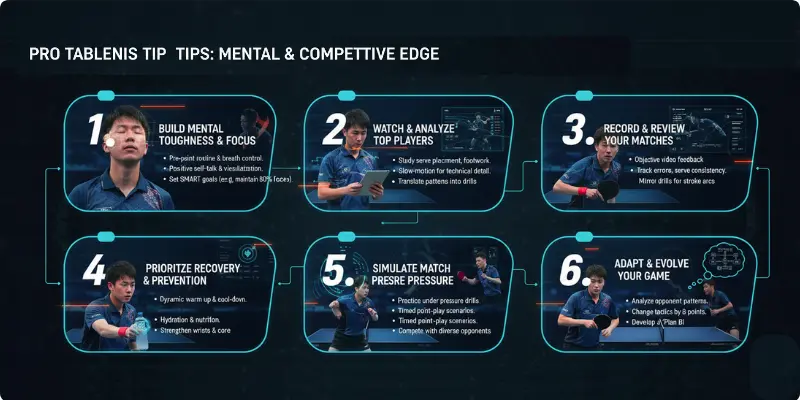
Pro Table Tennis Tips: Mental & Competitive Edge
Your mindset often decides close matches. Mental toughness helps you stay focused, recover from mistakes, and perform under pressure. Use these actionable methods to strengthen focus, resilience, and competitive thinking.
1. Build Unshakeable Mental Toughness and Focus
Close games are often decided in the mind before the paddle. Staying calm, present, and confident under pressure allows you to execute strategies effectively and recover quickly from mistakes. Positive self-talk, visualization, and mental routines are essential tools for 2026 competitive play. Strengthen your mental game by:
- Use a pre-point routine with breath control to reset focus.
- Using positive, instructional self-talk to maintain focus.
- Visualizing successful points before you serve to build confidence.
- Setting SMART goals for both mental and technical performance (e.g., maintain focus for 80% of points, reduce unforced errors).
Mental resilience ensures peak performance under pressure. Coupled with measurable goals, your focus and preparation translate directly into consistent improvement and match control.
2. Watch and Analyze Top Players for Pro Patterns
Watching professional matches isn’t just for inspiration; it’s a learning tool. By actively analyzing elite players, you can understand timing, positioning, and strategy, then adapt those patterns into your own game. Observing details such as footwork, serve choices, and stroke execution gives you insights you can’t gain from drills alone. Enhance your learning by:
- Actively analyze matches with a specific focus, e.g., serve placement or recovery.
- Use slow-motion playback to study technical details like wrist flicks and footwork.
- Translate observed patterns into personal drills.
Learning from the best accelerates technical and tactical development. Strategic observation provides a shortcut to 2026-level performance.
3. Record and Review Your Own Matches
Memory is subjective; video is objective. Recording your matches provides clear feedback on performance, allowing you to pinpoint weaknesses and track progress over time. Integrating mirror drills and structured practice sessions ensures that insights translate into actionable improvements. Make the most of self-review by:
- Recording matches regularly to create an objective performance record.
- Tracking specific metrics like unforced error types, first-serve consistency, and rally success.
- Using insights to create focused, personalized practice goals.
- Practicing in front of mirrors to monitor stroke arcs, wrist angles, and follow-through without a partner.
- Organizing practice sessions systematically: 30% basics (drives/pushes), 40% serves/returns, 30% match simulation for maximum improvement.
Objective video review, mirror drills, and structured practice reveal hidden flaws and provide a clear roadmap for improvement. This combination is a powerful self-coaching tool for 2026-level players.
4. Prioritize Recovery, Warm-Ups, and Injury Prevention
Long-term competitive success depends on keeping your body healthy and ready. Proper warm-ups, cool-downs, hydration, nutrition, and strengthening routines allow you to maintain peak performance and avoid injuries. These habits are just as important as technical training in 2026. Protect your body and performance by:
- Conducting a dynamic warm-up before every session to prime muscles and joints.
- Implementing a consistent cool-down and stretching routine after play.
- Listening to your body and addressing minor pains before they become injuries.
- Hydrating adequately before, during, and after matches.
- Incorporating post-match nutrition to accelerate recovery and maintain energy levels.
- Strengthening wrists, forearms, and core systematically to prevent injuries.
- Training with diverse opponents at clubs to adapt to different styles and intensities.
Proper recovery, nutrition, and diverse practice routines ensure longevity, consistent performance, and a competitive edge. Athletic health is now a strategic advantage in 2026.
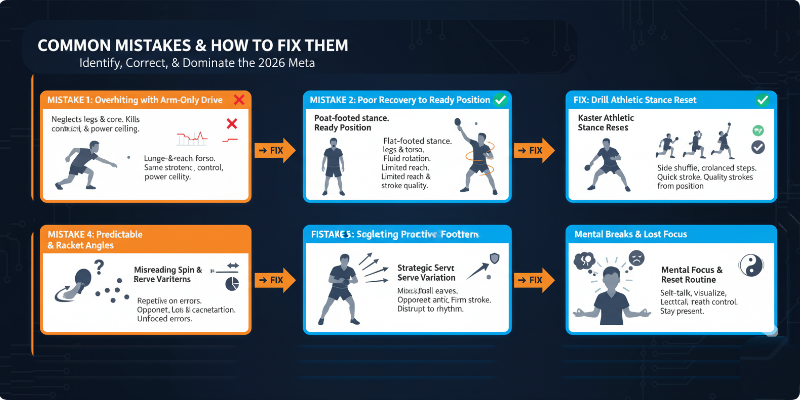
Common Mistakes & How to Fix Them
Even with the best tips, many players unknowingly make the same errors repeatedly. These mistakes not only cost points but also slow long-term improvement, no matter how much you practice. Recognizing these pitfalls and learning how to correct them is essential to turn hours of effort into real match-winning results.
1. Overhitting with Arm-Only Power
Relying solely on the arm and shoulder without engaging leg drive and torso rotation, which kills consistency and true power. This fundamentally limits your power ceiling and makes timing erratic.
2. Poor Recovery to the Ready Position
Failing to reset your athletic stance with knees bent and weight forward after playing a shot leaves you flat-footed and vulnerable. You lose the ability to react to the next shot effectively.
3. Neglecting Proactive Footwork
Remaining flat-footed or using a lunge-and-reach technique instead of small, balanced adjustment steps severely limits your reach and stroke quality. Quality footwork is what gets you into position to make a quality stroke.
4. Misreading Spin & Ignoring Racket Angles
Applying the same stroke and racket angle to every return without observing the opponent’s contact point and swing path, leading to easy unforced errors. Spin dictates the ball’s trajectory; ignoring it guarantees mistakes.
5. Predictable Serve Patterns
Using repetitive serve placement, spin, or toss height, which allows opponents to anticipate and attack your serve immediately. A predictable serve turns your first shot into your opponent’s first attack.
6. Mental Breaks & Loss of In-Point Focus
Dwelling on past errors or future outcomes, which breaks tactical concentration and disrupts the flow of the match. The point is played in the present moment, not in the last mistake.
Identifying and fixing these common technical and mental mistakes ensures your training translates into real match performance. Avoiding these unforced errors and reinforcing correct habits is a crucial step to mastering 2026’s fast, spin-heavy, and highly tactical table tennis meta.
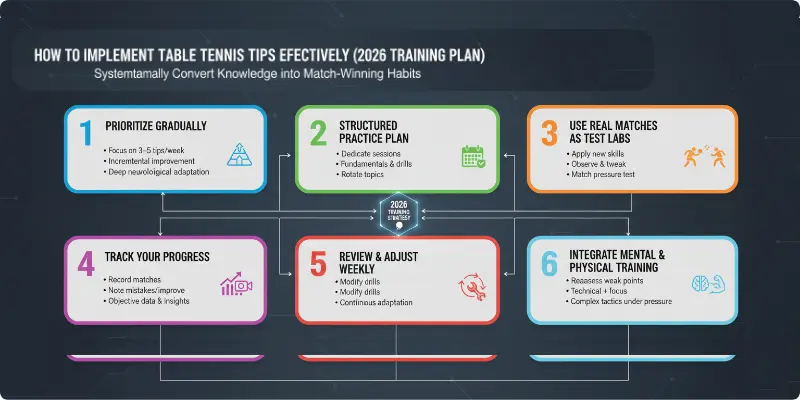
How to Implement Table Tennis Tips Effectively (2026 Training Plan)
Knowing the tips is one thing; applying them consistently is what separates players who plateau from those who dominate. Without a clear strategy, even the most advanced techniques can remain theoretical. This structured approach is the foundation of modern table tennis training. By approaching improvement systematically, you can convert knowledge into actionable habits that produce tangible results on the table.
1. Prioritize Gradually
Focus on 3–5 tips per week rather than trying to master all 20 at once. Incremental improvement ensures retention and reduces overwhelm. This focused approach allows for deeper neurological adaptation, turning isolated movements into reliable muscle memory.
2. Create a Structured Practice Plan
Dedicate sessions to fundamentals, technical drills, tactical exercises, and mental conditioning. Rotate topics to cover every aspect of your game. A periodized plan prevents burnout and ensures balanced development, which is critical for 2026’s all-around game demands.
3. Use Real Matches as Test Labs
Apply your drills and new skills in friendly or competitive matches. Observe what works and what needs tweaking. Match pressure is the ultimate test of any new technique, revealing flaws that don’t appear in controlled practice.
4. Track Your Progress
Record matches, note recurring mistakes, and track improvements. Adjust your training based on these insights. Objective data from video review is invaluable for identifying hidden patterns and measuring real improvement beyond feeling.
5. Review & Adjust Weekly
Reassess weak points and modify drills or focus areas accordingly. Continuous adaptation is the key to steady progress. This agile method ensures your training evolves with your game, targeting the current biggest opportunity for gain.
6. Integrate Mental & Physical Training
Combine footwork drills with serve strategies, and pair technical practice with focus exercises. This mirrors real-game conditions and ensures readiness for competitive play. Integration trains the neural pathways needed to execute complex tactics under fatigue and pressure.
Implementation is the bridge between theory and results. By following this structured plan, focusing incrementally, and continuously adapting, you can elevate your 2026 table tennis game from competent to elite, turning these 20 tips into a winning formula.
For structured routines and drills, explore our full table tennis training and practice guides. Training for Table Tennis to master speed, spin, and strategy.
Conclusion
Table tennis in 2026 is faster, smarter, and more demanding than ever. Winning consistently is no longer about relying on raw speed or instinct alone; it’s about combining strong fundamentals with advanced tactics, modern equipment awareness, and mental resilience. Players who adapt to the evolving, spin-heavy meta gain a clear advantage over those stuck in outdated training habits. By applying these 20 essential table tennis tips, you’re not just improving individual shots; you’re building a complete, competition-ready game. From footwork and spin control to serve strategy and in-match adaptation, each improvement compounds over time. Commit to structured practice, focus on gradual progress, and treat every match as a learning opportunity. Do that consistently, and you’ll not only keep up with 2026 table tennis, but you’ll also start setting the pace.
Start applying these tips consistently, and your 2026 season can become your strongest yet.
FAQs: Table Tennis Tips
What’s the fastest way to improve in table tennis in 2026?
The fastest improvement comes from structured, focused practice. Prioritize footwork drills, serve and return sequences, and regularly playing matches against stronger opponents to expose and correct weaknesses under pressure.
Should I buy a custom table tennis racket or a pre-made one?
Beginners should start with a pre-made all-round racket for consistency. Intermediate and advanced players will see significant benefits from a custom setup (selecting a specific blade and rubbers) to match their attacking, defensive, or all-round playing style.
How can I improve my reaction time and reflexes for table tennis?
Improve reaction time with random multiball drills, shadow footwork exercises, and playing against varied opponents. These methods train your brain and body to recognize patterns and move explosively without anticipation.
Is mental strength really important in winning table tennis matches?
Absolutely. Mental toughness is often the deciding factor in close matches. Key skills include maintaining focus between points, adapting tactics mid-game, and keeping composure under pressure to execute your strategy.
How can I read my opponent’s spin in table tennis?
Read spin by closely watching your opponent’s racket angle at contact and their swing direction (low-to-high for topspin, high-to-low for backspin, sideways for sidespin). Adjust your own racket angle and stroke accordingly to counter it effectively.
What is the best overall strategy for winning at table tennis?
The best winning strategy is to control the first three shots (serve, return, and third-ball attack). Use serve variation to create weak returns, then execute a strong third-ball attack (like a loop) to seize the initiative and pressure your opponent from the start of the rally.
Can I improve at table tennis effectively without a personal coach?
Yes, with high self-discipline. Utilize quality online video tutorials, record and analyze your own matches for feedback, and use training tools like table tennis robots for repetitive stroke and footwork drills.
What are the essential basic skills in table tennis I should master first?
The core skills are: a consistent grip and ready stance, efficient footwork, basic serve and return, controlling drives and pushes, and fundamental spin awareness. Mastering these creates the foundation for all advanced techniques.
Please Write Your Comments