Rules for Table Tennis: Official Guide to Scoring, Serves & Doubles
Updated: November 29, 2024
666
Wondering what the official rules for table tennis really are, and ready to settle those match-time debates once and for all? You’re in the right place.
Table tennis, often called ping-pong, is a fast-paced sport built on precision, strategy, and quick decision-making. Beyond skill and speed, every rally, serve, and point follows standardized rules that keep the game fair and competitive worldwide. Maintained by the International Table Tennis Federation (ITTF), these regulations ensure consistency across casual matches, club play, and professional tournaments, allowing players everywhere to compete under the same framework. Understanding these rules not only prevents confusion during play but also helps players appreciate the strategy behind every point.
In this guide, you’ll learn the official table tennis rules, including scoring, serving, singles and doubles play, and the key regulations used in professional and Olympic competition.
Let’s break down the rules of table tennis step by step.
What Are the Rules for Table Tennis?
The rules for table tennis are established by the International Table Tennis Federation (ITTF) to create a consistent framework for every match, from casual garage games to professional tournaments. Understanding these regulations ensures fair play and helps players avoid common disputes. At its core, table tennis revolves around a few key areas:
- Serving: specific requirements govern how each rally begins
- Scoring: a structured system determines how games and matches are won
- Singles vs. Doubles: each format has unique serving and rotation rules
- Lets, faults, and edge balls: these define interruptions, errors, and boundaries
Mastering these core rules ensures fair play and a solid foundation for any table tennis match. With this understanding, players can focus on strategy, skill, and enjoying the game to its fullest.
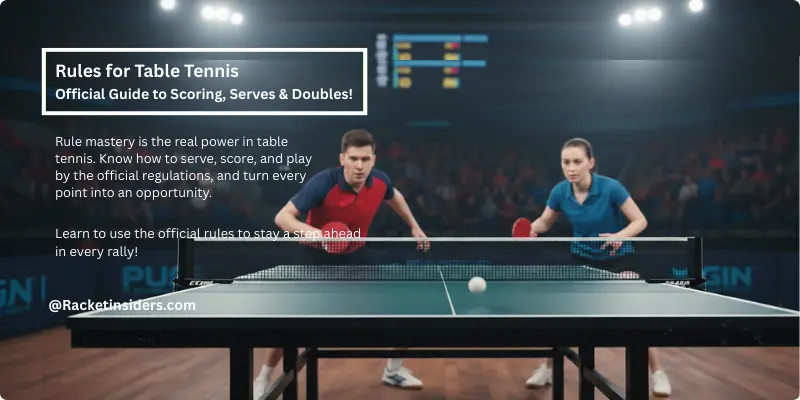
Official Rules of Table Tennis
The official rules of table tennis are established by the International Table Tennis Federation (ITTF), the organization responsible for regulating the sport worldwide. These rules define how the game is played at every level, from casual recreational matches to elite international competitions, ensuring fairness, consistency, and standardized gameplay across the globe.
Equipment Regulations in Table Tennis
Equipment rules exist to ensure fair and consistent play at every level. Here are the official specifications for tournament-legal equipment. Rather than covering manufacturing variations or equipment choices, this section focuses only on the essential rule-based requirements that directly affect gameplay and officiating.
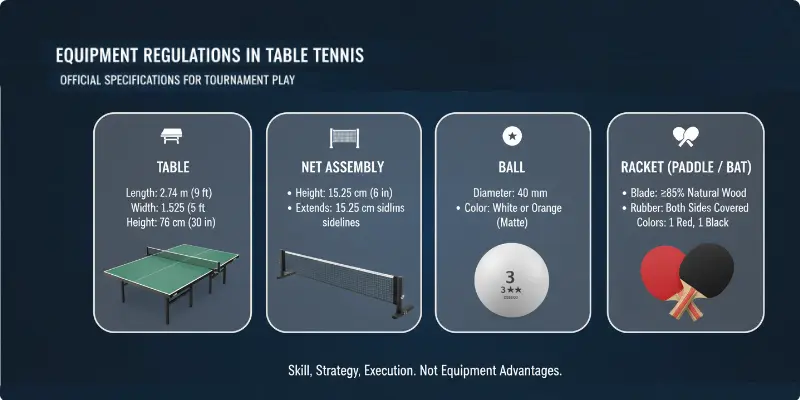
1. Table
The table is more than just a playing surface; its dimensions directly affect gameplay speed and bounce consistency. Instead of exploring table materials or design variations, official rules emphasize standardized measurements that guarantee identical playing conditions worldwide.
- Length: 2.74 meters (9 feet)
- Width: 1.525 meters (5 feet)
- Height: 76 centimeters (30 inches) above the floor
The playing surface must be rectangular and uniform to ensure a consistent bounce across all areas of the table.
2. Net Assembly
The net may seem simple, but its height and tension are critical to fair play. Rules, therefore, focus strictly on positioning and measurement rather than construction details or equipment types.
- Height: 15.25 centimeters (6 inches) throughout
- Net posts: Extend 15.25 centimeters beyond each sideline
The net must stretch across the entire width of the table and remain evenly supported to divide the playing area into two equal courts.
3. Ball
The ball has undergone significant changes over the years, most notably the shift to the 40 mm size to improve visibility and rally length. Here, only the standardized competition specifications are covered, excluding manufacturing differences or brand variations.
- Diameter: 40 mm
- Weight: 2.7 grams
- Material: Plastic (historically celluloid; non-flammable)
- Color: White or orange with a matte finish that contrasts with the playing surface
4. Racket (Paddle / Bat)
The racket is a player’s most personal piece of equipment, and its construction directly influences spin and control. However, regulations focus solely on structural legality rather than on playing styles or equipment selection advice.
- Blade: At least 85% natural wood by thickness
- Rubber: Both sides must be covered if used for striking
- Colors: One side red and one black (or two distinct approved colors)
- Surface: Plain, matte, and continuous
By standardizing equipment dimensions and materials, table tennis regulations ensure matches are decided by skill, strategy, and execution rather than equipment advantages. From recreational play to elite competition, these specifications create a level playing field where performance depends solely on the players.
How a Table Tennis Match Starts
Before the first rally, a quick pre-match ritual determines who serves and which end each player takes. This opening procedure ensures fairness by removing any advantage one player might gain from choosing first.
Choosing Who Serves First
The server is determined by one of these common random methods:
- Coin toss: A coin is flipped; one player calls “heads” or “tails” while it’s in the air.
- Racket spin: One player spins the racket; the opponent guesses which side faces up.
- Ball hiding: One player hides the ball; the opponent guesses which hand.
Rather than covering every possible pre-match ceremony, these are the three most common methods accepted in both casual and competitive play.
Service Rules in Table Tennis
Every rally starts with a serve, and strict rules define what makes a serve legal. These rules ensure fairness and prevent players from gaining an unfair advantage through deceptive or improper serving. Following these guidelines keeps the game consistent and competitive, whether played casually or at a professional level.
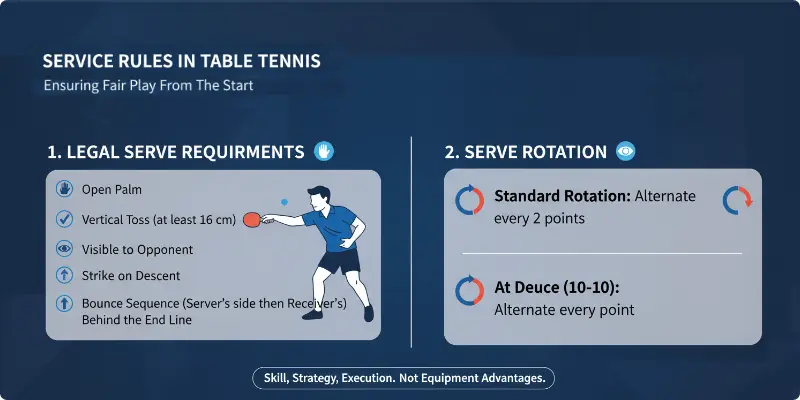
1. Legal Serve Requirements
A correct serve must meet all of the following conditions:
- Open palm: Ball rests stationary on the open palm, above the level of the table.
- Vertical toss: Tossed straight up at least 16 cm (6 inches).
- Visible: Ball remains visible to the opponent throughout the toss.
- Strike on descent: Ball must be struck as it falls, never on the way up.
- Bounce sequence: Ball must bounce once on the server’s side, then once on the receiver’s side.
- Behind the line: The server must stand behind the end line of the table.
- No second serves: Only one serve attempt allowed; a miss or illegal serve loses the point
2. Serve Rotation
Serving alternates in a structured way to maintain fairness throughout the game:
- Standard rotation: Players alternate serving every 2 points.
- At deuce (10–10): Serves alternate after every point.
Mastering these rules ensures that every rally begins fairly, keeping the game competitive and consistent for both players. To see how these rules translate into real gameplay, explore different serves in table tennis and the techniques players use to gain an advantage.
Scoring System & Winning a Match
Scoring is the heartbeat of every table tennis match, determining not just individual points but also who ultimately wins the game and the match. Once the serve is understood, the next essential element is how scoring works, which sets the structure for fair and competitive play.
1. Games and Match Format
Under current ITTF rules, table tennis uses an 11-point game system designed to boost match intensity, keep spectators engaged, and reward skill over chance. Here’s how it works:.
- Matches are typically best-of-five or best-of-seven games.
- Each game is played to 11 points.
- A player or team must win by at least 2 points.
- If the score reaches 10–10 (deuce), play continues until one player leads by 2.
2. How a Point Is Won
A player scores a point when their opponent:
- Fails to make a legal serve
- Fails to make a correct return
- Let the ball bounce twice on their side
- Strikes the ball twice in succession
- Hits the ball with the side of the racket blade
- Touches the playing surface with their free hand
- Touches the net during play
- Moves the table
- Hits the ball off the table
- In doubles, hits out of sequence
Understanding these rules ensures that each rally is counted accurately and that matches are decided by skill, strategy, and execution rather than mistakes or misunderstandings.
Rules for Singles Matches
In singles matches, one player competes on each side of the table. The format is preferred for its simplicity, fast pace, and straightforward rules, making it accessible to players at every level.
1. Serving in Singles
The serving rules in singles offer more flexibility than doubles, with no diagonal restrictions to worry about.
- The server may direct the ball to any part of the opponent’s side
- All general service rules still apply: open palm, vertical toss, visibility, and proper bounce sequence
- No requirement to serve from or aim at a specific court
2. Serve Rotation
Once the rally ends, serving duties shift between players in a structured pattern that keeps the game balanced.
- Players alternate serving every 2 points
- At 10–10 (deuce), serves alternate after every point
- This continues until one player establishes a 2-point lead
3. Returning the Ball
After the serve, the rally continues with both players working to keep the ball in play using proper returns.
- The ball must be returned before it bounces twice on your side
- A legal return must land on the opponent’s side of the table
- Returns can land deep, short, or wide, anywhere on the table is valid
Mastering serving, rotation, and returns in singles ensures a fair and competitive match while highlighting each player’s skill and strategy.
Rules for Doubles Matches
Doubles adds teamwork and strategy to the game, with two players on each side. While many core rules mirror singles, doubles introduces unique serving and rotation requirements to keep play fair and organized. Mastering these rules is key to successful and competitive doubles play.
1. Serving in Doubles
The diagonal serve is the most noticeable difference in doubles, ensuring structure from the first shot.
- Serve must travel diagonally from the server’s right court to the receiver’s right court
- The ball must land in the correct half; the center line counts as “in.”
- If the serve lands in the wrong court, the serving team loses the point
- All general service rules (open palm, vertical toss, visibility) still apply
- After two serves, partners switch positions: receiver becomes server, server’s partner becomes receiver
2. Serve Rotation
A set rotation ensures every player serves and receives fairly throughout the match.
- Service changes to the opposing team after every 2 points
- The previous receiver becomes the new server
- The partner of the previous server becomes the new receiver
- Rotation continues throughout the match, even after a deuce
3. Alternating Hits
Partners must coordinate their hits to maintain the correct sequence during rallies.
- Teammates must take turns hitting the ball during rallies
- Hitting twice in a row results in a point for the opposing team
- Sequence rules apply regardless of where the ball lands
- Clear communication prevents unintentional errors
Following the serving, rotation, and alternating hit rules keeps doubles matches fair and strategic, highlighting both teamwork and individual skill.
Lets and Faults in Table Tennis
Not every rally ends with a winner; some stop due to interruptions or errors. These situations are defined by specific rules that determine whether play continues or a point is awarded. Understanding the difference between a let (replay) and a fault (lost point) keeps matches running smoothly.
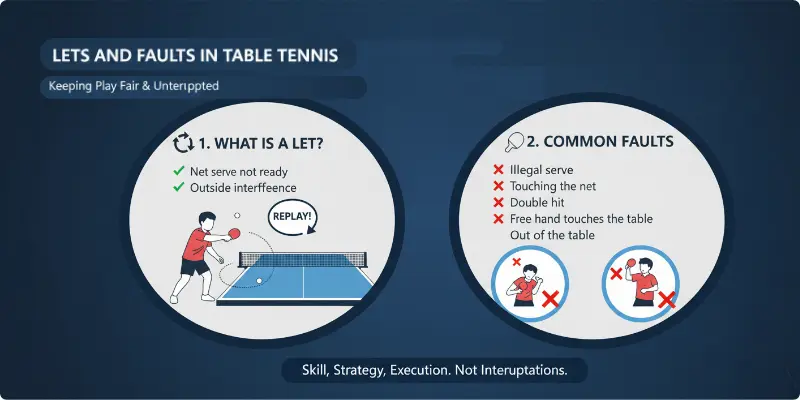
1. What Is a Let?
A let stops play, and the point is replayed with no score awarded.
- Net serve: Serve touches the net but still lands in the correct service area
- Receiver not ready: Receiver made no attempt to return and was unprepared
- Outside interference: A ball rolls onto the court, a distraction, or another disruption
2. Common Faults
A fault ends the rally, and the opponent wins the point.
- Illegal serve: Toss too low, hidden ball, or improper contact
- Touching the net: Any contact with the net assembly during play
- Double hit: Striking the ball twice in succession (unless accidental and continuous)
- Obstruction: Ball touches player’s body or clothing before bouncing
- Free hand touches the table: Non-paddle hand contacts the playing surface
- Moving the table: Any movement caused by the player during the rally
- Out of sequence (doubles): Partners hit out of correct order
Recognizing lets and avoiding faults helps maintain fair play while ensuring rallies are decided by skill rather than rule violations.
Other Official Rules in Table Tennis
While scoring, serving, and rally rules form the foundation of table tennis, several additional regulations ensure matches remain fair, controlled, and professionally managed under official standards set by the International Table Tennis Federation (ITTF). These rules may appear minor, but they play an important role in maintaining order during competitive play.
1. Time-Outs
Each player or team is allowed a short strategic break during a match to regroup and reset momentum.
- Duration: One 60-second timeout per match
- When allowed: Can be requested when the ball is out of play
- Strategy: Used to pause momentum, discuss tactics with a coach, or briefly recover focus
2. Edge Ball
Edge balls often confuse, but the rule itself is simple and clearly defined.
- A ball that hits the top edge of the table is considered good and remains in play
- A ball that strikes the vertical side of the table is out
- If the ball contacts the top edge and rebounds unpredictably, the rally continues normally
3. Illegal Returns
A player loses the point when a legal return is not completed.
- Double bounce: Ball bounces twice on the player’s side
- Off the table: Shot fails to land on the opponent’s side
- No touch: Player swings and completely misses the ball
- Carrying: Ball is held or dragged on the racket instead of struck cleanly (rare in casual play but illegal officially)
4. Expedite System
The expedite system prevents stalling and ensures matches progress at a reasonable pace during longer games.
- Activation: Triggered when a game reaches 10 minutes, and both players have fewer than 9 points
- Serve change: Each player serves 1 point at a time (instead of the usual 2)
- 13-stroke rule: If the receiver makes 13 consecutive good returns, they win the point
- Duration: Once activated, the expedite system remains in effect for the rest of the match
5. Ball Returning Over the Net
A rare but often misunderstood scenario that results in a point for the striker.
- The opponent’s shot bounces on your side and spins back over the net without being touched
- You win the point; your opponent failed to make a legal return
- This applies to both serves and rallies
Together, these additional rules refine how matches are controlled, ensuring that table tennis remains a fast, fair, and consistently regulated sport at every level of play.
Common Rule Misunderstandings in Table Tennis
Even experienced players sometimes misinterpret the rules for table tennis, leading to confusion or disputes during a match. Understanding these common misunderstandings ensures fair play, smoother gameplay, and can give you a strategic edge over casual opponents.
1. Let Serves
The net serve rule is one of the most misunderstood in casual play.
- Misunderstanding: A serve that touches the net is always a fault
- Truth: If the ball touches the net but still lands in the correct service box, it’s a let; the point is replayed
- Fault: Only serves that fail to reach the opponent’s side lose the point
2. Double Hits
Players often argue about whether striking the ball twice is legal.
- Misunderstanding: Any double contact with the ball is illegal
- Truth: A player loses the point only if the ball is struck intentionally twice
- Exception: Accidental double contact in one continuous motion is generally allowed
3. Edge Balls
Edge balls frequently spark disagreement, especially in fast rallies.
- Misunderstanding: A ball hitting any part of the table edge is good
- Truth: Only balls landing on the top edge are valid
- Out: Hitting the vertical edge or falling outside the table loses the point
4. Serving in Singles
Some players carry doubles rules over to singles by mistake.
- Misunderstanding: Singles serves must follow diagonal rules like doubles
- Truth: In singles, the server may direct the ball to any part of the opponent’s side
- Note: General service rules still apply, open palm, vertical toss, and visibility
5. Winning by Two Points
New players often celebrate too early when they hit 11.
- Misunderstanding: The game ends immediately at 11 points
- Truth: Players must win by a 2-point margin
- At deuce (10–10): Play continues until one player leads by two
6. Touching the Net
Accidental net contact happens often, but the rule is firm.
- Misunderstanding: Accidentally brushing the net is sometimes allowed
- Truth: Any contact with the net assembly during a rally immediately awards the point to the opponent
7. Honor System
When no referee is present, players are expected to resolve disputes fairly and respectfully.
- Misunderstanding: The referee must settle every disagreement
- Truth: In casual play, players use the honor system and discuss the call calmly
- No agreement: If you can’t agree, replay the point
- Tradition: Table tennis values fair play; the honor system keeps matches friendly and competitive
Knowing these common mistakes alongside the official rules for table tennis ensures every match is fair, competitive, and enjoyable, letting players focus on skill, strategy, and precise gameplay rather than confusion.
Conclusion
Understanding the rules for table tennis isn’t just about fair play; it’s about enjoying the game to its fullest. Whether you’re playing casually with friends or training for competition, knowing how serving, scoring, and gameplay work gives you confidence and a strategic edge. These official regulations, established by the International Table Tennis Federation (ITTF), ensure every match remains consistent, fair, and true to the spirit of the sport worldwide. So grab a paddle, put these rules into practice, and experience the speed, precision, and excitement that make table tennis unforgettable.
FAQS
Who makes the official rules of table tennis?
The official rules are created and maintained by the International Table Tennis Federation (ITTF), the global governing body responsible for regulating competitive table tennis worldwide.
How do you serve in table tennis?
Place the ball on your open palm, toss it vertically at least 6 inches (16 cm), and strike it as it falls. The ball must bounce once on your side and then once on your opponent’s side while remaining visible throughout the serve.
How does scoring work in table tennis?
A point is won when an opponent fails to make a legal serve or return, touches the net, or allows the ball to bounce twice. Games are played to 11 points and must be won by a 2-point margin. Matches are typically best of five or seven games.
What is a let in table tennis?
A let is a replay with no point awarded. It occurs when a serve touches the net but lands correctly, when the receiver is not ready, or when outside interference interrupts play.
Can you volley in table tennis?
No. Volleying (hitting the ball before it bounces on your side) is not allowed. The ball must bounce once before it is returned.
Do you have to serve diagonally in table tennis?
Only in doubles. In singles, the serve may land anywhere on the opponent’s side, while in doubles, it requires a diagonal serve from the right court to the right court.
What is a fault in table tennis?
A fault is any rule violation that results in losing the point. Common faults include illegal serves, touching the net, double hits, obstruction, or hitting the ball off the table.
How many games are in a table tennis match?
Matches are usually best-of-five or best-of-seven games. Each game is played to 11 points and must be won by at least two points.
Can the ball hit the net in table tennis?
Yes. During rallies, play continues if the ball touches the net and lands correctly. On a serve, a net touch that lands properly is called a let, and the point is replayed.
Please Write Your Comments