How to Become a Table Tennis Umpire: Certification, Training & Career Path
Updated: March 17, 2026
18
At the highest level, a table tennis rally can be over in less than a second. Every serve, every edge ball, every conduct decision, someone has to get it right, in real time, under pressure. That someone is the umpire.
Umpiring in table tennis is one of the most direct ways to stay close to a sport you love while developing a genuinely deep understanding of its rules. The pathway is structured, accessible, and open to anyone, no playing background required, no connections needed.
In this guide, we explain exactly how to become a table tennis umpire, from the role itself and certification requirements to ITTF badge levels and progression from local matches to international events. Whether you’re new to officiating or upgrading your badge, you’ll find everything here.
Key Takeaways
- The ITTF uses a five-level badge system (Basic to Gold), with each level unlocking access to higher competitions.
- Start with your national association; they control introductory courses and certification.
- The 16-hour course leads to a National badge within 3–6 months of match experience and maintaining a verified logbook.
- Umpire and referee are separate roles with distinct pathways; know the difference before you start.
- English competence is mandatory from White Badge (Level 3) upward; it is also required for the Blue Badge Advanced Rules Exam.
- Maintaining your badge is essential; letting it lapse means restarting from the previous level.
- Higher-badge umpires travel with expenses covered, though local umpiring is mostly voluntary.
- No playing background needed, just rules knowledge, focus, and the ability to avoid common mistakes.
What Does a Table Tennis Umpire Actually Do?
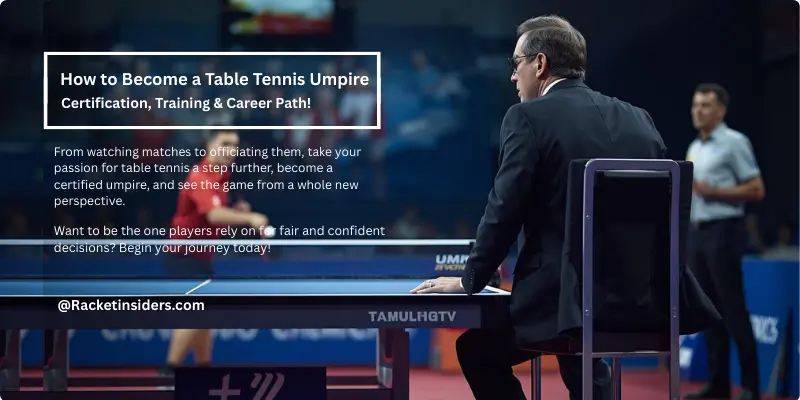
The umpire in table tennis is the match official responsible for everything that happens at the table. From the first serve to the final handshake, every rally, every call, and every dispute falls under the umpire’s jurisdiction. They are not just a scorekeeper; they’re the on-table authority who ensures fairness, maintains control, and keeps the match moving. The umpire’s duties cover the full duration of every game:
- Calling the score after every point, the server’s score is announced first
- Making service fault decisions when the service does not meet regulations
- Calling lets when play must be stopped and a point replayed
- Managing player conduct and issuing warnings or penalty points when necessary
- Applying the expedite system when a game exceeds 10 minutes
- Working alongside the assistant umpire who monitors the opposite end of the table
A good umpire is one you barely notice; the game flows, decisions come quickly, and both players feel the match is in fair hands.
Umpire vs Referee: Know the Difference
The umpire and referee’s roles in table tennis are often confused. They describe entirely separate functions with separate certification pathways, understanding the distinction matters from day one. Mixing them up at the start can send you down the wrong certification route entirely. Both roles are essential to how a competition runs, but they operate at completely different levels of the event.
The Umpire
The umpire in table tennis is the face of officiating during any match. Positioned at the tableside, they are responsible for everything that happens within that specific game.
- Controls an individual match
- Calls the score after every point
- Makes service fault and the let decisions
- Manages player conduct throughout the game
The Referee
The referee works behind the scenes, often unseen by spectators but essential to tournament operations. Their view is the big picture, not just one match.
- Manages the draw and schedule
- Resolves disputes escalated by umpires
- Enforces competition regulations
- Retains authority to overrule an umpire in defined circumstances
Most national associations require candidates to hold at least a State or National Umpire badge before sitting a referee course. Understanding which role you are pursuing from the outset keeps your certification journey on the right track.
ITTF Umpire Badge Levels
The International Table Tennis Federation (ITTF), founded in 1926 and headquartered in Lausanne, Switzerland, governs the sport globally. It administers a five-level umpire badge system, updated in 2024:
| Level | Name | Key Requirements | Scope |
| 1 | Basic Umpire | 16-hour course + written exam | Local / club |
| 2 | National Umpire | Level 1 for 1+ year, national experience, written + oral + practical exams | Domestic nationals |
| 3 | White Badge | National Umpire 2+ years, 3 national champs or 2 international events, English competence, online prep + exam | International events |
| 4 | Blue Badge | White Badge 2+ years, Advanced Umpire Training, ARE in English, 4 Meets Expectation evaluations | ITTF/WTT majors incl. World Champs |
| 5 | Gold Badge | Blue Badge 2+ years, ARE pass, 3 assessments avg 85%+ | Olympics, Paralympics, WTT Grand Smash |
ℹ️ Most national bodies add introductory levels beneath the national badge; always check the specific pathway your national body publishes.
Earning a badge is only half the work; maintaining it matters just as much. Letting a badge lapse means reverting to the previous level and restarting the process entirely.
How to Become a Table Tennis Umpire: Step-by-Step?
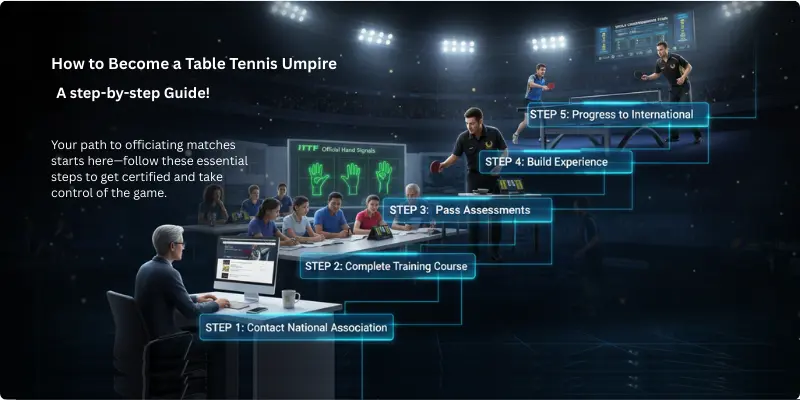
Becoming a certified umpire follows a clear pathway, but it doesn’t happen overnight. Expect to invest time in training, practice, and assessments as you build your skills. These five steps take you from your first inquiry to international accreditation, and each one builds on the last.
Step 1: Contact Your National Association
Your first move is to locate the table tennis governing body in your country. Most publish an officiating or umpiring section on their website with details of upcoming courses and a contact for their umpires’ committee.
- UK: Table Tennis England
- USA: USA Table Tennis (USATT)
- India: Table Tennis Federation of India (TTFI)
- Australia: Table Tennis Australia (TTA)
Reach out proactively; do not wait for a course to come to you. Umpiring communities are welcoming, and a direct email usually gets fast answers.
Step 2: Complete an Introductory Training Course
This is where your rules knowledge is built from the ground up, and where most people realise how much depth the sport actually has. All certification pathways begin with a formal training course. At the introductory level, these cover:
- The official Laws of Table Tennis, including service rules and the expedite system
- Umpire and assistant umpire roles, responsibilities, and correct positioning
- Official ITTF hand signals: let, fault, point, and time
- Conduct regulations, the yellow/red card system, and scoring procedures
The ITTF specifies a minimum of 16 hours for a Level 1 (Basic Umpire) course. Many associations now combine online theory modules with practical assessments at events.
Step 3: Pass the Written and Practical Assessment
Once your training is complete, you need to pass two assessments before your certification is confirmed. Both are straightforward if you have prepared. Here is what to expect from each.
- Written Test: Rules-based questions from the Laws of Table Tennis. The pass mark is typically 80% or higher.
- Practical Assessment: You umpire a real match while an assessor evaluates your positioning, calls, and communication.
Pass both, and your first certification is official. The next step is putting it to use. Most new umpires are surprised by how quickly their confidence grows once they are actually behind the table.
Step 4: Build Your Match Experience and Logbook
Volunteer at local league matches, club competitions, and regional tournaments. The more matches you umpire, the sharper your instincts become. Before every match, make sure you:
- Verify both players’ names and check racket compliance
- Complete the score sheet and set the scoring device to zero
- Conduct the coin toss and confirm the match format
- Time the two-minute warm-up accurately
- Confirm the match format with both players: best of 3, 5, or 7 games
Experience is the only thing that turns rule knowledge into confident decision-making. The more matches you seek out, the faster that development happens.
Step 5: Progress to White, Blue, and Gold Badges
Once you have solid national-level experience, the international pathway opens up. Each badge has specific, non-negotiable requirements set by the ITTF, and each one builds directly on the last.
- White Badge (Level 3): Hold a National Umpire qualification for two or more years and pass the ITTF International Umpires Exam. English competence required.
- Blue Badge (Level 4): Hold a White Badge for two or more years, complete the Advanced Umpire Training, and pass the Advanced Rules Exam in English.
- Gold Badge (Level 5): Hold a Blue Badge for two or more years and achieve a performance assessment average of 85%+ across at least three assessments.
Reaching Gold Badge level is rare, but the pathway is open to anyone willing to put in the years. Every step up earns you access to bigger competitions and greater recognition within the sport.
Why Become a Table Tennis Umpire?
Most officials arrive at umpiring the same way; they are already involved in the sport, love it deeply, and want to contribute beyond the playing side. Umpiring offers exactly that: you stay close to the game while developing a far deeper understanding of its rules.
What makes it distinctive compared to other volunteering roles in sport:
- An umpire is inside every competitive match, not watching from the stands
- Certified umpires receive nationally and internationally recognised accreditation
- Higher-badge umpires travel to regional, national, and international tournaments, often with expenses covered
- Playing experience is useful but never required; the pathway is open to anyone
It is worth being candid: umpiring requires patience, sharp concentration, and the ability to make impartial decisions under pressure from players and coaches who disagree with your call. If that sounds like a challenge you would enjoy, the pathway is well structured and genuinely rewarding.
Common Mistakes New Umpires Make
Every new umpire makes mistakes; that is part of the learning process. These six come up repeatedly and are entirely avoidable once you know to watch for them. The sooner you recognise them, the faster your development as an official will be.
- Hesitating on Service Faults: If you see a fault, call it the moment it happens. Players will exploit hesitancy faster than you expect, and your credibility suffers for it.
- Forgetting Hand Signals: Every ITTF decision has a corresponding signal. In noisy venues or across language barriers, it is often the only communication a player can rely on.
- Poor Positioning: The wrong angle creates blind spots, and blind spots lead to missed calls. Make positioning a deliberate habit from day one.
- Engaging in Debates with Players: Restate your decision clearly and move on. Players respect decisiveness and lose respect for negotiation.
- Not Starting the Logbook: Most associations require a verified logbook before approving progression. You cannot reconstruct it retrospectively.
- Announcing the Expedite System Late: Set a timer at the start of each game so the announcement lands cleanly when the moment arrives.
None of these mistakes is career-ending, but the umpires who correct them early are the ones who progress fastest. Keep this list somewhere accessible during your first season and revisit it after every match.
Do Table Tennis Umpires Get Paid?
This is one of the most searched questions about umpiring, and one of the least honestly answered. The short answer is: it depends entirely on the level at which you officiate. At the bottom, umpiring is voluntary. At the top, you are treated as a professional. Here is how the progression looks in practice.
- Club and Local Level: Umpiring is voluntary. The reward is experience, accreditation, and the satisfaction of contributing to the sport.
- National and Higher Domestic Events: Match fees, daily allowances, or full expenses are increasingly offered at the national level. This varies by country and competition.
- International Level (ITTF Appointments): Official ITTF appointments cover international travel, accommodation, meals, and a daily allowance.
At the top end, World Championships, WTT Grand Smash events, and the Olympic Games, Gold Badge umpires are part of a professional officiating team treated as full professionals for the duration of the event.
Final Thoughts
Knowing how to become a table tennis umpire is the first step, and the pathway is more structured and accessible than most people expect. No connections, no playing background, no prior officiating experience required, just the motivation to start. The process builds your expertise badge by badge, opening doors from local club matches to international tournaments. Every match you umpire makes the game fairer for someone. If you have the focus and passion, the table is waiting.
Please Write Your Comments