Chinese Table Tennis Dominance: Why Other Countries Can’t Copy It?
Updated: February 9, 2026
631
China doesn’t just win in table tennis; it defines the sport. Since table tennis became an Olympic event in 1988, Chinese athletes have claimed 32 out of 37 gold medals, leaving the rest of the world struggling to keep up. In both men’s and women’s team competitions, China’s national team remains unbeaten, and in World Championships, its players consistently sweep the podium.
The Chinese table tennis dominance isn’t the result of luck, population size, or a few generations of talent. It’s the product of a systematic, decades-long machine that scouts talent from childhood, forges champions through relentless training, and adapts to every rule and technique change faster than any competitor. The real question isn’t just how China stays on top; it’s why other nations, despite passion, funding, and talent, cannot replicate this level of mastery.
In this article, we’ll go beyond the medals to explore the full Chinese table tennis system: from scouting and academies to training protocols, coaching strategies, cultural mindset, and continuous technical innovation. By the end, you’ll understand why Chinese players dominate table tennis, year after year.
Let’s explore the secrets behind Chinese table tennis dominance.
Key Takeaways
- Chinese table tennis dominance is driven by a state-engineered, closed-loop system, not just talent or population.
- Scientific scouting begins at age 5–7, filtering for reaction time, coordination, and mental resilience.
- Full-time, immersive academies standardize training, transforming potential into world-class skill.
- Flaw-elimination drills, like multiball and two-on-one, build robotic consistency by removing weaknesses.
- Strategic coaching leverages personalized profiles, opponent simulation, and real-time match adaptation.
- Continuous innovation, such as the Reverse Penhold Backhand (RPB), keeps players ahead of rivals.
- Other nations cannot replicate the system’s depth, centralization, and cultural mandate.
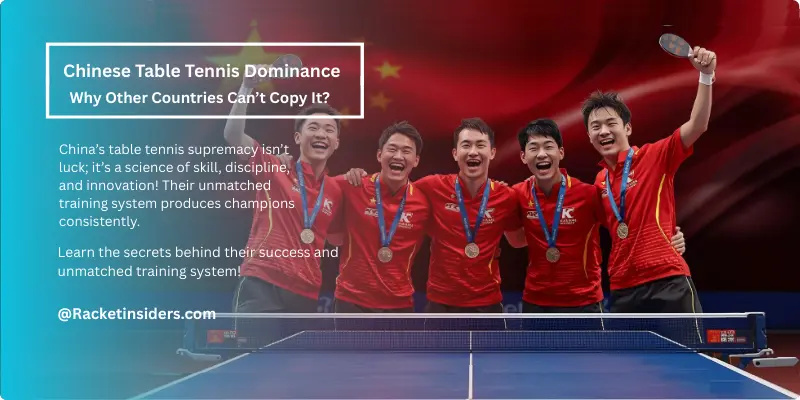
What “Chinese Table Tennis Dominance” Really Means
To say China dominates table tennis is an understatement. We’re not talking about a fleeting era or a few generational talents. This is decades of systematic, top-to-bottom superiority, a dynasty built not on stars alone, but on an unbroken production line of table tennis champions. This dominance shows up in every major trophy case:
- Olympic Games: Unrivaled since table tennis’s 1988 debut.
- World Championships: A near-monopoly in men’s and women’s singles and team events.
- ITTF World Tours & Cups: Consistent saturation of podiums.
But the true measure goes beyond medals. The Chinese table tennis system maintains dozens of elite players across senior, junior, and reserve squads, all competing in an internal hierarchy more brutal than most international tournaments. Even those who don’t reach the top tier form a global diaspora of talent, often dominating leagues worldwide. See how table tennis works at the Olympics, and why China’s medal record is unmatched, in our in-depth guide on Table Tennis at the Olympics.
Is China’s Table Tennis Dominance Just About Population Size? (Spoiler: No.)
It’s a tempting explanation: with 1.4 billion people, of course, China finds more talent. But this is the laziest myth in sports, and the data demolishes it. India (≈1.4B) and the United States (≈340M) have massive populations, yet between them, they have never produced an Olympic gold medalist in table tennis.
Population creates potential. Systems convert potential into champions. China’s edge isn’t in having more kids pick up a paddle; it’s in what happens next:
- Scientific Talent Identification: Children as young as five are screened for hand-eye coordination, reaction speed, spatial awareness, and psychological resilience.
- Full-Time Athletic Academies: Promising players enter state-run sports schools where table tennis is not a hobby, but a curriculum.
- Ruthless Competitive Funnels: Players must survive local → provincial → national trials just to remain in the system, with internal competition often more intense than early international rounds.
The result is a talent pipeline that doesn’t merely discover skill; it manufactures elite performance at scale. While other nations rely on individual passion and private coaching, China’s table tennis dominance is built on a fully optimized conversion system that ensures champions year after year.
China’s Table Tennis System: The Closed Competitive Ecosystem
Calling it a “system” undersells it. This is a closed-loop talent refinery, a high-stakes engineering project where human potential is the raw material and Olympic gold is the output. It doesn’t just train players; it manufactures them under relentless pressure, turning childhood promise into world-class performance. Every stage is designed to push, filter, and perfect talent, leaving only the strongest, fastest-learning, and most resilient to rise. The process is a multi-stage filter, built for one purpose: to create table tennis champions.
Stage 1: Precision Scouting (The Quality Control Gate)
This is where potential is identified, not developed. The goal here is simple: separate raw talent from the rest of the population at the earliest stage. Only those who demonstrate the right combination of physical, mental, and cognitive attributes are allowed to progress.
- Ages 5–7: Children undergo scientific selection, assessed for reaction time, spatial awareness, and psychological resilience.
- Objective: Identify raw potential, not just enthusiasm or hobby-level interest.
Stage 2: The Academy Grind (The Assembly Line)
Here, talent is standardized into championship form. This stage turns raw potential into disciplined skill, teaching children the fundamentals of elite table tennis while instilling a work ethic and mental toughness. Training becomes a lifestyle rather than an activity.
- Full-time sports schools: Training becomes total immersion.
- Daily routine: Technique drills, physical conditioning, match analysis, mental coaching.
- Goal: Flawless fundamentals built through repetition until instinctive.
Stage 3: The Funnel of Fire (Where Only Elite Survivors)
Competition is used as the ultimate filtering mechanism. Every match, every trial, every championship serves as a test of skill, focus, and resilience. Only those who consistently outperform peers advance.
- Pyramid progression: Local → Provincial → National Trials. Provincial championships are often more demanding than the early rounds of World Tour events.
- Purpose: Only the most skilled, disciplined, and mentally tough survive to reach the top.
The Result: A Self-Sustaining Ecosystem of Excellence
The output is a competitive depth that no other nation has consistently replicated. China doesn’t just produce champions; they create a system where excellence regenerates itself every year.
- The Chinese national team is the visible tip of a massive, churning iceberg.
- Thousands of daily matches among system-trained peers sharpen skills beyond what international competition can replicate.
- Internal competitive density ensures that facing the rest of the world is often a relative relief for Chinese players.
China’s table tennis dominance isn’t a mystery; it’s a manufacturing process. This precision-engineered pipeline transforms raw talent into world-class champions through staged filtering: early scouting, academy standardization, and relentless internal competition. The result is a depth of skill and mental toughness no other nation can replicate. This is why Chinese players dominate table tennis at every level of international play.
Why Chinese Training Is a “Flaw-Elimination” Protocol
While global training often focuses on amplifying strengths, the Chinese training system is engineered for one primary goal: to systematically identify and eradicate weaknesses. The core philosophy is defensive mastery; a player with no exploitable flaws cannot be strategically defeated. Opponents don’t face a superior shot; they confront a defensive and tactical structure with no easily exploitable weaknesses.
Every drill is both physically grueling and diagnostically precise, designed to expose micro-weaknesses and force their correction under duress.
1. Multiball: The Engine of Repetitive Perfection
This drill stress-tests technique at the point of failure: exhaustion. A coach or machine fires balls in rapid, unpredictable sequences. The goal isn’t to hit winners but to maintain perfect form, positioning, and decision-making under physical fatigue, the precise moment technique breaks down for most players. This forges the robotic consistency that defines Chinese table tennis champions.
2. The Two-on-One Drill: Manufacturing Chaos to Build Calm
It simulates match pressure, then multiplies it. A single defender faces two attackers targeting extreme angles. This eliminates recovery time and punishes any lapse in footwork or anticipation instantly. The adaptation is non-negotiable: the brain learns to process faster, movement becomes more efficient, and strokes stabilize under siege. There is no room for a weak side.
3. Serve & Receive: Weaponizing the First Three Shots
The opening exchange is treated not as a rally’s start, but as its decisive tactical phase. Chinese players dominate table tennis by developing a modular arsenal of serves, varying spin, placement, and disguise, each drilled with a specific, lethal third-ball attack in mind. Concurrently, receiving practice is honed to either neutralize any incoming serve or convert it immediately into an offensive opportunity. This turns the game’s commencement into a forced advantage.
Explore the most effective table tennis serves, how they work, and how elite players use them to control matches in our guide to Serves in Table Tennis.
The Result: The Complete Competitor
The output of this protocol is not a player with a famous weapon, but a holistically fortified athlete. By the time they reach the world stage, every potential weakness, in footwork, stroke technique, serve variety, or tactical response, has been systematically identified, stressed, and corrected. Opponents are left searching for a tactical opening that no longer exists.
In essence, the world trains to win points. China trains to eliminate the very possibility of losing them. This is why Chinese players dominate table tennis consistently. Learn why elite footwork in table tennis is the foundation of balance, speed, and shot stability in our guide on Footwork in Table Tennis.
Coaching Depth: The Strategic Intelligence Unit
If China’s training eliminates weaknesses, its coaching system functions as a tactical command center, turning raw skill into fully operational match intelligence. Chinese coaching strategies are central to the Chinese table tennis system, transforming raw talent into table tennis champions. Coaches are not just instructors; they are strategists, analysts, and psychological engineers, designing game plans tailored to each player and each opponent. This meticulous preparation ensures that athletes face no true unknown; they step onto the court armed not only with skill but with a precise, adaptable strategic blueprint.
1. Player-Centric Optimization: Building the Complete Profile
Each athlete is treated as a unique project with a fully customized development roadmap. Beyond strokes and footwork, coaches track conditioning, recovery patterns, psychological triggers, andmatch-day routines. This holistic profiling allows for hyper-personalized training that amplifies strengths and addresses vulnerabilities.
2. Opponent Simulation: Rehearsing Victory Before the Match
Practice is a targeted dress rehearsal. Using video analysis and dedicated partners who replicate top rivals’ styles, Ovtcharov, Harimoto, or other players “face” their next opponent in training. By match day, what might have been unknown is neutralized through familiarity and repetition.
3. In-Game Adaptation: Coaching for Real-Time Problem Solving
The game plan is dynamic, not fixed. Players are trained to read and adjust mid-match with precision, following decision trees like: “If they block loops to the middle, switch to sharp angles; if they step around, attack the wide forehand.” This fosters match IQ and tactical flexibility that keeps them perpetually one step ahead.
The outcome is athletes who enter every match as both performers and preemptive analysts, executing detailed plans while adjusting instantly to evolving scenarios. Opponents are left reacting, while Chinese players dictate the flow, combining mental acuity, tactical depth, and physical excellence into an almost unmatched competitive advantage in modern table tennis.
Technique Evolution: The System’s Built-In Update Cycle
China doesn’t just adapt to change; it anticipates and engineers it. While other nations react to new techniques or rule changes, the Chinese table tennis system treats evolution as a mandatory, continuous upgrade process. From youth academies to the national R&D wing, every adjustment, every tweak, and every new method is systematically tested, refined, and implemented to maintain a technical advantage before competitors even perceive a gap. Innovation isn’t accidental; it’s institutionalized, embedded in the very DNA of Chinese table tennis dominance.
1. Reverse Penhold Backhand (RPB): Solving a Historical Flaw
China didn’t just adopt a new shot; it weaponized a structural weakness. The traditional penhold grip had an inherent limitation: a weak backhand. The RPB wasn’t a stylistic experiment; it was a systematic engineering solution that transformed the backhand from a defensive liability into a primary offensive weapon. Players like Wang Hao and Xu Xin became omnidirectional attackers, expanding tactical options and redefining penhold’s potential.
2. Shakehand Looping: The Industrialization of a Weapon
What others treat as an art, China treats as precision engineering. Coaches deconstructed the European looping style, built on power and flair, and rebuilt it for repeatability, accuracy, and tactical integration. The result: a high-percentage, low-risk backhand loop executed with near-robotic consistency. Technique, timing, and biomechanics are optimized to ensure every stroke works perfectly within the match strategy.
3. Rule & Equipment Changes: Turning Disruption into Advantage
Whenever ITTF rules shift, like the transition to the larger, slower plastic 40+ ball, China treats it as a system-wide update. Internal competition, centralized R&D, and depth of talent allow Chinese players to pre-adapt strategies, adjust rubber selection, and recalibrate training intensity. While other nations react, China has already anticipated, simulated, and integrated the change, turning potential disruption into a tactical advantage.
The Outcome: A Moving Technical Frontier
China’s technical evolution isn’t reactive; it’s preemptive, systematic, and relentless. Other nations chase the current “best” technique, while China is already prototyping the next. Every rule change, every innovation, and every new opponent is absorbed into a living, self-updating system. The result is a perpetually widening gap: competitors are not merely catching up, they are racing to match a game China has already redesigned, refined, and optimized.
Understanding how China builds champions is only half the equation. The other half lies in why even the strongest table tennis nations struggle to reproduce the same results.
Why Europe, Japan, and Others Can’t Bridge the Gap
The rest of the world isn’t losing to Chinese players; they’re losing to China’s national team structure and Chinese table tennis system. No matter the talent, funding, or passion abroad, other systems are structurally disadvantaged under current sporting models when compared to China’s closed-loop machine. The gap isn’t technical; it’s architectural.
1. Fragmented Systems vs. Centralized Command
Other nations struggle with disjointed organizations where priorities, resources, and strategy rarely align. China dominates table tennis through a unified pipeline, ensuring every stage, from scouting to national trials, is coordinated and optimized.
- Funding & Priorities: National federations work with shoestring budgets and short-term Olympic cycles, while China invests with decades-long, state-backed certainty.
- Club vs. Country: In Europe, a player’s primary loyalty (and salary) often lies with a professional club, fracturing focus between league play and national duty. In China, the national system is the career.
2. Shallow Talent Pools vs. Deep Competitive Oceans
Countries relying on individual stars can’t match China’s internal competitive ecosystem. While top European players face only a handful of peers annually, Chinese table tennis champions train daily against dozens of near-equals, forging unmatched skill, resilience, and tactical sharpness.
- Player Turnover: Small national teams often recycle the same veterans, stifling youth progression and reducing daily competitive intensity.
- Competition Density: A top European player might face a handful of elite peers each year. A Chinese counterpart faces dozens of near-equal rivals every week in internal matches, a relentless pressure cooker that builds invincible competitive toughness.
3. Cultural Mindset: Sport as Career vs. Sport as Mandate
The psychological foundation is incomparable. In the West, table tennis is often a passion or a profession. In China’s state academies, it is a national mission instilled from childhood, wrapped in profound social pressure and patriotic duty. This cultivates a level of resilience, sacrifice, and long-term focus, contributing to Chinese table tennis dominance.
Europe and Japan produce excellent players. China produces standardized champions from a system that has consistently maintained dominance. Until another nation is willing to dismantle its entire sporting model and rebuild it with the same centralized, long-term, and ruthlessly competitive design, it will remain structurally one step behind under existing development frameworks, not just in skill, but in the very structure that produces it.
Do ITTF Rules Actually Help China? (Spoiler: They Strengthen It)
For decades, the International Table Tennis Federation (ITTF) has introduced rule and equipment changes, the larger 40+ ball, plastic construction, and serve visibility regulations, to level the playing field and curb Chinese dominance.
The irony? These changes have frequently reinforced China’s existing structural advantages. China doesn’t just react; it pre-adapts. Its closed-loop system, deep talent pool, and institutional R&D treat each change not as a challenge, but as an opportunity to upgrade the entire program.
1. The Adaptation Accelerator: Systemic Agility
China doesn’t wait for rules to impact performance; they anticipate, test, and implement adjustments proactively. Every change triggers a coordinated, system-wide response, so players are already prepared before the first international match.
- Serve & Receive Re-engineering: While rivals struggle with the new ball or spin dynamics, Chinese coaches have already recalibrated serve mechanics, rubber selection, and third-ball strategies.
- Targeted Drills as Diagnostic Tools: Multi-ball and specialized partner drills are repurposed instantly, stress-testing players under the new rules and correcting weaknesses before competitions resume.
2. The Depth Advantage: Competition as a Laboratory
Internal rivalry becomes a real-time innovation engine. European stars may have only a few peers to adapt against; Chinese players face dozens of elite teammates daily. This constant high-level competition accelerates tactical innovation, sharpens technical adjustments, and builds a mastery that isolated players cannot replicate.
Rule changes momentarily slow everyone down, but China’s system has a built-in acceleration curve that allows it to recover and adapt faster than its competitors. It recovers first, adapts faster, and often emerges further ahead. In effect, ITTF’s attempts at parity highlight the unbridgeable structural advantage of China’s model. Learn how the ITTF governs the sport and shapes modern table tennis in our guide to the International Table Tennis Federation (ITTF).
The Final Question: Can Anyone Ever Break China’s Dominance?
To understand the future, you must first accept the reality: China’s supremacy is structural, not circumstantial. It is the product of a closed-loop ecosystem built over generations. No single rival nation can “break” this dominance; it would have to replicate the entire system.
True competition would require duplicating the system’s core pillars, not just its output:
- A Centralized, High-Intensity Talent Pipeline: A unified, state-aligned system where every stage, from scientific scouting to ruthless national trials, is coordinated and fueled by relentless internal competition.
- Deep, Unwavering Institutional Backing: Commitment measured in decades, not Olympic cycles. Guaranteed funding, world-class facilities, and coaching continuity must persist through political and economic shifts.
- A Cultural Engine of Discipline and Mission: Transforming the sport from a profession into a national mandate, instilling sacrifice, resilience, and patriotic duty from childhood, a level of commitment that voluntary systems rarely achieve.
The Verdict: Possible in Theory, Unlikely in Reality
Short-term upsets may happen, a generational talent on a perfect day can win a match, but a sustained, system-wide challenge is another matter. To even approach China’s level, a nation would have to dismantle its existing sporting culture and rebuild it from scratch, with centralized planning, long-term funding, and a competitive intensity matched only by China.
For now, the structural, cultural, and institutional advantages keep Chinese players dominating table tennis, with China firmly at the top, leaving the rest of the world perpetually chasing a system that has not yet been replicated at a national scale.
Conclusion
China’s supremacy in table tennis isn’t just about talent; it’s a masterclass in structure, strategy, and relentless optimization. From early scouting and intensive academies to innovative coaching and constant technical evolution, the Chinese system turns potential into world-class champions. Other countries may produce individual stars, but the combination of a centralized pipeline, cultural commitment, and institutional backing ensures that Chinese table tennis dominance endures. It’s no accident; it’s decades of careful planning, rigorous execution, and continuous innovation, setting a benchmark that the rest of the world can only chase.
What is the key to China’s dominance in table tennis?
The key is system over individual talent. China’s closed-loop state system, integrating scientific scouting, full-time academies, ruthless competition, and flaw-elimination training, creates a depth and consistency no voluntary, club-based model can match.
How many Olympic golds has China won in table tennis?
China has won 32 of 37 gold medals since the sport’s Olympic debut in 1988, a win rate of over 86%.
Why can’t other countries copy China’s table tennis system?
It requires decades of centralized state funding, control, and a cultural mandate that treats sport as a national duty, conditions fundamentally at odds with the decentralized, market-driven sports models in Europe, Japan, and the USA.
Can anyone beat China in table tennis?
Individual matches can be won, but sustained dominance cannot. Other nations compete against players; China’s rivals compete against an institutional machine where the internal competition is fiercer than on the world stage.
How do Chinese table tennis players train?
Training is systematic and diagnostic. “Multiball” and “two-on-one” drills build consistency under fatigue, while every session targets weakness elimination. It’s less about winning points and more about removing the possibility of losing them.
Has the ITTF changed rules to stop China’s dominance?
Yes, but changes (like the 40+ plastic ball) often strengthen China. Their system adapts fastest, using deep talent pools and internal R&D to integrate new rules while rivals are still adjusting.
Who is the greatest Chinese table tennis player?
Ma Long is widely considered the GOAT, having achieved the career “Grand Slam” (Olympic, World, and World Cup titles) with unparalleled longevity and technique.
How are Chinese players selected so young?
Through nationwide scientific scouting at ages 5–7, assessing reaction speed, coordination, and mental aptitude. Promising children enter state sports schools, beginning a journey of continuous elimination through local, provincial, and national trials.
Please Write Your Comments