Service rules in Table Tennis: Master the ITTF Guidelines 2026
Updated: April 29, 2026
2256
Do you know how important the service rules in table tennis are? A single mistake can cost you an Olympic gold. Just ask Ding Ning, whose 2012 Olympic final was derailed by service penalties that changed the course of the match.
Serving is the only moment in a rally where you have 100% control over the ball. It is your unique opportunity to dictate the spin, speed, and placement of the game before your opponent can even touch the ball. Understanding the International Table Tennis Federation ITTF regulations is crucial for every player, ensuring fair play and helping you avoid giving away ‘free’ points to your opponent through avoidable faults.
In this guide, we break down the fundamental guidelines, the historical “why” behind the rules, and the professional edge cases that every competitive player needs to know.
Table of Contents
How Do You Serve Legally in Table Tennis? A Quick Summary
Mastering the serve is the fastest way to dictate the pace of a match, but your strategy only works if your technique is strictly compliant. To execute a legal ITTF serve, you must follow these five technical pillars:
- Open Palm: Start with the ball resting freely on a flat, stationary palm
- 16cm Vertical Toss: Throw the ball at least 16cm (approx. 6 inches) nearly straight up
- Total Visibility: Keep the ball visible to the receiver from the toss until impact
- Behind the End Line: Strike the ball behind the table’s edge and above the surface
- The Two-Bounce Rule: The ball must hit your side of the table first, then the opponent’s side (diagonally for doubles).
Failure to meet any of these requirements results in a service fault, awarding your opponent the point immediately. There are no second serves in table tennis; one service violation, and the point is gone.
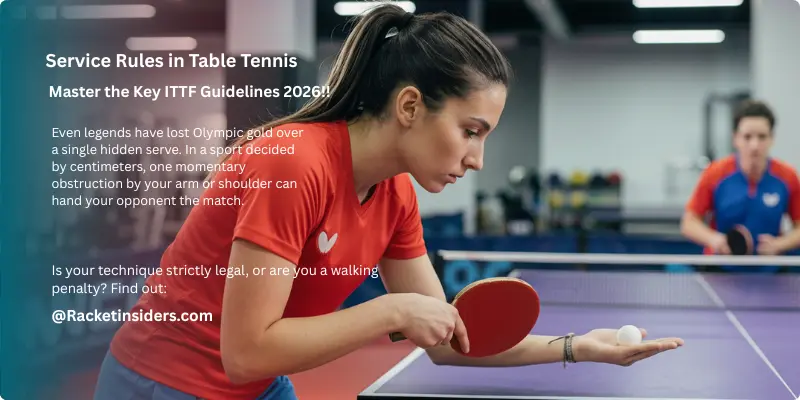
Why the Serving Rules Exist: A Brief History of Fair Play
Rules are not just obstacles to work around; they exist because the ITTF had to close loopholes that players were using to gain an unfair advantage. Every rule in the book was written in response to someone, somewhere, finding a creative way to win without skill. Understanding this history turns a dry list of regulations into a living story of competitive evolution.
1. The Finger Spin Era: 1930s–1940s
In the early days of the sport, players would “flick” the ball directly from their fingers during the toss. By imparting spin before the racket even touched the ball, the serve became physically impossible to read.
- The Loophole: Using fingers to create pre-impact rotation.
- The Rule Change: The ITTF mandated the open-palm toss, ensuring all spin must be generated solely by the racket’s impact.
2. The “Hidden” Racket Tactics: 1980s–1990s
For decades, players like Carl Prean became famous for hiding the ball behind their arm or torso during the strike. Receivers were essentially guessing the spin, which led to short, frustrating rallies.
- The Loophole: Using the body as a shield to hide the point of contact.
- The Rule Change: In 2002, the ITTF required the ball to be visible throughout the entire service sequence. This made receiving fairer and shifted the focus to athletic, high-speed rallies.
3. Precision and Professional Penalties: 2000s–Today
As the game moved into the digital age, the 16cm minimum toss height and “near-vertical” path became the new battlegrounds for fairness.
3.1 The Ding Ning Incident (2012)
At the London Olympics, superstar Ding Ning was penalized three points in the women’s final for serves that were previously considered legal. This high-profile controversy prompted the ITTF to implement even stricter, more consistent standards for umpires worldwide.
3.2 The 2025 Standard (Manush Shah)
At the 2025 ITTF World Championships, Indian player Manush Shah faced a critical penalty when his free arm momentarily blocked the receiver’s line of sight. Despite a video review challenge, the point stood, proving that the ITTF’s commitment to the Visibility Triangle (the clear line of sight between the ball, the racket, and the receiver) is now absolute.
History shows that table tennis rules aren’t arbitrary. Each one was written because a player found a way to cheat the system, and the ITTF stepped in to ensure that skill, not deception, decides the winner.
The 5 Core ITTF Service Rules (with “Why” for each)
Serving is the only moment in a rally where you have total control over the ball. It is your unique opportunity to dictate the spin, speed, and placement before your opponent can even touch the ball. Understanding ITTF regulations is crucial for every player, ensuring fair play and helping you avoid giving away ‘free’ points through avoidable faults. To master this phase, you must adhere to these technical pillars, starting with the equipment in your hand.
1. Pre-Service Equipment Requirements (Rule 2.04 & 2.05)
Before you can legally execute any serve, your gear must pass a standard inspection. Fail the inspection, and you never serve. While not a motion rule, equipment violations prevent your serve from being sanctioned under the official service rules in table tennis. Umpires check your ball and racket before the first serve of the match; if either fails, you cannot begin.
- The Technical Requirement: You must use an ITTF-approved 40mm ball (2.7g) that is clean and dry. Additionally, you must disclose both racket surfaces (Red and Black) to your opponent and the umpire before the very first point of the match.
- The Strict Reality: If you switch rackets mid-match due to damage without re-disclosing the equipment, as seen in the 2019 Korea Open incident, any points won can be retroactively voided and awarded to your opponent.
Your opponent has a legal right to see your rubber colors before the first serve to mentally prepare for the spin characteristics you will generate. Furthermore, a wet or dirty ball cannot be gripped properly by the racket, making it impossible to execute the consistent, predictable contact required by the service rules in table tennis.
2. The Open Flat Palm: Why Stationary Matters (Rule 2.06.01)
The service begins with the ball resting freely on the server’s open, flat, and stationary palm. Your fingers must be together with the thumb free, ensuring the ball is not “cupped” or held by the fingers. The ball must also stay behind the end line and above the table’s surface height throughout this stationary phase to be considered a legal starting position.
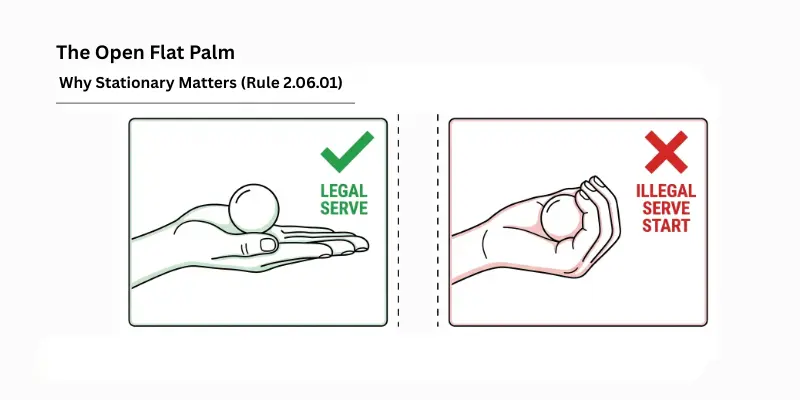
- The Technical Requirement: Before the toss even starts, the ball must be completely stationary. Any movement of the hand, such as a “pre-spin” flick or a sliding start, is technically a fault.
- The Strict Reality: Umpires watch your palm and position. If your hand starts below the table or your fingers curl, you have committed a service fault before you even hit the ball. A cupped hand imparts spin during the toss, hence the flat palm rule.
Before this rule, players used the “finger spin” serve, snapping their fingers during the toss to generate massive RPMs before the racket even touched the ball. This made the serve impossible to read. The open palm ensures all spin comes only from the racket, keeping the game transparent and fair.
3. The Vertical Toss: Why 16cm & Straight Up (Rule 2.06.02)
Once the ball leaves the open palm, it must be tossed nearly vertically upwards at least 16cm (6.3 inches) before it is struck. A consistent, high toss is not just a legal requirement but a tactical necessity, as it provides the potential energy needed to generate maximum spin and speed.
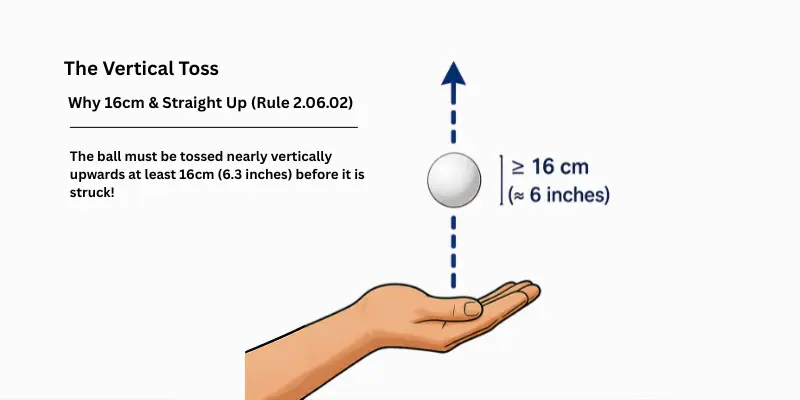
- The Technical Requirement: The toss must leave the palm vertically, not backward, forward, or sideways toward your body. If the ball fails to reach the required height or is thrown at an angle exceeding “near vertical,” it is an automatic service fault.
- The Strict Reality: Most club players toss only 10–12cm. The net is 15.25cm; if your toss does not clearly clear the net, an umpire will likely call a service fault.
Before this rule, players would “shoot” the ball directly from their palm. This “flat serve” was impossible to track. The 16cm vertical requirement ensures the receiver has a clear view of the ball’s trajectory and a fair chance to read the spin. It also eliminates the “diagonal toss,” an old trick used to pull the ball back into the body to hide the racket’s contact point.
1. The Net Height: A standard net is 15.25cm; ensure your ball peaks above it.
2. Standard Objects: Common pens and smartphones are usually 15–16cm long.
3. Racket Width: Your racket head is about 16cm wide—a perfect on-table reference.
4. Wall Drill: Practice tossing next to tape placed at 16cm to build muscle memory.
⚡ Advanced note – the 30‑degree rule: According to the TTR system used at the 2019 ITTF Grand Finals, a serve is illegal if the toss angle exceeds 30 degrees from vertical. While higher tosses allow more leeway, the safest way to follow the service rules in table tennis is a strictly vertical trajectory.
4. Ball Visible to Opponent: Why No Hiding (Rule 2.06.03 & 2.06.04)
From the moment the ball leaves your palm until it is struck, it must remain above the level of the playing surface and be clearly visible to the receiver. Maintaining a clear line of sight is your legal responsibility as a server; any momentary obstruction by your body or clothing is grounds for an immediate point loss.
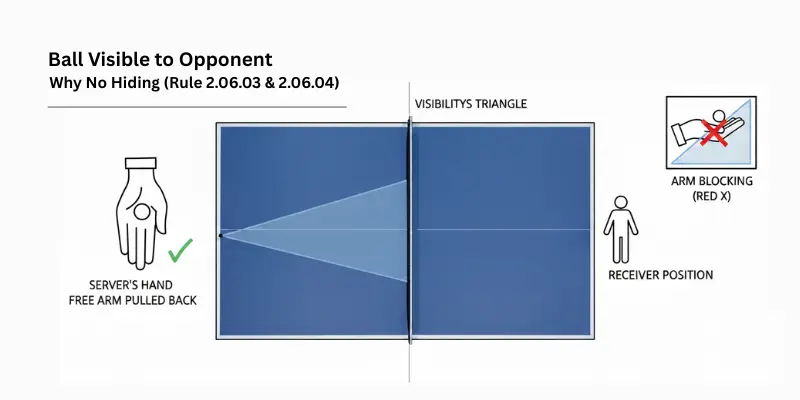
- The Technical Requirement: Umpires look for the “Visibility Triangle,” the unobstructed space between the ball, the net posts, and the receiver. If your free arm, shoulder, or head enters this space during the toss or at the moment of contact, the serve is a service violation.
- The Strict Reality: This is the most debated rule in the sport due to inconsistent enforcement. The 2012 Olympic final remains the ultimate warning: Ding Ning was penalized three points for “hidden” serves that had passed as legal in prior rounds. The safe approach? Move your free arm completely out of the “triangle” the instant the ball leaves your hand.
Before 2002, hiding the ball was standard. Players like Carl Prean shielded the racket contact with their torso, forcing receivers to guess the spin. This created short, unwatchable rallies. The visibility rule restored fairness, shifting the advantage back to skill and reaction speed, and permanently banned the “body shield” tactic.
5. Contact Behind the End Line: Why Position Matters (Rule 2.06.04)
The ball must be struck while behind your own end line and above the playing surface. This rule defines the strike zone, ensuring every serve begins from a standardized distance to give the receiver a fair chance to react. By strictly defining this boundary, the ITTF prevents servers from “invading” the table space, which would otherwise allow unreturnable shots from an unfair proximity.
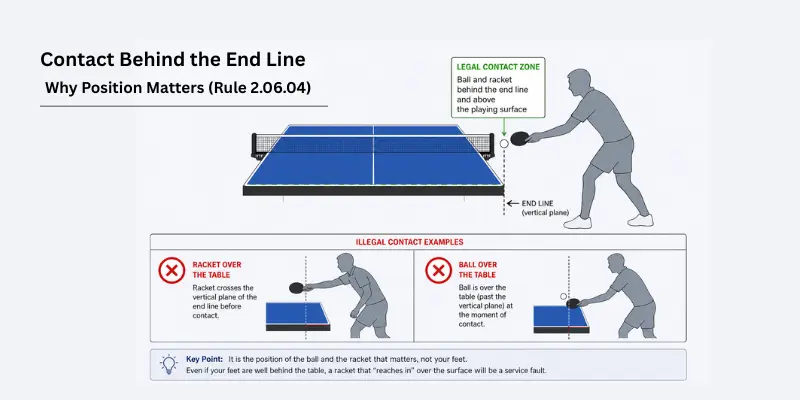
- The Technical Requirement: It is the position of the ball and the racket that matters, not your feet. If your racket or the ball crosses the vertical plane of the end line before contact occurs, the serve is illegal. Additionally, the ball must be struck as it is descending from the peak of its toss, not while it is still rising.
- The Strict Reality: A common club-level fault occurs when players lean forward during a heavy spin serve, accidentally moving their racket hand over the table surface. Umpires watch the vertical plane of the end line like a hawk; even if your feet are well behind the table, a racket that “reaches in” over the surface will be called a service fault.
Before this rule was strictly codified, players would strike the ball from directly over the table, significantly closer to the net. This shortened the travel distance, making the serve faster, flatter, and nearly impossible to read. By forcing contact to occur behind the end line and on the descent, the ITTF ensures a predictable contact point and a fair “reaction window” for the receiver.
6. In Doubles: The Diagonal Serve (Rule 2.06.06)
In doubles play, the service rules become even more restrictive. Unlike singles, where you can serve to any part of the table, doubles serves must be hit diagonally from your right-half court to the opponent’s right-half court. This fixed trajectory shifts the challenge from wide-angle deception to extreme precision, as you must navigate a much smaller landing zone while maintaining the same toss height, visibility, and contact requirements.
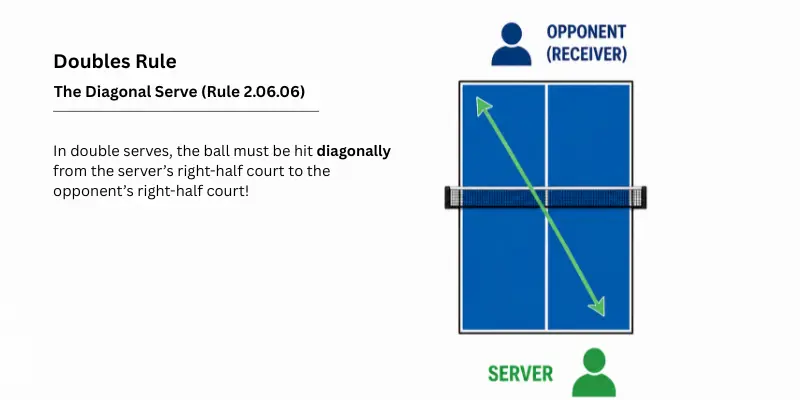
- The Technical Requirement: In doubles, the ball must bounce in the server’s right-half court first, then the receiver’s right-half court. The center line becomes an active boundary; if the ball hits it, it’s “in” and legal.
- The Rotation Rule: Service alternates every two points, unlike singles, where the same player serves continuously to one opponent.
Without the diagonal rule, doubles would be chaotic collisions, not strategic rallies. The rule forces precision placement and organized movement between partners. For a complete breakdown of rotation sequences and positioning strategies, check out our detailed guide: Doubles in Table Tennis, with tips and strategies.
Recent ITTF Rule Changes & Enforcement Updates (2024-2026)
Service regulations continue to evolve as the ITTF refines enforcement standards and incorporates new technology. These updates represent a significant shift from human estimation to digital verification, ensuring a level playing field for all competitors. By standardizing these interpretations, the ITTF aims to eliminate the “gray areas” that previously allowed for illegal service deception.
1. ITTF Clarifications 2024: Codifying Gray Areas.
The 2024 clarifications provide umpires with exact numerical benchmarks to replace subjective “on-table” judgment. These refinements ensure that players and officials share a singular, data-driven understanding of what constitutes a legal serve.
1.1 Enhanced Visibility Triangle Enforcement (2024)
Umpires now utilize AI-assisted video analysis to detect hidden serves with frame-by-frame accuracy. Starting at the 2024 World Championships in Busan, this tech-driven training eliminated the “benefit of the doubt” for servers.
- The 1/60th Rule: If the ball disappears for even one video frame (1/60th of a second), it’s an automatic fault.
- Three-Camera Review: Major events now use a three-angle review system to verify compliance instantly.
- Pro Tip: Your arm must be completely clear of the triangle before the ball leaves your palm; late movements are no longer safe.
1.2 Near-Vertical Toss Angle Standardization (2024)
Precision replaced guesswork in 2024 as the ITTF defined the exact degree of a legal vertical trajectory. The ITTF codified near-vertical as being within 30 degrees of true vertical.
- Digital Measurement: Toss angles are now measured using digital protractors during Video Review challenges.
- The Fault Line: A 35-degree backward toss that might have passed in 2023 is now a confirmed fault.
- Coaching Tip: Practice against a wall or use a smartphone level app to ensure your toss stays within the 30-degree legal window.
2. World Championships Precedent 2025: Frame-by-Frame
The 2025 season established the first legal precedents for upholding faults based on microscopic video evidence. These rulings have effectively ended the era of “judgment calls,” replacing them with undeniable visual proof.
2.1 Manush Shah Video Challenge Ruling (2025)
This landmark case proved that even momentary obstructions are sufficient for a point deduction in professional play. During a Round of 16 match in Busan, Indian player Manush Shah challenged a fault call using the new Video Review System.
- The Ruling: A 90-second review of three angles showed the ball was hidden for just two frames (0.033 seconds); the fault stood.
- The Impact: This established the “Visibility Triangle” as an absolute technical standard, not a judgment call.
- Strategy: Players must prioritize complete arm clearance over the “quick movements” previously used for deception.
3. Experimental Tech: Automated Officiating (2024-2026)
As we move through 2026, the ITTF is moving closer to removing human error from service officiating entirely. This technological evolution aims to create an environment where every serve is monitored with 100% accuracy.
3.1 Service Monitor System (2026)
The Service Monitor represents the final step toward a fully automated, tech-enforced service environment. Tested in Beijing, this system uses high-speed cameras to track every metric of the service motion in real-time.
- How it works: 240fps cameras track the ball trajectory, height, and visibility automatically.
- Real-Time Alerts: A light indicator (green/yellow/red) provides the umpire with instant feedback on serve legality.
- Projected Rollout: Expect this system to be the global standard by the 2028 Olympics.
The 2024-2026 enforcement shift is about consistency. If your serve relies on marginal compliance, tossing exactly 16cm or moving your arm quickly, build a safety buffer into your technique now to future-proof your game. For the complete and most up-to-date official rules, consult the ITTF Official Handbook 2026 – Complete Laws of Table Tennis directly.
Recreational & Youth League Service Variations
By mastering these professional standards now, you ensure your serve remains a weapon rather than a liability when the stakes are highest. While this guide covers official ITTF regulations used in sanctioned tournaments, many players first encounter table tennis in recreational or youth settings where rules may be modified for accessibility and skill development.
1. Youth Leagues: Under-12 & Beginner Programs
At local and regional youth levels, organizers often adjust service requirements to match developmental capabilities. These modifications prioritize learning fundamentals over strict technical compliance.
- Toss Height Requirement: Reduced to 12–14cm instead of the strict 16cm minimum, allowing younger players to focus on clean contact.
- Visibility Enforcement: Umpires focus on “obvious” hiding rather than marginal obstructions, giving developing players time to build body awareness.
- Service Fault Warnings: A “three warnings before penalty” system is often used instead of immediate point loss to prioritize education.
2. Recreational Club Play (Unchanged)
Casual club settings often develop some unwritten rule variations that can create bad habits if you later transition to competitive play. What feels legal in self-umpired practice may fail immediately under tournament scrutiny.
- Net Serve Limits: Some leagues cap consecutive lets at 2–3, but official ITTF rules allow an unlimited number of lets without penalty.
- Self-Umpiring: Players calling their own faults leads to inconsistent enforcement, where questionable serves often go uncalled.
- Gentleman’s Agreement: Many clubs adopt a “don’t call minor violations unless egregious” approach, allowing illegal habits to become muscle memory.
3. Para Table Tennis Adaptations (Unchanged)
Mastering these professional standards ensures that your service remains a formidable asset regardless of the physical classification or adaptive environment. Para table tennis maintains strict compliance with ITTF service rules, with specific modifications based on physical classification.
- Standing Classes (6-10): Standard ITTF service rules apply with no modifications.
- Wheelchair Classes (1-5): Toss and visibility rules remain identical; the ball must be struck behind the end line, but wheelchair positioning is flexible.
- Intellectual Disability (Class 11): Full ITTF rules apply without modification.
You will never be penalized for being too compliant with the rules, but you will lose critical points for “acceptable” habits that fail under tournament pressure. Train with the strictest standards from day one to keep your points on the scoreboard.
Legal, Let, and Fault Serves: Knowing the Outcomes
Understanding the rules is only half the battle; you must also understand how an umpire or opponent will “call” your serve. Every serve in table tennis results in one of three distinct rulings, and knowing the difference can prevent the frustration of losing points on a technicality. By mastering these definitions, you can better advocate for yourself during a match and ensure you aren’t being penalized or penalizing others incorrectly.
1. The Legal Serve: When All Requirements Are Met
A legal serve occurs when the server complies with all core ITTF laws. The ball is tossed from an open palm, reaches 16cm, remains within the 30-degree vertical window, and bounces on both sides of the table. In the modern era of AI-assisted reviews, a legal service is defined by total transparency and visible contact. Achieving this standard is the only way to transition into a high-intensity rally without the risk of an umpire’s intervention.
- The Result: The rally continues and play proceeds normally.
- The 2026 Standard: Unlike the other categories, a legal serve requires no intervention from the umpire or the TTR (Table Tennis Review) system.
2. The Let Serve: Why Net Contacts Replay (Rule 2.09)
A let serve occurs when a serve is otherwise legal, but the ball touches the net assembly while passing over it, provided the ball still lands in the opponent’s court. While frustrating for the server, a let serve acts as a “reset” button, ensuring that a lucky net cord doesn’t decide a point before the rally even begins. It is important to note that a “Let” is only called if the service was technically legal before hitting the net
- The Result: The point is replayed with no penalty.
- The Rule: Unlike some recreational house rules, there is no limit on consecutive lets in competitive ITTF play. If you hit the net and it goes over 10 times in a row, you simply serve an 11th time.
3. The Fault Serve: How One Violation Costs the Point
A service fault is any violation of the ITTF Regulation. Common errors include a hidden ball (Visibility Triangle violation), a “soft” toss (rising less than 16cm), or striking the ball inside the end line. Because the server has total control over the start of the point, the ITTF imposes the harshest penalty for technical errors during the service phase.
As of 2026, the Table Tennis Review (TTR) system allows officials to verify these faults with frame-by-frame precision. Even a single video frame showing an occluded (hidden) ball or an illegal toss angle is enough to trigger a point loss.
- The Result: The opponent is awarded the point immediately.
- The Penalty: Unlike tennis, table tennis has no second serve. Once the ball leaves your hand, it is in play. If you fail to deliver a legal serve on the first try, the point is lost.
In competitive play, the margin for error on your serve is zero. While a “Let” provides a replay, a “Fault” is an unforced error that hands a free point directly to your opponent. Repeated technical faults, or “doubtful” serves, will trigger the ITTF penalty escalation system, moving from verbal warnings to Yellow and Red cards.
For complete details on how penalties work across all foul types, including the famous Ding Ning 2012 case study, see our dedicated guide: [Common Penalties in Table Tennis: Complete Guide to Warnings, Cards & Disqualifications]
Common Service Faults: Technical Violations That Cost Points
Even the most effective serves are useless if they don’t pass the umpire’s scrutiny. Many players develop “lazy” habits in practice that translate to immediate point losses in competitive matches where technical precision is non-negotiable. Recognizing these common errors is the first step toward building a bulletproof, tournament-ready service game.
1. The Palm-Cupping Flick
Instead of keeping the palm flat and stationary, players often cup their fingers or use their thumb to “flick” the ball upward. This imparts illegal pre-spin and makes it impossible for the umpire to verify that the ball is resting freely before the toss.
2. The Diagonal “Hook” Toss
This occurs when a player throws the ball backward toward their body or sideways to generate “fake” momentum. The ITTF requires a nearly vertical trajectory; any significant angle that brings the ball closer to the racket during the toss is an immediate technical fault.
3. The Table-Invasion Strike
This is a frequent mistake for aggressive servers who lean into their shot. No matter how far back your feet are planted, if the point of contact between your racket and the ball occurs inside the vertical plane of the end line, the serve is illegal.
4. The Hidden Contact (The Shield)
Many players drop their head, shoulder, or free arm to block the receiver’s view of the racket, making contact with the ball. If the opponent cannot see the exact moment of impact, the serve is considered deceptive and violates the “Visibility Triangle” rule.
5. The Illegal Toss Angle (Service Angle Fault)
A service angle fault occurs when the ball is tossed more than 30 degrees from vertical. The ITTF codified this limit in 2024, replacing subjective judgment with a measurable standard. Servers who throw the ball backward to generate power or disguise contact are now at immediate risk, even if the habit went unnoticed for years. Straight up, straight down. That is the only safe toss.
Most service rules violations aren’t intentional attempts to cheat, but rather technical “leaks” in form that give umpires no choice but to award the point to your opponent. Beyond service faults, learn about rally fouls like freehand touching the table, net touches, and double hits in our detailed guide: Fouls in Table Tennis.
Common Service Myths & Illegal Serves (The Fix-It Guide)
Even among experienced players, certain “house rules” and bad habits persist that can lead to unexpected penalties in a sanctioned match. Clearing up these misconceptions is essential for any player looking to transition from recreational play to competitive tournaments where umpires are less forgiving.
1: “You only get two chances at a ‘Let’ serve.”
Many players believe hitting the net three times in a row results in a fault. But ITTF rules have no limit on consecutive lets. The serve must be:
- Otherwise legal (proper toss, visibility, contact)
- Land correctly in the opponent’s court after touching the net
If you are hitting the net consistently, you aren’t being penalized; you’re just losing your rhythm. Take a breath, adjust your contact height slightly higher, and serve again.
2: “As long as the toss is high, it doesn’t matter if it’s vertical.”
Players often throw the ball backward into their bodies to generate more power. But this is an illegal “diagonal toss.” The toss must be:
- At least 16cm high
- Nearly vertical (within 30 degrees of straight up)
- Free of diagonal or backward trajectory
Practice tossing the ball against a wall. If the ball hits the wall or moves significantly away from it, your toss is too diagonal. Aim for a “straight up, straight down” trajectory.
3: “My hand was behind the table, so the serve is legal.”
The umpire doesn’t care where your hand or feet are; they care where the ball is. Striking the ball even one inch over the table surface is a fault. The contact must be:
- Behind the vertical plane of the end line
- Above the playing surface
- Made as the ball is descending from its peak
Standardize your stance. Stand a few extra inches back from the end line during practice to build the muscle memory of striking the ball in “open space” rather than over the wood.
4. “I can move my free arm back once I hit the ball.”
Many players believe timing is all that matters. But the rule requires visibility from toss to contact, not just at the moment of impact. The ball must be
- Visible throughout the service
- Not blocked by your arm during the toss (blocking leads to a fault)
Use the “Salute” method. As soon as the ball leaves your palm, pull your free arm back toward your hip or out to the side immediately. Never let your arm linger in the Visibility Triangle.
Most service faults aren’t intentional cheating; they are simply lazy habits developed in practice that won’t hold up under the scrutiny of a real umpire.
Practice Drills to Ensure a Legal Serve
Internalizing the rules requires more than just reading the handbook; it requires deliberate, repetitive training. Integrating these specific drills into your routine will help you develop the muscle memory needed to execute legal serves instinctively, even under the pressure of a match. Consistent drills bridge the gap between knowing the rules and performing them under heat.
1. The Wall Verticality Drill
Stand sideways with your shoulder 2–3 inches from a flat wall. Practice your toss so the ball rises and falls parallel to the wall without touching it. This physical constraint eliminates the “hook” toss by forcing your hand to move in a strictly upward motion that stays within the legal 10-degree vertical limit.
2. The Net-Height Benchmark
Practice your toss while focusing on the peak height relative to the net cord. Since the net stands at 15.25cm, training your eyes to ensure the ball clearly peaks above the top of the net guarantees you are safely exceeding the mandatory 16cm ITTF requirement.
3. The Slap-the-Hip Visibility Drill:
Focus entirely on your free arm during the toss rather than the racket contact. By forcing your tossing hand to immediately strike your hip or thigh after the ball leaves your palm, you create a fail-safe habit that clears your arm from the “Visibility Triangle” every single time.
4. The End-Line Shadow Drill
Place a piece of tape on the floor six inches behind the table’s end line and practice serving with your feet anchored behind this mark. This extra distance creates a “safety buffer” for your torso and racket, ensuring that even when you lean forward to generate power, you never accidentally cross the vertical plane of the table.
Technical errors are unforced errors; by refining your toss and contact through these drills, you ensure that every point you win is earned through skill rather than handed to your opponent by a referee. Legal serve drills are just the start. Ready to add spin, deception, and placement? See our: Serve in Table Tennis: The Ultimate Guide to Serving Techniques and Tactics.
Conclusion
The serve in table tennis is the only moment where you have absolute control over the ball, spin, and pace. While service rules in table tennis may seem restrictive, they ensure a fair start to every rally, and mastering them separates recreational players from true competitors. Internalize the technical pillars, from the 16cm vertical toss to the “Visibility Triangle“, and you remove unforced errors while forcing your opponent to play on your terms.
Don’t wait for an umpire’s whistle. Start incorporating the Wall Verticality Drill and Net-Height Benchmark into your warm-ups today. As your technique becomes strictly compliant, your confidence will grow, allowing you to focus less on mechanics and more on the tactical spin that wins points.
Expand Your Rules Mastery; now that you’ve mastered service compliance, complete your rule knowledge across all areas of play: How to Serve in Table Tennis: Master Every Technique.
Service rules are your foundation. Build on them with technique, foul awareness, and penalty knowledge to become a complete, confident competitor.
FAQs
What are the 5 rules of serving in table tennis?
The five mandatory ITTF service rules are:
(1) Ball must rest on an open, flat palm before the toss
(2) Ball must be tossed at least 16cm (6.3 inches) nearly vertically
(3) Ball must remain visible to the receiver from toss to contact
(4) Contact must occur behind the end line and above the playing surface
(5) Ball must bounce once on the server’s side, then once on the receiver’s side.In doubles, serves must travel diagonally from the right court to the right court. Violating any of these rules results in an immediate point awarded to your opponent.
Can you serve from anywhere on the table in ping pong?
No. You can stand anywhere behind your end of the table, but the ball must be struck while it is behind the vertical plane of the end line and above the playing surface. Your feet’ position doesn’t matter, only the ball’s position at contact. In singles, you can serve to any part of the opponent’s court, but in doubles, you must serve diagonally from your right half-court to the opponent’s right half-court.
What happens if you serve illegally in table tennis?
An illegal serve (called a fault) awards the point immediately to your opponent. Unlike tennis, table tennis has no second serve; you only get one attempt. Common illegal serves include: tossing below 16cm, hiding the ball with your body or arm, striking the ball over the table surface, or failing to make the ball bounce on both sides. Repeated service violations can result in yellow card warnings and potential game forfeiture.
How high must you toss the ball when serving in table tennis?
The ball must be tossed at least 16 centimeters (approximately 6.3 inches) in a nearly vertical trajectory. To visualize this: the net is 15.25cm tall, so your toss must clearly rise above the net height. Common household references: a standard pen (15-16cm), three-quarters of an A5 notebook height (21cm total), or most smartphone lengths (14-16cm). Professional matches use the TTR system, which flags tosses angled more than 30 degrees from vertical as illegal.
Is it legal to hit the net on a serve in ping pong?
Yes. If the ball touches the net assembly during a serve but still lands in the correct service court, it is called a “let,” and the serve is replayed with no penalty. There is no limit to the number of consecutive lets; if you hit the net 10 times in a row, you simply serve an 11th time. However, if the ball hits the net and fails to land in the correct court, it is a fault, and your opponent wins the point.
Can you lose on a serve in table tennis?
Yes. You can lose a point on your serve if:
(1) Your serve violates any ITTF rule (illegal toss, hidden ball, wrong contact point),
(2) The ball fails to bounce on your side first
(3) The ball doesn’t land in the correct service court (diagonal in doubles)
(4) You commit a service fault, such as touching the table with your free hand
during the toss.Each service violation immediately awards a point to your opponent.
What is the penalty for serving illegally in professional table tennis?
In professional matches, the first illegal serve awards a point to your opponent, plus a verbal warning from the umpire. A second violation results in a point loss and a yellow card. Three or more violations in a single game can lead to game forfeiture at the umpire’s discretion. The most famous example: Ding Ning lost three critical points in the 2012 Olympic final due to service fault penalties.
Do the same serving rules apply in doubles table tennis?
The fundamental rules (16cm toss, visibility, open palm) are identical, but doubles adds a strict diagonal requirement: you must serve from your right half-court to your opponent’s right half-court. The center line becomes an active boundary (if the ball hits the line, it’s legal). Service rotation also changes; you don’t serve to the same opponent twice in a row; partners alternate receiving positions every two points.
Can you spin the ball with your fingers when tossing in table tennis?
No. This is explicitly illegal and called the “finger spin” serve, banned since the 1930s. The ball must rest freely on a flat, open palm with fingers together (thumb free). Any finger flicking or palm cupping that imparts spin before the racket contacts the ball results in an immediate fault. All spin must come solely from the racket’s impact.
What is a service angle fault in table tennis?
A service angle fault occurs when the toss exceeds 30 degrees from vertical. Codified by the ITTF in 2024, toss angles at major events are now verified using digital protractors during Video Review challenges. The most common cause is a backward toss, throwing the ball toward the body to generate power or hide contact.
The fix: practice a straight-up, straight-down toss. If the ball drifts toward your body, your angle is already illegal.
Please Write Your Comments