Table Tennis Table: Complete Guide to Types, ITTF Specs, Features & Selection
Updated: December 27, 2024
1016
A table tennis table isn’t just a surface; it’s the heart of every rally, spin, and point. With ITTF-approved dimensions, high-density surfaces, and precise bounce, every feature shapes gameplay, fairness, and tournament-level performance, at home, in a club, or on the Olympic stage.
The table tennis table (or ping pong table) serves as the regulated playing surface, built to meet strict International Table Tennis Federation (ITTF) standards for size, height, surface, and bounce consistency. Tables vary by environment and purpose: indoor tables with high-density fiberboard for controlled conditions, outdoor tables with weather-resistant aluminum or resin-coated surfaces, and foldable or conversion designs for space-saving versatility, each catering to different skill levels, practice routines, and club or home use. Popular brands like Butterfly, Stiga, and Cornilleau provide models ranging from recreational setups to professional tournament-grade tables.
In this guide, we cover every essential aspect: table tennis table types, official ITTF size and thickness standards, surface materials, bounce performance, net systems, and practical maintenance tips. By the end, you’ll know how specs affect bounce, durability, and play, and pick the right table for your space, skill, and goals.
Let’s explore the key aspects of a table tennis table and find the perfect fit for your game!
Table of Contents
What is a Table Tennis Table?
A table tennis table is the regulated competition surface where every serve, rally, and point unfold. ITTF-approved (certified by the global governing body) tables meet exact specifications to ensure consistent bounce, uniform ball response, and fair play, from casual club matches to Olympic finals.
The key Elements of a ping pong table include:
- Surface: Regulation blue or green, made of high-density fiberboard (HDF, dense engineered wood) or aluminum composite (weatherproof metal sandwich).
- Frame: Steel or aluminum construction, often foldable with wheels for portability
- Finish: Matte laminate (non-glare coating) for indoor tables; weatherproof resin coating (plastic UV/moisture seal) for outdoor tables
- Net System: Adjustable tension, center-mounted, meeting ITTF height standards
Understanding these components clarifies how table construction directly affects spin, speed, bounce consistency, and overall match performance, whether you’re looking at a Butterfly tournament table or a Stiga home model. Master the language of the game with our Table Tennis Terminologies guide.
Anatomy of a Table Tennis Table: Understanding Every Component
A table tennis table looks simple from a distance, but several distinct parts work together to deliver consistent bounce, stability, and portability. Knowing these parts helps you compare models, understand maintenance guides, and shop with confidence, whether you’re buying your first recreational table or a tournament-grade investment.
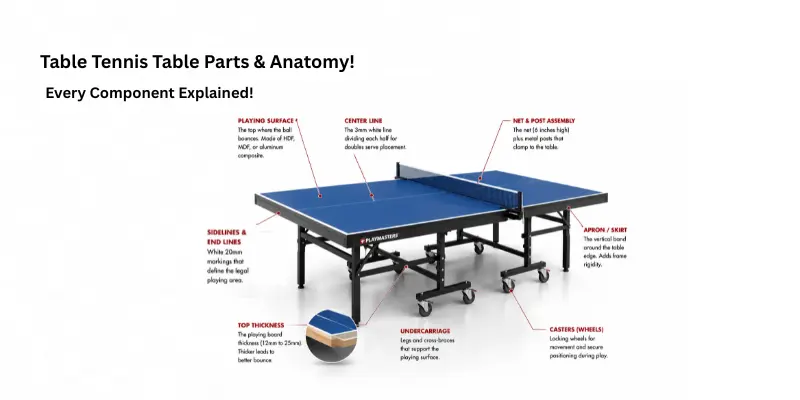
Here are the components that define every table’s behavior.
- Playing surface: The top where the ball bounces. Made of HDF, MDF, or aluminum composite.
- Sidelines & end lines: White 20mm markings that define the legal playing area.
- Center line: The 3mm white line dividing each half for doubles serve placement.
- Net & post assembly: The net (6 inches high) plus metal posts that clamp to the table.
- Apron / Skirt: The vertical band around the table edge. Adds frame rigidity.
- Undercarriage: Legs and cross-braces that support the playing surface.
- Casters (wheels): Locking wheels for movement and secure positioning during play.
- Top thickness: The playing board thickness (12mm to 25mm). Thicker leads to better bounce.
When reading reviews or shopping online, focus first on the playing surface material and top thickness. These two parts determine roughly 80% of how the table plays.
Types of Table Tennis Tables
Table tennis tables are engineered with specific materials, designs, and ITTF compliance levels, catering to a wide range of environments, from home basements to Olympic arenas. Understanding each type ensures optimal bounce, consistent ball response, and long-lasting durability for practice, club play, or tournament preparation.
1. Indoor Table Tennis Table
Indoor tables are precision-built for controlled environments such as clubs, training centers, home game rooms, and professional arenas. They offer a stable, smooth surface, ideal for spin-heavy rallies, fast exchanges, and skill refinement across all levels.
The key specifications of an indoor ping pong table are:
- Surface Material: High-density fiberboard (HDF) or medium-density fiberboard (MDF, affordable engineered wood)
- Bounce Consistency: Uniform 23 cm+ bounce across the surface (ITTF standard)
- Best For: Professional training, league matches, home practice
- Environmental Note: Not weather-resistant; keep away from moisture and direct sunlight
- Top Models: Butterfly Centrefold 25, Stiga Advantage, Cornilleau 500 Series
Indoor tables remain the tournament standard, delivering authentic ball feedback, reliable performance, and long-term play quality for serious players.
2. Outdoor Table Tennis Table
Outdoor tables are designed to endure varying weather conditions, offering durability and long-lasting performance while maintaining a near-professional playing experience. Built with waterproof and weather-resistant materials, these tables can stay outside for years, making them ideal for schools, public parks, leisure centers, and backyard setups.
The key specifications of an outdoor table include:
- Surface Material: Aluminum composite, weatherproof resin, or treated MDF (water-repellent version), for moisture resistance
- Bounce Consistency: Slightly less uniform than indoor tables, but advanced coatings improve ball response
- Regulation Size: 2.74 m × 1.525 m × 0.76 m (length × width × height), ITTF-compliant
- Best For: Outdoor clubs, public venues, recreational play, backyard fun
- Environmental Note: Built to resist rain, UV exposure, and temperature fluctuations
- Top Models: Cornilleau 500M Crossover, Stiga Advantage Outdoor, Butterfly Outdoor Rollaway
Outdoor tables balance durability and playability, offering reliable performance in all-weather conditions while still providing a competitive bounce and authentic gameplay for casual and semi-professional players.
3. Foldable Table Tennis Table
Foldable table tennis tables are designed specifically for space efficiency, offering easy storage and portability without compromising on play quality. Ideal for home setups, schools, community centers, or apartments, these tables allow players to fold, roll, and store the table quickly when not in use.
The key specs of a foldable table include:
- Playback Mode (returns balls like an opponent): One-half of the table can be folded upright for solo practice
- Surface Material: High-density fiberboard (HDF) or aluminum composite, depending on indoor/outdoor design
- Bounce Consistency: Maintains near-professional bounce, suitable for recreational and club-level practice
- Storage & Portability: Foldable design with wheels for compact storage and easy transport
- Best For: Home use, space-limited areas, solo training, schools, and community centers
- Top Models: Stiga Advantage Rollaway, Butterfly Centrefold 25, Cornilleau 250S Crossover
Foldable tables combine versatility and convenience, allowing players to practice or play full matches while saving space, making them perfect for both indoor and outdoor environments.
4. Conversion Top Table Tennis Table
Conversion top table tennis tables are space-saving, portable surfaces designed to be placed on existing tables, such as dining tables or pool tables. Perfect for home use or multi-purpose spaces, these tables allow players to enjoy full gameplay without a dedicated table while maintaining consistent bounce and proper ball response.
The key specifications include:
- Surface Material: Medium-density fiberboard (MDF) or similar materials for uniform bounce
- Padding & Protection: Foam backing (soft padded underside) or protective padding prevents scratches or damage to the underlying furniture
- Storage & Portability: Lightweight, foldable, and easy to store or transport
- Net System: Detachable net and post system for quick setup and removal
- Best For: Home recreation, space-limited areas, multi-use rooms, casual practice
- Top Models: Stiga Conversion Top, Butterfly Compact Conversion Table, Joola SpaceSaver
Conversion top tables provide a versatile and convenient solution for players seeking practice, casual games, or family entertainment in environments where a full-sized table isn’t feasible.
Official ITTF Table Tennis Table Specifications
A standard table tennis table is built to meet International Table Tennis Federation (ITTF) regulations, ensuring consistent play, fair competition, and uniform bounce across all levels, from home practice to professional tournaments. Understanding the official dimensions is essential for selecting the right table and ensuring proper gameplay.
The official ITTF specifications include:
- Length: 2.74 m (9 ft)
- Width: 1.525 m (5 ft)
- Height: 76 cm (2 ft 6 in) from the floor
- Net Height: 15.25 cm (6 in) at the center
- Playing Surface Material: Plywood, medium-density fiberboard (MDF), or weather-resistant materials for outdoor tables
- Color & Markings: Dark green or blue tabletop with white end lines and side lines; doubles play includes a center line (3mm white serve boundary) dividing each half
- Optional Outdoor Variations: Concrete or aluminum composite surfaces with steel net systems
These precise dimensions and markings ensure consistent bounce, proper spin, and regulation-compliant gameplay, whether using a Butterfly, Stiga, Cornilleau, or Joola table. Beyond these core measurements, tournament setups must account for clearance zones, ceiling heights, and micro-millimeter surface tolerances that affect ball trajectory and competitive fairness.
Want exact measurements, tolerance levels, space requirements, and detailed dimension breakdowns? Read our comprehensive guide: Official Table Tennis Table Dimensions: Complete ITTF Specs.
How to Measure Your Space for a Table Tennis Table
Space planning is one of the most overlooked factors when buying a table tennis table. A table that fits your room dimensions may still leave you cramped for serves, backhands, and wide shots. Before you shop, take a few minutes to understand how much clearance your playing style actually needs.
- Recreational play: Allow roughly 3–5 feet of clearance on each end and 2–3 feet on each side.
- Competitive play: Allow 6–8 feet of clearance on each end and 4–5 feet on each side.
- Ceiling height: Add at least 2 feet above the tallest player’s reach.
- The simple test: Mark table corners on your floor with tape. Practice serves and movement for a few minutes. You’ll know immediately if the space works.
Want exact measurements for your room? Use our Table Tennis Space Calculator to get personalized clearance recommendations based on your room dimensions and playing level.
Table Tennis Table Thickness & Bounce Quality
The thickness of a table tennis table is more than just a number; it directly affects bounce, speed, and overall play quality. From casual home setups to professional tournament tables, understanding surface thickness helps players select a table that delivers consistent ball response and optimal performance for their skill level.
To better understand how thickness impacts performance, consider the following guide:
Thicker surfaces (22–25 mm) provide better bounce, reduced vibration, and enhanced spin control, making them ideal for tournament and professional play. Thinner tables (12–19 mm) suit recreational or home use. Selecting the appropriate thickness ensures a reliable bounce, consistent ball response, and an enjoyable playing experience for every level. Learn how rubber affects table performance in our guide: Table Tennis Rubber: Choose the Best One for You.
Table Tennis Table Materials & Surface Finishes
The material and surface finish of a ping pong table determine how it performs, lasts, and feels under every serve, rally, and spin. From high-density fiberboard for tournament precision to weather-resistant aluminum composites for all-season outdoor play, picking the right table ensures consistent bounce, durability, and an optimal playing experience for your environment, home, club, or professional arena.
Choosing the right material and finish is essential to match your skill level, environment, and playing goals. Professional tables rely on HDF with matte laminate for precise tournament play, while outdoor tables use coated composites to handle the elements year-round. The same logic applies to your racket; see our guide: Table Tennis Racket Guide: Parts, Types, Performance & How to Choose.
Indoor vs Outdoor Table Tennis Tables: Location & Environment Guide
Where you place your table tennis table directly affects its durability, bounce consistency, and maintenance requirements. Indoor tables are engineered for controlled environments and precision play, while outdoor tables are designed to withstand weather exposure, temperature changes, and long-term outdoor use.
1. Indoor vs Outdoor Table Tennis Table Comparison
Indoor tables deliver precise bounce and spin for controlled settings, while outdoor tables focus on durability and weather resistance. This table highlights key differences in materials, maintenance, and best-use scenarios.
2. Portability & Storage Solutions
For homes, schools, and multi-purpose spaces, portability and storage play a crucial role in table selection, especially when floor space is limited or shared. The foldable and portable features include:
- Vertical Storage (stored on its edge): Table folds upright to minimize floor space
- Playback Mode: One-half folds for solo practice drills
- Wheels & Handles: Lockable casters (wheels with brakes), for easy relocation
- Quick Setup: Typically under 5 minutes
- Safety Locks: Prevent accidental folding during play
Choosing between indoor and outdoor, and the right level of portability, depends on your environment, space, and performance needs. Indoor tables prioritize bounce and spin, outdoor tables focus on durability, and foldable designs add flexibility without sacrificing gameplay.
How to Maintain Your Table Tennis Table for the Longest Lifespan
Regular maintenance preserves bounce consistency, spin control, and table longevity across all playing levels and environments. Follow these essential care guidelines to protect your investment and ensure peak performance year‑round.
1. Regular Surface Cleaning
Daily and weekly cleaning prevents surface degradation and maintains uniform ball bounce. Dust, dirt, and debris directly impact gameplay accuracy and surface quality.
- Indoor tables: Wipe with a slightly damp microfiber cloth; avoid abrasive cleaners
- Outdoor tables: Rinse with water and mild soap; remove debris from seams
- Never use: Bleach, ammonia, or pressure washers
2. Environmental Protection
Proper environmental care prevents warping (surface bending), fading, and moisture damage that compromise play quality. Humidity, UV exposure, and temperature changes damage playing surfaces over time.
- Indoor protection: Keep away from windows, radiators, and damp areas
- Outdoor protection: Use weatherproof covers, ensure proper drainage, and avoid standing water
- All tables: Allow to dry completely before covering to prevent mold
3. Mechanical & Safety Checks
Regular inspections ensure that foldable and portable table tennis tables operate safely and smoothly during play. Monthly checks prevent accidents and extend the lifespan of moving parts.
- Professional servicing: Annual inspection recommended for tournament-grade tables
- Monthly checks: Hinges, safety locks, wheel brakes, frame bolts
- Before each use: Confirm stable setup, test locking mechanisms
Proper cleaning, environmental care, and routine checks ensure your table tennis table delivers consistent bounce, spin, and safe play, extending its lifespan and performance for years to come. Looking to maintain the rest of your gear? Check out our full guide: Maintaining Your Table Tennis Equipment, with key tips for longevity & performance.
Common Table Tennis Table Defects
Not all table tennis tables play the same, even when they look identical. Over time or due to poor manufacturing, certain defects can ruin bounce consistency, frame stability, and play quality. Knowing how to spot these problems helps you evaluate tables intelligently.
- Warping (surface bending): Sight along the table edge or roll a ball slowly from one end. If the ball curves or stops, the surface is warped. A warped table produces unpredictable bounces.
- Dead spots (low-bounce areas): Drop a ball from 12 inches in several zones. Consistent bounce height across the entire table is a hallmark of quality.
- Delamination (layer separation): Look for bubbles, blisters, or soft spots. Tap with your knuckle. A hollow sound confirms separation.
- Frame wobble (unstable legs): Press down firmly on each corner on a flat floor. Any movement means uneven legs or loose bolts.
- Net post issues (faulty tension): Tension the net fully. If it sags or loosens quickly, the tension mechanism is compromised.
A well-built table should have none of these issues. Understanding these defects helps you read reviews more critically and appreciate what separates premium tables from poor ones.
How to Choose a Table Tennis Table That Matches Your Skill & Space
Selecting the right table tennis table requires balancing performance, durability, budget, and space. With so many types, materials, and specifications available, this framework helps you match a table to your environment, skill level, and playing goals. The key selection factors include:
1. Environment
Indoor tables (HDF/MDF surfaces) prioritize bounce consistency and spin control, while outdoor tables (aluminum composite, weatherproof coatings) focus on weather resistance and durability.
2. Skill Level
Beginners benefit from 16–19 mm thickness for recreational play, while intermediate and competitive players should opt for 22–25 mm tournament-grade surfaces for uniform bounce and better ball response.
3. Table Type
Choose your table based on space and storage needs, permanent indoor/outdoor models for dedicated areas, foldable tables with wheels for easy movement, or conversion tops for temporary setups on existing furniture.
4. Surface Thickness
Directly affects bounce consistency and play feel. Recreational tables (16–19 mm) are suitable for casual play; club and tournament tables (22–25 mm) provide professional-grade performance.
5. Material Quality
Indoor tables use HDF with matte laminate for precise play; outdoor tables rely on aluminum composite or resin-coated surfaces for all-weather durability.
6. Portability Needs
Foldable designs with lockable wheels, playback mode for solo practice, and upright storage are ideal for limited or shared spaces.
7. Budget & Trusted Brands
Butterfly and Stiga dominate premium tournament tables ($1,000+), Cornilleau excels in outdoor durability ($500–$1,500), and Joola offers mid-range club options ($300–$700). Recreational models under $300 often have thinner tops (12–16 mm) with less consistent bounce.
Choosing the right table tennis table means matching type, surface, thickness, material, portability, and trusted brands to your environment, skill level, and goals, ensuring consistent performance, durability, and an enjoyable playing experience.
Conclusion
The table tennis table stands as the foundational playing surface that shapes every serve, spin, and rally, making it essential to understand ITTF regulations, surface thickness, material durability, and table types when selecting the right equipment. Whether you’re choosing indoor tournament models for precise bounce, weather‑resistant outdoor tables for all-season play, or space‑saving foldable designs for versatile use, selecting a table that matches your space, environment, skill level, and playing goals ensures long-term performance, consistent gameplay, and endless competitive enjoyment. With the right table, every practice session, club match, and tournament experience becomes more reliable, enjoyable, and professional.
FAQs
What is a table tennis table?
A table tennis table is the regulated playing surface where the game occurs, meeting International Table Tennis Federation (ITTF) standards for dimensions, bounce consistency, and material quality.
What are the dimensions of a ping pong table?
Official ITTF dimensions are: 9 ft long × 5 ft wide (2.74 × 1.525 m) with a 30-inch (76 cm) height. The net stands 6 inches (15.25 cm) high at the center. For complete dimensional specifications, see our detailed dimensions guide.
How big is a ping pong table?
A regulation ping pong table measures 9 × 5 feet (2.74 × 1.525 meters) with a playing surface of 30 inches (76 cm) above the floor. This size is standardized globally for competitive play.
What size is a ping pong table?
The standard ping pong table size is 9 feet long, 5 feet wide, and 2.5 feet high (2.74 × 1.525 × 0.76 meters). All tournament tables must match these exact ITTF specifications.
How long is a ping pong table?
A regulation ping pong table is exactly 9 feet (2.74 meters) long. This length is consistent across all ITTF-approved tables, from recreational to professional models.
Is ping pong and table tennis the same?
Yes, “ping pong” and “table tennis” refer to the same sport. “Table tennis” is the official competitive term used by the ITTF, while “ping pong” is more common for casual/recreational play.
What’s the difference between indoor and outdoor tables?
Indoor tables use materials like high-density fiberboard for precise bounce and spin control. Outdoor tables feature weather-resistant aluminum composite or resin-coated surfaces for durability against the elements.
How does surface thickness affect gameplay?
Thickness determines bounce quality: 12–15 mm for recreational play, 16–19 mm for club training, and 22–25 mm for professional tournaments. Thicker surfaces provide better ball response.
What does ITTF-approved mean?
ITTF-approved tables meet strict International Table Tennis Federation standards for dimensions, bounce consistency (23 cm minimum), surface quality, and line markings, required for official tournaments.
How much space do I need for a table tennis table?
Minimum space: 19 × 11 ft for casual play. Competitive play: 28 × 13 ft. Add extra clearance for serving and movement around the table.
Please Write Your Comments