Umpire in Table Tennis: Roles, Hand Signals, Authority & How to Get Certified
Updated: April 9, 2026
1329
Behind every fair match is an umpire making calls that most players never think about, until one goes against them. While players battle with speed, spin, and strategy, the umpire in table tennis ensures each rally follows ITTF rules and every point is awarded correctly.
From enforcing service laws and managing timeouts to resolving disputes and upholding sportsmanship, the umpire’s authority is essential at every level of play. With calm confidence, they make decisive calls, explain decisions when needed, and keep the match moving without disruption.
Whether you’re a player, coach, fan, or aspiring official, this page covers everything you need to know about the table tennis umpire, from core responsibilities and hand signals to certification levels and how to get started.
Key Takeaways
- The umpire in table tennis is the final on-table authority, making calls on points, serves, and player conduct.
- Core duties include enforcing ITTF rules, managing game flow, timeouts, and resolving disputes.
- Assistant umpires support by judging edge balls, net touches, and scoring.
- Referees oversee the entire tournament, handling disputes beyond individual matches.
- Becoming a certified umpire requires training, official exams, and practical match experience, all following ITTF-approved standards
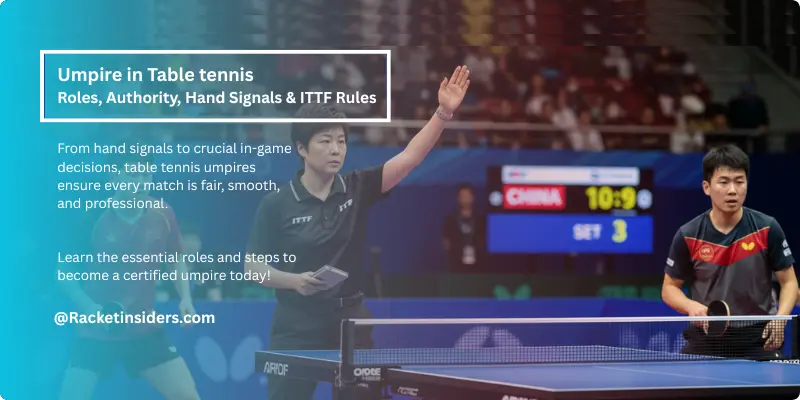
What is an Umpire in Table Tennis?
An umpire in table tennis is the primary official responsible for managing a match from start to finish, ensuring every rally follows International Table Tennis Federation (ITTF) rules. The umpire monitors player conduct, enforces service and scoring rules, resolves disputes, and maintains the overall flow of the game, making quick, accurate, and impartial decisions that keep every match fair and competitive, from local leagues to the Olympic stage. At elite levels, no ITTF-sanctioned match begins without one.
Most recreational players have never played under a certified umpire. The first time you do, you realise how many small decisions you were making yourself, and getting wrong.
Official Authority of a Table Tennis Umpire
The umpire holds the final on-table authority throughout the match. This authority is granted by ITTF regulations and begins the moment they step to the table and ends only when the match is officially concluded.
- Has the final say on scoring, faults, and lets
- Player challenges do not override the umpire, and experienced players know better than to argue. Pushing back wastes energy and rarely changes anything.
- Their authority is limited to the match itself; tournament-wide decisions fall to the referee
This authority allows the umpire to keep matches running smoothly, maintain fairness, and uphold the integrity of the sport. No decision made during live play carries more weight than theirs.
Top Responsibilities of a Table Tennis Umpire You Must Know?
The umpire in table tennis plays a critical role in ensuring every match is fair, orderly, and competitive. Beyond simply calling points, the umpire enforces International Table Tennis Federation (ITTF) rules, monitors service and scoring regulations, makes decisive judgments on close calls, and manages the overall flow of the game. From resolving disputes to maintaining sportsmanship, the umpire’s responsibilities are essential to upholding fairness, integrity, and smooth gameplay at all levels, from local tournaments to professional competitions.
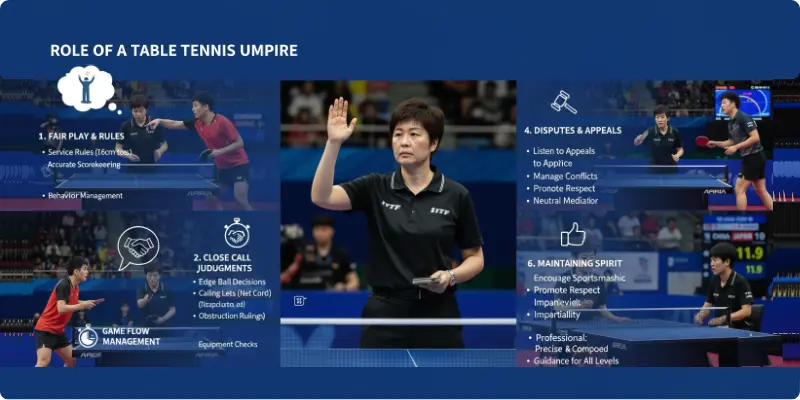
1. Ensuring Fair Play and Rule Enforcement
The umpire’s first job is simple: make sure the match is played by the rules. That means an in-depth understanding of service regulations, scoring procedures, and player conduct, applied consistently from the first point to the last.
The hidden serve is the most penalised fault at club level, and the most argued. Most players genuinely don’t realise their free arm is blocking the contact point. Their key duties include:
- Monitoring service rules: Ensuring the server tosses the ball at least 16 cm and strikes it from behind the end line, penalizing illegal serves such as hidden or low tosses.
- Accurate scorekeeping: Tracking and announcing scores after each point, with final authority in disputes to maintain game flow and fairness.
- Behavior management: Observing player conduct and issuing warnings or penalties for unsportsmanlike actions such as shouting, racket-throwing, or intentional delays.
2. Making Judgments on Close Calls
Table tennis is a game of millimeters. Determining whether a ball has touched the edge of the table, whether a serve qualifies as a let, or whether a player has obstructed the ball can be challenging. An edge ball at 100km/h gives the umpire roughly half a second to decide. Get it wrong once, and both players know it. The key responsibilities include:
- Edge ball decisions: Quickly judge if a ball near the table edge is in or out, relying on keen observation and experience.
- Calling lets: Identify when a serve touches the net but lands legally, ordering a replay without disrupting the match.
- Obstruction rulings: Award points against players who obstruct the ball with their body, clothing, or equipment, requiring fast reflexes and a thorough understanding of ITTF rules.
3. Managing the Flow of the Game
The umpire in table tennis plays a crucial role in managing the pace and rhythm of the match. Their responsibilities extend beyond making calls; they ensure that the game progresses smoothly, without unnecessary delays, and maintain fairness and consistent gameplay in accordance with ITTF rules and regulations. The key tasks include:
- Enforcing time limits: Monitor intervals between points, games, and matches to prevent stalling and keep the match on schedule.
- Managing breaks and timeouts: Ensure all breaks and player-requested timeouts comply with ITTF regulations, avoiding excessive delays.
- Equipment checks: Inspect players’ rackets, balls, and other equipment for compliance with ITTF standards, requesting replacements if necessary to maintain fair play.
4. Handling Disputes and Appeals
In the heat of competition, disputes can arise between players or between players and officials during a match. The table tennis umpire must act as a neutral mediator, resolving conflicts quickly and fairly to maintain match integrity and ensure smooth gameplay. The key responsibilities include:
- Listening to appeals: Carefully consider player challenges, review the call if necessary, and make the final ruling, sometimes consulting assistant umpires or the referee for guidance.
- Managing conflicts: Handle disputes calmly and professionally, resolving them efficiently to prevent disruptions and keep the match flowing.
5. Maintaining the Spirit of the Game
Beyond enforcing the rules, the table tennis umpire plays a vital role in upholding the spirit of the game. They ensure that matches are conducted in a fair, respectful, and sportsmanlike manner, promoting integrity, discipline, and mutual respect among players at all levels. The key responsibilities include:
- Encouraging sportsmanship: Recognize fair play, reward good conduct, and penalize unsportsmanlike behavior such as deliberate distractions or aggressive actions.
- Maintaining impartiality: Treat both players with respect, fairness, and courtesy throughout the match, ensuring decisions are unbiased and transparent.
6. Communication with Players and Officials
Effective communication is a critical skill for a table tennis umpire, ensuring that matches are conducted smoothly and fairly. Umpires must communicate clearly with players, assistant umpires, referees, and other officials to maintain order, clarity, and consistent application of ITTF rules. The key responsibilities include:
- Announcing decisions: Clearly and confidently communicate scores, lets, warnings, and penalties to players, spectators, and officials.
- Collaborating with assistants: Work closely with assistant umpires to delegate tasks such as service monitoring, scorekeeping, and equipment checks.
- Interacting with spectators: Manage crowd behavior professionally, answer questions when appropriate, and maintain a positive, respectful environment around the table.
7. Adapting to Different Levels of Play
The role of a table tennis umpire can vary depending on the level of competition, from local amateur matches to high-stakes professional tournaments. At higher levels, the stakes are greater, and the umpire must be more vigilant, precise, and consistent in applying ITTF rules and making decisions under pressure.
- Amateur matches: Umpires take a more relaxed approach, emphasizing fun, learning, and rule clarification while guiding players through proper gameplay.
- Professional tournaments: Umpires must demonstrate high skill and composure, making quick, accurate decisions under pressure, managing disputes, and maintaining fairness and smooth match flow at all times.
The table tennis umpire ensures every match is fair, orderly, and smooth, from enforcing ITTF rules and judging close calls to resolving disputes and upholding sportsmanship at every level of play. For a detailed breakdown of all official rules and regulations, see our Rules for Table Tennis: Everything You Need to Know.
Hand Signals Used by Table Tennis Umpires
Umpires use standardized hand signals to communicate decisions instantly and clearly, ensuring the match flows smoothly regardless of language barriers. Recognized globally, these signals eliminate confusion across language differences and keep both players and spectators informed in real time.
Most players learn these signals by watching, not studying. But knowing exactly what each one means, and why, removes the confusion that causes unnecessary disputes mid-match.
| Signal | Gesture | Meaning |
|---|---|---|
| Point Awarded | Arm extended toward the winning player | Indicates who scores the point |
| Let | Open palm raised above the head | Rally to be replayed |
| Timeout | “T” shape formed with both hands | Grants a one-minute timeout |
| Yellow Card | The yellow card was held up visibly | Official warning for misconduct |
| Red Card | Red card held up visibly | Point awarded to the opponent |
These signals are the umpire’s universal language, preventing misunderstandings and maintaining match control with authority. [To learn more, read our full guide: Hand Signals Used by Table Tennis Umpires]
Common Decisions and Close Calls
An umpire’s expertise is tested in milliseconds. Edge ball calls are the most disputed decisions in the game, and even with perfect positioning, some are genuinely impossible to call with certainty. Good umpires will admit that.
From edge balls to service faults, these split-second decisions directly determine points and match outcomes, requiring sharp eyes, deep ITTF knowledge, and confidence under pressure. The most frequent close calls an umpire handles include:
- Edge balls: Judging whether the ball clipped the top surface (in) or the side of the table (out).
- Net touches and lets: Calling a let when a served ball grazes the net but lands correctly in the opponent’s court.
- Service faults: Penalizing illegal serves, most commonly for a hidden serve or insufficient toss.
- Obstruction: Awarding a point when a player illegally stops the ball with their body, free hand, or clothing.
- Double hits: Calling a point against a player who strikes the ball twice successively.
Mastering these calls separates good umpires from great ones, and understanding them helps players, coaches, and fans better appreciate the precision this role demands.
[Read our full guide: Common Decisions and Close Calls]
Assistant Umpire in Table Tennis
In high-speed table tennis, no single pair of eyes catches everything. That’s exactly why the assistant umpire exists. Positioned opposite the main official, they focus specifically on calls that are difficult to judge from the primary vantage point: edge balls, net touches, and player conduct. This specialized role ensures that no critical edge ball, net touch, or player action goes unnoticed, particularly from angles the main umpire simply cannot cover.
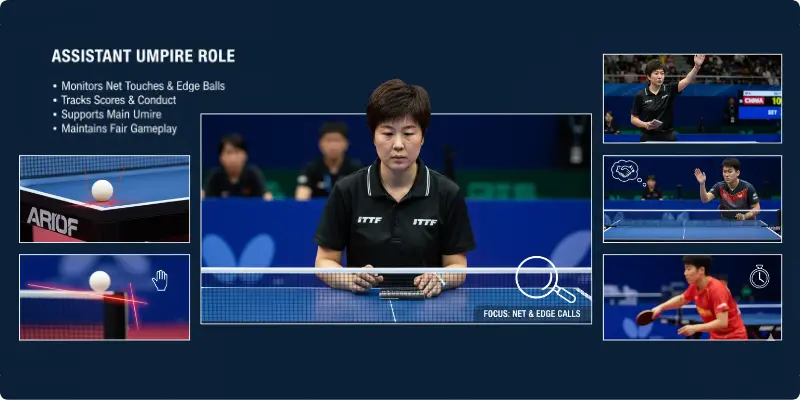
Key Responsibilities of an Assistant Umpire
The assistant umpire’s role centers on three key duties that ensure match accuracy and fairness. Each requires sharp focus and coordination with the main umpire, helping ensure rallies are judged correctly and matches run smoothly. The key responsibilities include:
- Monitor edge balls and net touches: catch fine details the main umpire may miss to ensure correct point calls, and service lets
- Track scores and player conduct: maintain accurate scoring and flag unsportsmanlike behavior
- Communicate on close calls: discreetly signal the main umpire to enable fast, informed decisions
In short, the assistant umpire is essential for supporting the main umpire, ensuring accurate point judgments, smooth gameplay, and fair matches conducted according to ITTF rules, a role critical at every level of play. [Read our full guide: Assistant Umpire in Table Tennis]
Referee in Table Tennis
In table tennis, the referee is the chief official operating above the match level entirely. While the umpire manages what happens at the table, the referee oversees the entire tournament, ensuring every match, official, and procedure complies with ITTF rules from start to finish. When serious disputes arise or umpire decisions are challenged, the referee holds the final authority.
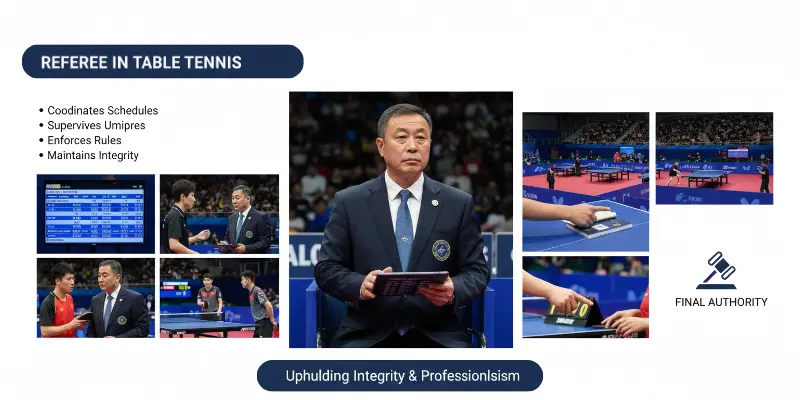
The Role and Responsibilities of a Referee
The referee plays a pivotal role in the overall success of a table tennis tournament, ensuring that all matches are conducted fairly and according to the International Table Tennis Federation ITTF standards. The key duties of a table tennis referee include:
- Coordinate schedules and umpire assignments: Structure the tournament and assign qualified officials to matches.
- Supervise umpires and resolve disputes: Monitor decisions across tables, guide officials, and intervene when conflicts escalate.
- Handle protests and make final decisions: Serve as the ultimate authority on appeals, delivering impartial rulings.
From local opens to world championships, the referee ensures tournaments run fairly, smoothly, and to the highest International Table Tennis Federation ITTF standards, making this role indispensable at every level of the sport.
Read our full guide: Referee in Table Tennis
Umpire vs Referee in Table Tennis: Key Differences
Understanding the distinction between an umpire and a referee is essential for players, coaches, and fans. The umpire manages a single match, making real-time calls on scoring, faults, and player conduct. The referee, by contrast, oversees the entire tournament, handling broader organizational duties and serving as the final authority when serious disputes arise.
While the umpire controls day-to-day match play, the referee ensures consistency and rule compliance across every table. In major disputes, the referee can even overrule an umpire’s decision.
Differences between Umpire and Referee: A Quick Comparison Table
| Feature / Role | Umpire | Referee |
|---|---|---|
| Scope | Manages a single match | Oversees the entire tournament |
| Primary Duties | Enforces match rules and calls scores | Assigns umpires, handles appeals, and ensures rule compliance |
| Decision Authority | Real-time match decisions | Final authority; can overrule umpires |
| Focus | On-table match play | Overall tournament flow and integrity |
[Read our full guide: Umpire vs Referee in Table Tennis]
Levels of Table Tennis Umpires
Table tennis umpires are classified into official levels based on their authority, experience, and certification, a tiered structure defined by the ITTF and implemented globally through national associations. Each level comes with greater responsibility, higher-stakes competitions, and more rigorous certification requirements. The three official umpire levels form a clear progression:
- Local / County Umpire: The entry point into officiating. Covers local leagues, club tournaments, and school events, helping new umpires build rule knowledge and match confidence. Most people who become umpires start here and stay here, and that’s completely fine. Local officiating is where the sport actually runs, and good local umpires are genuinely hard to find.
- National Umpire: Officiates national championships and domestic leagues, handling competitive matches and advanced rule application. Requires proven experience at the local level.
- International Umpire (ITTF Blue Badge): The highest standard in table tennis officiating. Reserved for elite global events, including World Championships and World Cups, awarded after rigorous ITTF training and examination.
Each level of umpires builds greater responsibility and authority, creating a clear pathway from grassroots officiating to the world stage. [Read our full guide: Levels of Table Tennis Umpires]
How Table Tennis Umpires Are Trained & Certified
Becoming a certified table tennis umpire requires more than knowing the rules; it involves structured training, official examination, and recognized certification. The ITTF designs the framework, while national associations deliver and administer it at every level. This ensures that every certified umpire, regardless of where they officiate, meets a consistent and trusted standard of competence.
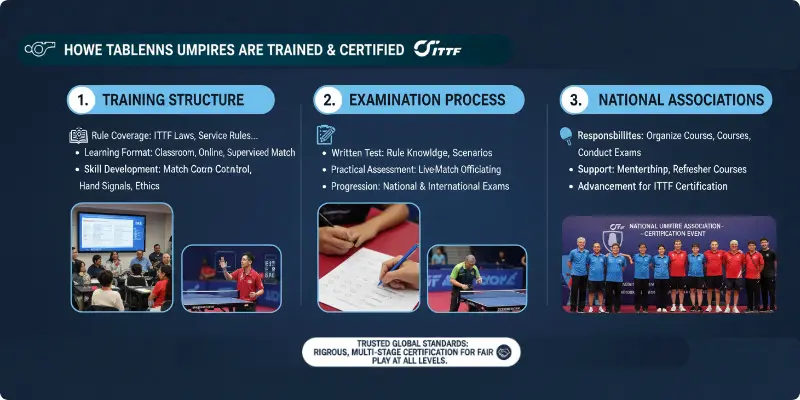
- Training: Combines classroom sessions, online modules, and supervised match observation, covering ITTF Laws, service rules, scoring, hand signals, and officiating ethics.
- Examination: Requires both a written test and a practical match assessment. Exams become progressively more rigorous at national and international levels.
- National Associations: Organize courses, conduct exams, nominate candidates for ITTF international certification, and provide ongoing mentorship and development.
This multi-stage system ensures umpires at every level, from local clubs to World Championships, are held to consistent global standards. [Read our full guide: How Table Tennis Umpires Are Trained & Certified]
How to Become a Table Tennis Umpire
Becoming a table tennis umpire is a gradual process that blends learning, certification, and hands-on experience. Following the official pathway ensures proper recognition and supports long-term career growth. Whether you’re just starting or looking to advance, each stage builds the skills and authority needed to officiate with confidence.
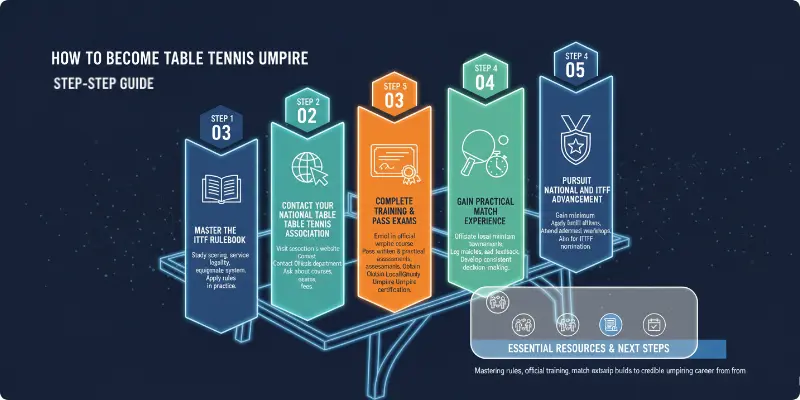
- Master the ITTF Rulebook: Build a strong foundation in scoring systems, service legality, equipment standards, and the expedite system, the rules you’ll apply in every match.
- Contact Your National Association: Reach out to your national table tennis association to find available courses, exams, fees, and timelines for getting started officially.
- Complete Training & Pass Exams: Enroll in the official umpire course and pass both written and practical assessments to earn your first certification and gain tournament access.
- Gain Match Experience: Officiate regularly at local tournaments, log your matches, and seek feedback from senior umpires to sharpen your decision-making under pressure.
- Pursue National & ITTF Advancement: Progress through national certification and aim for an ITTF nomination to officiate at the international level and earn the prestigious Blue Badge.
Every ITTF Blue Badge umpire started at a local club tournament, probably making nervous calls in front of twelve people. That’s still where it begins. While most umpiring roles are voluntary at the local level, national and international umpires may receive match fees, travel, and accommodation coverage.
???? Read our full guide: How to Become a Table Tennis Umpire.
Conclusion
The umpire in table tennis stands at the heart of every fair match, making split-second decisions on edge balls, service faults, and lets while ensuring play proceeds within ITTF Laws. Without a qualified umpire, even the most skilled players cannot compete with true fairness and order. From local leagues to the World Championships, certified umpires follow a structured path through training, examination, and practical experience. Whether you’re a player, coach, fan, or aspiring official, understanding this role reveals how much precision and authority go into every point played.
Most players never think about the umpire until a close call goes against them. Knowing what goes into every decision changes that and makes you a better, more composed competitor for it.
FAQs
Who is an umpire in table tennis?
An umpire in table tennis is the official responsible for controlling the match. They ensure the game is played according to the rules and make final decisions on points, faults, and other situations that occur during the match.
What are the main duties of an umpire in table tennis?
The umpire’s main duties include announcing the score clearly after each point, making decisions on lets and faults, ensuring fair play between players, timing intervals and the overall match duration, and overseeing equipment and player behavior to maintain the integrity of the game.
How to become an umpire in table tennis?
To become an umpire, you typically start by joining your national table tennis federation. You then complete an official umpire training course, pass a written exam, and gain experience officiating at local matches. With additional exams and practical evaluations, you can progress to national and international umpiring levels.
How to umpire a table tennis match?
When umpiring a match, the umpire usually sits at the center of the court to have a clear view of the ball, players, and net. They call out the score clearly after each point, watch carefully for any rule violations such as double bounces or illegal serves, and coordinate with the assistant umpire if one is present. Sounds simple. It’s not.
How many officials are in a table tennis match?
A standard table tennis match typically has at least two officials: one umpire and one assistant umpire. In higher-level competitions, additional officials such as a referee and other support staff may be present to oversee the event.
Who are the officials in table tennis and their duties?
The officials in table tennis include the umpire, assistant umpire, and referee. The umpire manages the match and enforces the rules on the table. The assistant umpire supports the umpire by watching for edge balls, service faults, and helping with scorekeeping. The referee oversees the entire tournament or event, ensures that rules are followed, and handles any disputes or appeals.
What are the duties of an assistant umpire in table tennis?
The assistant umpire is responsible for calling edge balls on their side of the table, assisting with service faults that the main umpire may not see, helping to keep score, and tracking time-outs. They also provide support to the main umpire or step in if the umpire is unavailable.
What’s the difference between a table tennis referee and an umpire?
The umpire is responsible for running the match and making on-table decisions such as scoring and faults. The referee, on the other hand, supervises the entire tournament or event, ensures that rules are followed off the table, and handles appeals or serious disputes.
What is the average salary of an umpire in table tennis?
Most table tennis umpiring is voluntary, especially at local levels. Compensation varies widely; national-level umpires may receive a small daily fee ($20–$75), while international ITTF umpires typically have travel and accommodation covered, sometimes with an additional honorarium. If you’re considering umpiring for the money, don’t. Do it because you love the sport and want to give back to it.
Please Write Your Comments