How to Master the Backhand Smash in Table Tennis: A Step-by-Step Guide
Updated: January 1, 2026
873
Ever watched a table tennis match and thought, “That was an incredible shot, but how did they do that?” Chances are, it was a perfectly executed backhand smash!
The backhand smash in table tennis is one of the rarer shots, but when used effectively, it can leave your opponent scrambling. While most players rely exclusively on their forehand smash for power shots, mastering the backhand smash adds a surprise element to your game that’s tough to defend against.
In this article, we’ll break down everything you need to know about the backhand smash in table tennis, from what it is and why it works to step-by-step techniques, common mistakes, and practice drills. Get ready to transform your backhand from a defensive tool into a powerful offensive weapon.
Let’s get started!
Key Takeaways
- Use the backhand smash in table tennis as a surprise attack when you can’t pivot to your forehand.
- Select the right ball: only smash high, floating returns; avoid low or heavy backspin balls.
- The “pressing down” follow-through helps control power and keeps the ball on the table.
- Timing is critical; strike the ball at its highest point for maximum consistency.
- Footwork and balance generate more power than arm swing alone.
- Pros use it selectively, not as a primary finisher, to disrupt opponents.
- Focused drills like multi-ball and target practice turn technique into match-ready skill.
The forehand smash is the undisputed king of power shots, your default weapon to finish points. This is precisely why developing a powerful backhand smash provides a critical strategic edge: it transforms your backhand from a predictable weakness into a surprise offensive option for when you can’t pivot to your forehand. Mastering this dual threat makes you a complete and unpredictable player. Let’s break down exactly how this shot works and why it’s key to elevating your game.
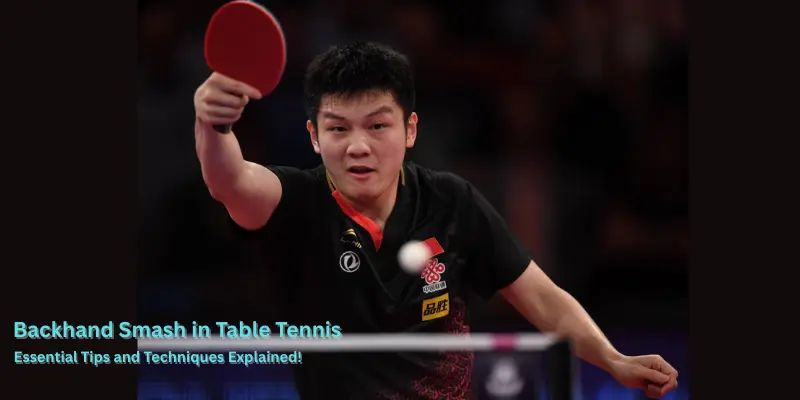
What Is a Backhand Smash?
A backhand smash is an aggressive shot in table tennis used to counter a high ball on the backhand side with speed and force. It’s typically performed when an opponent’s return is high enough to allow for a decisive attack. The key aspects of a backhand smash include:
- Speed and Power: The shot is executed quickly to overpower the opponent.
- Timing: Hitting the ball at the optimal height maximizes effectiveness.
- Precision: Placement matters; corner shots and table edges can force errors.
- Surprise Element: Many players rely on forehand smashes, making a backhand smash unexpected.
- Finesse over Raw Strength: Unlike the forehand smash, it requires control and proper technique rather than sheer power.
Mastering this finesse makes the backhand smash an excellent tool for countering high returns instantly, without having to pivot to your forehand.
The “Pressing Down” Biomechanics: A Pro Secret
Many players struggle to keep powerful backhand smashes on the table. The secret, often discussed by advanced players on forums like TableTennisDaily, lies in a specific follow-through mechanic often called the “pressing down” mechanism.
1. The Key Insight
For a true, full-power smash, your racket shouldn’t just stop after contact. To pull the ball down onto the table with authority, the follow-through should end with your racket head pointing down near your right hip (for a right-handed player). This mirrors the finish of a forehand smash, which ends near the left hip.
2. Watch the Pros
- Fan Zhendong uses this exact technique. Watch slow-motion replays of his backhand winners; you’ll often see his racket finish low by his right side, creating a powerful downward trajectory.
- Wang Hao (the legendary penhold player) also demonstrated this “pressing down” finish, proving its effectiveness across different grips.
3. Why Height Matters
This technique is especially critical for shorter players or when the ball bounces to head height or higher. Taller players like Benedict Olah can sometimes get away with a more arm-oriented stroke on chest-high balls, but the “pressing down” finish is what gives you control over maximum power in the most challenging situations.
For an excellent visual breakdown of this exact principle, search for Coach Meng’s video tutorials, which are highly regarded in the coaching community for explaining these biomechanical details.
Why the Backhand Smash Matters in Modern Table Tennis
The backhand smash in table tennis is a powerful, often overlooked shot that can completely change your game. When used effectively, it becomes a strategic game-changer. Adding this shot to your arsenal makes you a more well-rounded and unpredictable player. Here’s how it gives you an extra advantage:
1. The Surprise Factor
Many players rely heavily on their forehand smash, making the backhand smash an unexpected weapon. A well-timed, powerful backhand can catch your opponent off guard, giving you a crucial edge to win key points.
2. Versatility and Efficiency
The backhand smash allows you to attack high balls on your backhand side without losing time or position. Instead of awkwardly pivoting for a forehand, you can strike decisively and recover faster for the next shot.
3. A Complete Offensive Arsenal
Relying solely on your forehand makes you predictable. Adding a confident backhand smash forces your opponent to defend the entire table, disrupts their rhythm, and makes you a much tougher competitor.
Mastering the backhand smash isn’t just about another shot; it addresses tactical challenges, creates opportunities, and turns your backhand from a defensive weakness into a strong offensive weapon, making you a more complete player.
Backhand Smash vs. Forehand Smash: Knowing Your Offensive Tools
The forehand smash is a primary power weapon, while the backhand smash serves a different, crucial role. A complete offensive game isn’t about choosing one over the other; it’s about knowing precisely when to deploy each for maximum effect. Choosing the wrong smash often leads to weak attacks or errors, so this distinction is key to smarter, more consistent offense.
Forehand Smash vs. Backhand Smash: Key Differences
The table below breaks down their key differences, clarifying when each shot is most potent during a match.
| Aspect | Forehand Smash | Backhand Smash |
|---|---|---|
| Power & Swing | High power from full body rotation and a long, fluid swing. | Moderate power from a compact swing, relying on arm extension and wrist snap. |
| Best Ball Height | Very high balls (head height or above). | Medium-high balls (between net and shoulder height). |
| Recovery & Role | Slower recovery; your main offensive “kill” shot. | Faster recovery; best as a surprise counter-attack when out of position. |
The forehand is your go-to when you have time to set up and finish the point with authority. The backhand shines in quicker exchanges or defensive transitions, where its speed and surprise factor can turn defense into offense. Mastering both transforms them from risky attacks into reliable, situation-specific point-winners.
How to Perform a Powerful Backhand Smash
While less common than the forehand smash, the backhand smash is a potent weapon in table tennis. It’s the optimal shot for turning a high ball on your backhand side into an instant, point-winning attack. Perfect execution relies on a sequence of precise movements. Follow these steps to build a consistent and powerful backhand smash:
1. Get Set: Position and Stance
- Stand slightly to your backhand side of the table in a balanced, ready position.
- Keep your feet shoulder-width apart, knees slightly bent, and weight on the balls of your feet for mobility.
2. Grip and Prep: Racket Readiness
- Use a relaxed grip (shakehand or penhold). Tension slows your swing.
- Raise your racket to chest height, backhand side facing forward, elbow slightly in front of your body.
3. Time the Bounce: Read and Move
- Watch the ball closely, judging height, spin, and trajectory.
- Move quickly into position, aiming to strike at the highest point of the bounce for maximum control and power.
4. Unleash the Shot: Swing and Contact
- Initiate a short, sharp forward swing. Rotate your upper body slightly and snap your wrist at the moment of impact.
- Strike through the ball with the flat part of your racket, keeping a slightly closed racket angle, and think ‘fast and through,’ not ‘hard at it.
5. Finish Strong: Follow-Through and Recovery
- Let your racket follow through naturally in the direction of the shot.
- Immediately recover your balance and return to the ready position, prepared for the next return.
Mastering the backhand smash in table tennis requires patience, practice, and attention to detail. By linking each step into one fluid motion, you can turn this often-overlooked shot into a powerful offensive weapon. To see this fluid motion demonstrated clearly, watch the video breakdown below.
Watch the Backhand Technique in Action
To see these steps demonstrated clearly, we recommend this excellent tutorial from Ping Skills, a trusted coaching resource in table tennis. Watch how the coach integrates stance, timing, and follow-through into one fluid motion.
Pro Tip!
As you watch, pay special attention to the ‘pressing down’ finish near the hip, which we discuss in detail in the next section. This is key to controlling high balls.
Common Mistakes to Avoid and How to Fix Them
Perfecting your backhand smash means knowing what not to do as much as what to do. Even with good technique, these common errors can undermine your power and consistency. Identify and correct them to transform your smash from inconsistent to lethal.
1. Mistiming the Ball
- Hitting too early or too late robs your shot of power and accuracy, often sending the ball into the net or off the table.
- The Fix: Focus on your footwork to get into position early. Aim to make contact at the highest point of the ball’s bounce for optimal control.
2. Using Only Your Arm
- Swinging with just your arm and shoulder results in a weak shot. True power comes from a kinetic chain.
- The Fix: Generate power from the ground up. Initiate rotation from your hips and core, finishing with a sharp wrist snap at the moment of impact.
3. Choosing the Wrong Ball
- Attempting to smash a low, heavy backspin, sidespin, or fast ball is a low-percentage play and often results in errors.
- The Fix: Be patient and selective. Only use the backhand smash against high, attackable balls (typically above net height) with little spin. For other balls, use a loop or drive.
4. Poor Footwork and Balance
- Starting from a static stance or being off-balance forces you to “arm” the ball and compromises recovery.
- The Fix: Stay on the balls of your feet and take quick adjustment steps to get behind the ball. Keep your torso rotated and ready to uncoil into the shot.
5. Obscuring Your Vision
- Raising the racket too high across your body blocks your view of the ball and opponent just before contact. This common error, caused by overreaching, destroys accuracy.
- The Fix: Keep your elbow forward and initiate the swing from your core, not just your shoulder. Ensure your head stays up and your vision remains clear throughout the entire stroke.
Consistently avoiding these mistakes will improve your backhand smash in table tennis more than focusing solely on power. Smart shot selection, precise timing, and full-body mechanics are the true foundations of a point-winning smash. Master these, and your power and consistency will naturally follow.
Drills to Improve Your Backhand Smash
A powerful smash isn’t built in matches; it’s forged in practice. To develop a consistent and lethal backhand smash, you need focused repetition. Integrate these four essential drills into your training to build technique, accuracy, and muscle memory.
1. Multi-Ball Smash Training
- The Goal: Ingrain the correct technique through high-volume repetition and build stamina.
- How to Do It: Have a partner or coach feed a bucket of balls to your backhand side, providing a consistent stream of high, attackable balls.
- Focus Point: Concentrate on perfect form for every single shot: stance, wrist snap, and full follow-through, without the pressure of a rally.
2. Targeted Backhand-to-Backhand Rallies
- The Goal: Practice the smash in a semi-live, rhythmic context and work on recovery.
- How to Do It: Rally with a partner where they agree to lift high balls exclusively to your backhand side. Your only response should be a controlled smash back to their backhand.
- Progression: Start slowly to master timing. Then, gradually increase the pace of the feeds to simulate game pressure.
3. Accuracy Target Practice
- The Goal: Transform power into precision by learning to place the smash exactly where you want it.
- How to Do It: Place physical targets (like cups or coasters) in the corners or on the edges of the table. Aim to hit them with your smash.
- Focus Point: Don’t just hit hard. Aim small, miss small. Start with larger target areas and shrink them as your control improves.
4. Technique Shadow Practice
- The Goal: Isolate and perfect your body mechanics without worrying about the ball.
- How to Do It: Stand in front of a mirror and perform the full backhand smash motion slowly and deliberately, without a ball or table.
- Focus Point: Pay close attention to your weight transfer, hip rotation, and the crisp, finishing snap of your wrist. This builds pure muscle memory.
Commit to just 10 minutes of these drills per training session. Consistent, focused practice is far more effective than occasional, lengthy workouts. The goal is to make the correct motion so familiar that it happens instinctively during a match.
Strategic Tips for Using the Backhand Smash
A backhand smash is more than just a stroke; it’s a tactical tool. To wield it effectively, you must use it at the right time, in the right place, and for the right reason. Apply these four strategic rules to maximize its impact.
1. Be Selective: Only Smash High Balls
The smash is a high-reward, high-risk shot. Forcing it on a low, heavy-spin, or fast ball drastically increases your chance of an error and gives your opponent an easy counter.
- The Rule: Only use the smash against high, floating balls above net height.
2. Be Unpredictable: Vary Your Placement
A predictable pattern makes you easy to play against. If you always smash to the same spot, a prepared opponent will already be moving to counter it.
- The Rule: Alternate your targets: aim for wide corners and fast shots down the line.
3. Be Prepared: Prioritize Footwork
True power is generated from the ground up. A weak stance or poor positioning forces you to rely only on your arm, resulting in a less powerful and less accurate shot.
- The Rule: Use quick steps to get your whole body behind the ball before you swing.
4. Be Surprising: Counterattack Aggressively
The greatest strength of this shot is the element of surprise. Most opponents expect a standard push or loop from a backhand position, not an offensive shot.
- The Rule: Turn defense into offense by aggressively smashing high balls when your opponent expects a passive return.
5. Know Your Alternatives: Smash vs. Topspin Kill
As noted in player discussions, a hard topspin attack (loop kill) is often a safer and higher-percentage alternative to a flat smash, especially against high-bouncing balls with heavy backspin. The topspin helps bring the ball down onto the table. Reserve the pure smash for the highest, most floating balls.
- The Rule: Choose spin over pure speed when the ball has heavy backspin or isn’t floating perfectly.
Advanced Note: If you play with long pips on your backhand side, remember that smashing with them is nearly impossible. Your best option against a high ball is to twiddle (rotate your racket) to use your inverted rubber side for the attack.
Use the backhand smash selectively and unpredictably. Its true power isn’t in brute force, but in strategic timing and surprise, making it a decisive tool to break your opponent’s rhythm and win crucial points.
Conclusion
The backhand smash in table tennis is a decisive tactical weapon that elevates your offensive game when mastered. By applying the precise technique, focused drills, and smart strategy from this guide, you transform it from a rare shot into a reliable point-winner that surprises opponents and controls rallies. This addition forces your opponent to defend the entire table, breaking their rhythm and creating more opportunities for you to attack. The key now is consistent practice. To build this skill, start by dedicating 15 minutes of your next practice to one key drill, like Target Practice.
With the backhand smash mastered, the logical next step is to ensure your primary weapon is equally sharp. Dive into our complete guide on the Forehand Smash in Table Tennis. A complete guide!
FAQS
What is the key difference between a backhand smash and a forehand smash?
The forehand smash uses full-body rotation for maximum power. The backhand smash is a compact, wrist-driven shot best used as a surprise counter-attack when you can’t pivot to your forehand.
How can I generate more power in my backhand smash like Fan Zhendong?
Copy the ‘pressing down’ finish. Pros like Fan Zhendong and Wang Hao end the stroke with the racket pointing down near the right hip to pull the ball onto the table. Coach Meng’s tutorials explain this well.
Is a backhand smash or a backhand loop kill better?
For high balls with heavy backspin, a topspin loop kill is safer. Use the flat smash only for the highest, floating balls with little spin. This is a key strategic choice discussed on forums like TableTennisDaily.
Do pros like Ma Long use the backhand smash?
Yes, strategically. Players like Ma Long and Koki Niwa use it as a surprise weapon when out of position, proving its value at the highest level.
Is the backhand smash suitable for beginners?
The backhand smash is best learned after mastering basic backhand drives and blocks. Because timing and ball selection are critical, beginners should focus on control first before attempting flat smash shots.
Please Write Your Comments